


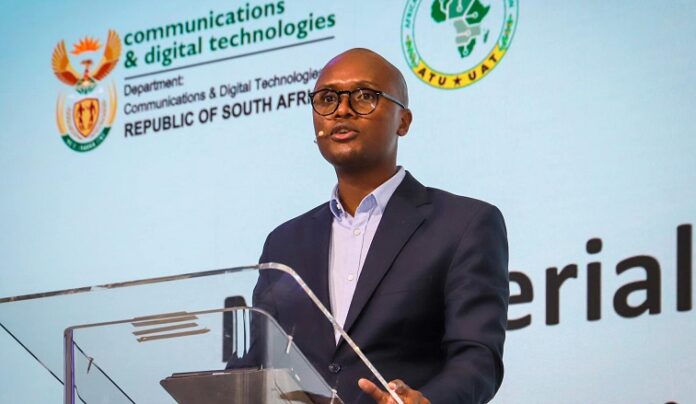
World Telecommunication and Information Society Day, annually observed on May 17, is a reminder that in today’s world, access to technology increasingly determines access to opportunity.
This year’s global theme, “Digital Lifelines: Strengthening Resilience in a Connected World”, speaks directly to the realities facing countries across the globe. It recognises that in today’s world, digital infrastructure is no longer secondary infrastructure. It has become essential infrastructure.
From undersea cables and satellites to broadband networks and data systems, digital technologies now support economies, healthcare systems, education, communication, emergency response, and public services worldwide.
Weak, unreliable, or unaffordable networks actively lock entire communities out of the digital economy.
Meaningful connectivity is an enabler of access to economic opportunity.
Overcoming Digital Exclusion in South Africa
Not everyone in South Africa has the same level of access, which means that they do not have the same level of access to economic opportunity. A major recent study by the Development Bank of Southern Africa confirmed that only 2.2% of South African households do not have access to connectivity, which means we have made great progress in South Africa to improve access.
And this makes sense: digital infrastructure is now part of our daily lives and the foundation for economic activity. The business case for investing in digital infrastructure is strong, and that is why it is one of South Africa’s fastest growing industries.
This growth is a signal that connectivity is not just a technology sector issue. It is an issue of productivity, competitiveness, and inclusion for every sector of the economy.
But, access is not the same as meaningful access, because coverage is not the same as inclusion. Meaningful access requires more than just a connection: it requires affordability, devices, skills, reliability and productive use.
Access only means something when people can use it, afford it, and understand it.
The real test is not whether a network exists near a community. The real test is whether a learner can learn, a jobseeker can apply, a patient can access services, and a small business can reach customers.
It is, therefore, imperative that our conversation and focus shift from coverage to participation. That means reducing the cost of data, increasing access to devices, ensuring reliable connections where people live, and developing the skills necessary to leverage connectivity to pursue economic opportunities.
When more South Africans are meaningfully connected, the economy does not simply become more digital; it becomes more productive, more competitive and more inclusive.
Growing participation in our economy is the surest way to improve the business environment.
If more people are economically active, and active in a meaningful way, we create more economic opportunities and set off a virtuous cycle of growth.
For businesses, this means larger markets, more avenues to reach potential customers, more SMMEs transacting in the markets, and more workers able to participate in modern value chains.
The Role of Government in the South African ICT Sector
And this is where I believe that government must be honest about our role.
The role of the Department of Communications and Digital Technologies is not to build every tower, lay every fibre line, regulate every transaction, or deliver every digital service itself.
Our role is to create the enabling environment for the digital economy to grow.
That means clear policy, predictable regulation, better coordination across government, more effective oversight of state-owned entities and a willingness to remove unnecessary obstacles that prevent investment, innovation and delivery.
As I must often remind my colleagues in government, we cannot approach this role from a perspective of control. We must approach it from a perspective of unlocking potential, while still protecting the public interest.
This balance is critical.
When government does its work well, it creates the conditions for others to do what they do best: invest, innovate, build and deliver.
Government must focus on setting the rules of the game clearly and fairly, in collaboration with all stakeholders. The private sector must then bring capital, innovation, technical capability and implementation capacity to the table.
Fostering Sustainable Public-Private Partnerships
This is particularly important in a constrained fiscal environment.
Public resources are limited. We cannot keep doing things the same way and expect different results. We cannot hide behind fiscal constraints as an explanation for why progress is too slow.
Instead, we need to think differently about how we use what we do have.
We need to ask where public resources can have the greatest catalytic effect.
We need to ask how government can mitigate risk in areas where the commercial case is difficult, but the social return is high.
We also need to ask how private sector capability can be aligned with public development goals.
This is what partnership must mean.
Partnership is not only about privatisation. It is not only about ownership. It is not only about once-off sponsorships or corporate social investment projects that look good in an annual report.
Partnership means working together to solve practical problems. It can mean using state assets more intelligently so that private sector players can deliver services at more affordable prices. It can mean designing blended financing models that make it commercially viable to connect underserved communities.
It can mean working together on device affordability, digital skills, cyber safety, e-commerce participation, digital payments, and the productive use of technology by small businesses.
Overcoming Policy Friction and Stabilizing the Fundamentals
It can also mean government listening more carefully when business tells us where our own systems are creating friction.
We know that investors and operators often face delays, uncertainty and inconsistent implementation across different parts of government. We know that policy fragmentation creates opacity. We know that unclear rules raise the cost of investment. We know that when government is slow, the economy pays the price.
So, part of our reform agenda is to stabilise the fundamentals. This work is not glamorous and does not make for good headlines, but it is critical.
It includes modernising our policy and legislative environment, improving regulatory certainty and accelerating rapid deployment of communications infrastructure.
It means reviewing how we measure connectivity so that we focus not only on coverage, but on affordability, device access, active usage, skills and economic participation.
It also includes looking at practical investment reforms.
For example, we support the extension of the Real Estate Investment Trust regime to digital infrastructure such as fibre networks, towers and data centres. These assets are no longer peripheral. They are core infrastructure for a modern economy.
If we can unlock long-term capital for digital infrastructure, we can expand connectivity, attract investment and move closer to universal meaningful access.
But policy reform is only one side of the equation.
The other side is trust.
Ethical Leadership and Shared Corporate Responsibility
No meaningful partnership can exist without trust. Trust between government and business. Trust between citizens and institutions. Trust between investors and regulators.
Trust between consumers and the digital systems they are increasingly expected to use.
That is why ethical leadership matters.
Ethical leadership is not a soft issue. It is not separate from economic growth. It is a condition for growth.
Where governance fails, investment becomes more expensive. Where rules are applied inconsistently, confidence weakens. Where public institutions are captured by vested interests, public value is destroyed. Where corruption is tolerated, honest businesses and honest citizens pay the price.
In our portfolio, we are asking hard questions about financial sustainability. I believe it is high time that we admit that sole ownership by the state in all the entities in our portfolio no longer makes sense. Partial privatisation must become part of the conversation.
We have also been very clear that governance failures cannot be tolerated. We are strengthening oversight of our entities. We are taking action where wrongdoing occurs.
This is not about creating fear, but about setting a standard.
If we want to build a capable state, we must also build an ethical state. And if we want business to partner with government, then government must be worthy of that partnership.
But ethical leadership is not only required from the public sector.
The private sector also has responsibilities.
Business cannot only point out the problems. It must also help build the solutions.
Many businesses in South Africa already do extraordinary work under very difficult conditions. Many of creates jobs, invest in communities, train young people, support entrepreneurs, and keep parts of our economy moving despite challenges that are not of your making.
But if we are serious about inclusive growth, then we need to move beyond critique and into co-creation.
Do not build around government only because government is difficult to work with. Help to fix what makes government difficult to work with.
Do not only tell us that our systems are broken. Work with us to design systems that function better.
Do not only ask what government will do for business. Ask what business can do with government, in the public interest, in a way that is commercially sustainable and developmentally meaningful.
This does not mean that business must become charity. It does not mean that profit is a dirty word. Profitable businesses create jobs, pay taxes, build capability and sustain investment.
But it does mean that we should be more deliberate about finding the overlap between commercial opportunity and public value.
Meaningful connectivity is exactly such an opportunity.
When a rural community becomes meaningfully connected, that is not only a social intervention. It is a future market. It is a future talent pool. It is a future site of enterprise. It is a future source of customers, suppliers, creators and workers.
When a young person gets access to an affordable smart device and the skills to use it, that is not only a personal opportunity. It is an addition to the productive capacity of our economy.
When a small business can transact online, advertise digitally, receive payments securely and reach customers beyond its immediate area, that is not only digital inclusion. It is economic expansion.
This is why I believe the next phase of South Africa’s digital development must be built around a simple idea: moving from access to opportunity.
Access is the foundation. But opportunity is the goal.
The work before us is to make connectivity affordable enough to use, device-enabled enough to matter, reliable enough to trust, and skill-enabled enough to change lives.
Government must lead where only government can lead. We must create the policy environment. We must protect the public interest and coordinate across institutions.
We must regulate fairly and use public resources more intelligently. And we must hold our own institutions to higher standards.
But business must also lead where business is best placed to lead. It brings investment, innovation, speed and operational experience. Business understands customers, markets, logistics, technology and delivery in ways that government often does not.
The question is whether we can bring these strengths together.
I believe we can but it will require a different kind of relationship between the state and the private sector.
A relationship that is honest about constraints but not paralysed by them. A relationship that welcomes investment but insists on public value. And a relationship that allows business to make a fair return, while ensuring that ordinary South Africans are not left behind.
In other words, a relationship built on shared responsibility.
That is the spirit in which I want us to approach the digital economy.
South Africa has real advantages. We have strong operators, a sophisticated financial sector and a growing data centre market. We have significant digital infrastructure investment.
We have entrepreneurs who understand the realities of our market and young people with talent, ambition and creativity.
But we also have deep inequality, weak trust, uneven skills, affordability challenges and institutions that must perform better.
Our task is to close that gap between potential and reality.
To do that, we must build a South Africa where connectivity is not just something people have, but something people can use to improve their lives. That is the work before government and the opportunity before business.
And that is the partnership we must now build.
- World Telecommunication and Information Society Day emphasizes that digital infrastructure is now essential for economic, health, education, and public services, making meaningful connectivity crucial for access to opportunity.
- South Africa has improved connectivity with only 2.2% of households lacking access, but meaningful access requires affordability, skills, devices, and reliable connections—not just network coverage.
- The government’s role is to create an enabling environment with clear policies, better coordination, and regulatory certainty, fostering investment and innovation without directly delivering all digital services.
- Sustainable public-private partnerships are vital, focusing on risk mitigation, blended financing, digital skills, device affordability, and removing policy and operational friction to expand inclusive digital access.
- Ethical leadership and trust between government, business, and citizens are critical; partial privatization, stronger oversight, and shared responsibility can close inequalities and transform connectivity from mere access into real economic opportunities.


