


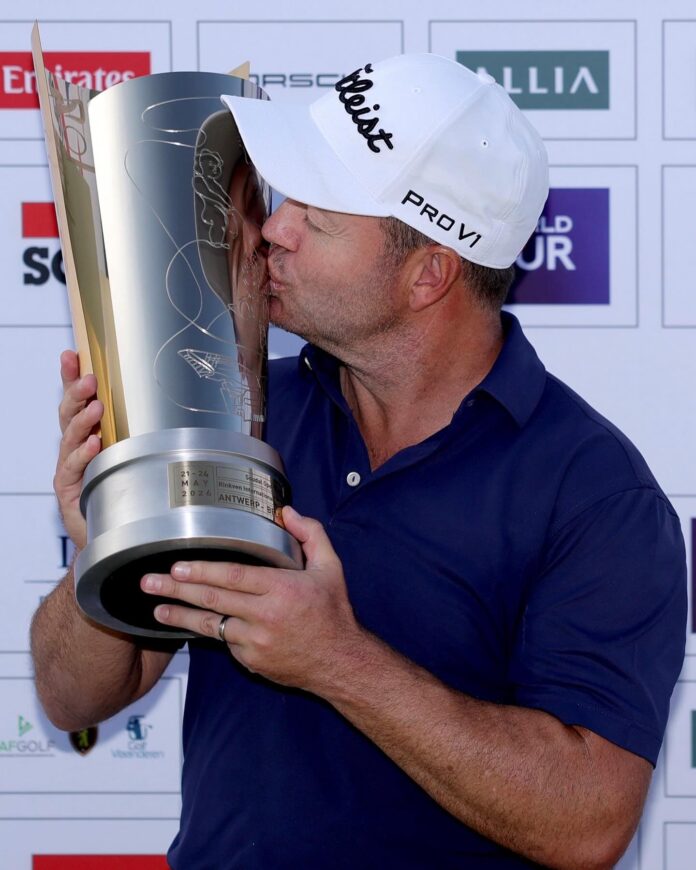
Richard Sterne has finally won his first DP World Tour event in 13 years at the Soudal Open in Belgium. His last win was in 2013 at the Joburg Open.
After fellow South African Zander Lombard had led comfortably for most of the tournament, Sterne timed his move to perfection with a stunning eagle – and almost an albatross – at the 17th.
The 44-year-old has a titanium disc in his back, among a host of other surgeries that have wiped out several years of his career, and he said: “Three wrist ops, a disc replacement, hip surgery; I’ve been through it all, so I’m pretty happy. It’s been very tough, the last couple of years, but there’s been some signs of good things.”
Sterne’s win was the sixth for a South African player on this season’s DP World Tour, following two each for Jayden Schaper and Casey Jarvis and Yurav Premlall’s stunning win at the Estrella Damm Catalunya Championship.
In South Africa, Justin Walters waited 15 years for his third victory on the Sunshine Tour, winning at Humewood last week. Just goes to show, never give up.
Show up, keep up, shut up
Garrick Higgo fired his caddy after missing the cut at the US PGA Championship. When things go badly at a tournament, it is often the caddy who takes the blame.
Jack Nicklaus famously stated he wanted his caddy to do three things: “Show up, keep up, and shut up”. While he said it in jest, it reflected his philosophy that the player should take full responsibility for decisions and avoid relying on caddies for club selection, green reading, or lining up shots. Of course, Jack would blame his caddy if he hit a bad shot, even though the caddy wasn’t allowed to give any input. So, another role for the caddy is as stress relief.
Tiger Woods’ long-time caddy, Steve Williams, who helped Tiger win 13 of his 15 majors, was so well reimbursed that at one point he was considered the richest sportsman from New Zealand.
Caddies
At your local club you are unlikely to get a caddy of Steve’s ability, but if you play regularly, finding a caddy who is compatible with you and your game, can be beneficial. In South Africa the average income for a club caddy is only R140 000 per year. So maybe be a bit more generous with your tipping when you find the right one.
Professional golf can be a lonely life, so having the right caddy can make a huge difference. Many players on the Sunshine Tour use their wives/girlfriends, or close friends, as their caddy. This probably helps more off the course than on it, but every little bit helps.
Professional caddies are very expensive, in salaries and travel costs, so the player needs to ensure they are worth it. On the PGA a top caddy will earn US$2 000 per week, plus expenses. They also receive a percentage of their player’s tournament winnings (typically 10% for a win, 7% for a top 10 finish, and 5% for any other result).
On the Sunshine Tour caddies earn about R3000 per week, plus a percentage of winnings. There is fierce competition to carry the bag of the in-form player, as the real money comes from the winning percentage. An average win on the Sunshine Tour pays R400 000, so the caddy would receive R40 000, not too bad for a week’s work. Win the SA Open and the caddy receives R400 000!
Professional golf has been compared to gambling on yourself. For the caddy, it is gambling, but on somebody else.
- Richard Sterne won his first DP World Tour event in 13 years at the Soudal Open, overcoming numerous surgeries including a titanium disc implant in his back.
- Fellow South African golfers have been successful this season, with six DP World Tour wins among players like Jayden Schaper, Casey Jarvis, and Yurav Premlall.
- Garrick Higgo fired his caddy after poor performance at the US PGA Championship, while Jack Nicklaus emphasized that players should rely on themselves rather than their caddies.
- Professional caddies play a crucial role and can earn significant wages and percentages of winnings, but on local tours like the Sunshine Tour, incomes are much lower (around R140,000 to R300,000 per year).
- Many Sunshine Tour players use wives, girlfriends, or friends as caddies for emotional support, highlighting the mix of personal and professional roles in golf.


