


If the World Cup is supposed to promote harmony in football, the latest controversy around FIFA is certainly provoking a loud and unified vocal chorus from around the world.
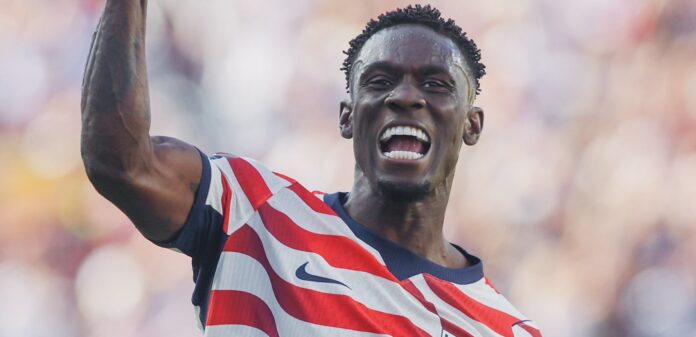
In an extraordinary turn of events, world football’s governing body overturned a suspension for the US star striker Folarin Balogun – after President Donald Trump personally urged FIFA President Gianni Infantino to review the case.
The highly unusual move – the first time since 1962 that FIFA has nullified a suspension for a red card received during the World Cup – thrust the governing body’s disciplinary process into the global spotlight and prompted an angry response from Belgium, who play the US on Monday for a place in the quarter-finals.
It also ensured that one of the tournament’s biggest talking points would centre not on tactics or team selection, but on the relationship between football’s governing body and political power.
Balogun’s suspended suspension
Balogun scored his third goal of the World Cup in Thursday’s 2-0 win over Bosnia and Herzegovina but was sent off for planting his boot into the ankle of defender Tarik Muharemovic.
Although the Brazilian referee Raphael Claus did not initially indicate a foul by Balogun, he changed his mind after being advised by the Video Assistant Referee (VAR) to review the footage.
Under FIFA rules, a straight red card automatically triggers a one-game ban, ruling the 25-year-old striker out of the clash with Belgium for a place in the quarter-finals.
However, on Sunday FIFA announced it would allow Balogun to face Belgium – without rescinding the red card.
“In line with article 27 of the FIFA Disciplinary Code, the implementation of the match suspension is suspended for a probationary period of one year,” FIFA said in a statement.
“If Folarin Balogun commits another infringement of a similar nature and gravity during the probationary period, the suspension shall be revoked and the sanction enforced without prejudice to any additional sanction imposed for the new infringement.”
Trump and Infantino
Within hours, Trump, who has not attended any of the games in the World Cup his country has co-hosted, and who has barely mentioned it on social media, took to Truth Social to post “Thank you to FIFA for doing what was right, and reversing a great injustice.”
On X, the White House reacted to Balogun’s reinstatement with a post saying: “USA-USA-USA.”
The footballing furore quickly snowballed into a political storm as various news agencies reported that the Trump administration had applied pressure on FIFA. The New York Times said appeal lawyers had been engaged by commerce secretary Howard Lutnick and Andrew Giuliani, the executive director of the White House task force on the World Cup.
Reuters and AFP, among other news agencies, cited sources saying Trump had personally called Infantino, the FIFA President who has frequently praised the US leader, to intervene.
Last December, as Trump lobbied to win the Nobel Peace Prize, FIFA created and gave him the FIFA Peace Prize during the World Cup draw in Washington DC, with Infantino saying it was “in recognition of his exceptional and extraordinary actions to promote peace and unity around the world.”
“This is your prize, this is your peace prize,” Infantino said on stage to Trump. “There is also a beautiful medal for you that you can wear everywhere you want to go.”
In February Infantino attended the inaugural meeting of Trump’s so-called Board of Peace, wearing a red hat with ‘USA’ on the front and the numbers 45-47, for the two non-consecutive presidencies of Trump.
At the ceremony, Infantino signed an agreement on FIFA’s behalf to spend up to $75 million of its funds in Gaza.
‘If Gianni said it, I’m ok’
For his part, Trump has spoken warmly of Infantino. In spring, asked whether his immigration forces would allow Iranian players to enter the country, Trump replied “If Gianni said it, I’m OK.”
Last month, the Norwegian Football Federation formally backed an official complaint against Infantino over a breach of political neutrality rules, and the Balogun decision has added fuel to the fire.
“It’s not that things like that didn’t happen in the past, but it didn’t happen so obviously and so emphatically as they do now,” Miguel Maduro – former chairman of FIFA’s governance and review committee – told Politico. “But it didn’t happen so obviously and so emphatically as they do now.”
On Monday, the discontent spread to Brussels when Glen Micallef – the EU Commissioner whose portfolio includes sport – joined the row in a post on X.
“Many football fans, including former players, have already spoken out about the suspension of Balogun. As a fan, I too believe it was the wrong decision,” wrote Micallef.
“I have always been clear. Decisions on sporting rules and sporting matters belong to sporting bodies, not politicians. Influencing sporting decisions would undermine the autonomy of sport,” he added.
Football’s reaction: ‘Astonished’, ‘disbelief’, ‘big mistake’
Within football, the reaction was scathing. The Belgian federation said it was “astonished by FIFA’s decision” and citing Article 66.4 of the FIFA Disciplinary Code, which “clearly provides that a red card automatically results in a suspension for the team’s next match, as has been the case for all previous red cards issued during this FIFA World Cup.”
Belgian coach Rudi Garcia wondered sarcastically if the whole thing was an April Fool’s joke.
“I didn’t know that at the FIFA World Cup 5 July is now 1 April,” he told reporters, adding about his federation’s complaint: “We’re not defending the national team or the federation, we’re defending football.”
German Football Association President Bernd Neuendorf said FIFA should clarify reports about contact between Trump and Infantino.
“The impression that there has been active political interference in sport must be dispelled swiftly and conclusively,” said Neuendorf. “The integrity of the competition and the credibility of FIFA are at stake.”
UEFA weighs in
On Monday morning, European football’s governing body UEFA weighed in, saying “We express our disbelief at such an unprecedented, incomprehensible and unjustifiable decision” that “crossed a red line.”
“When the certainty of rules is no longer guaranteed by its guardians, the integrity of the game is at stake and the credibility of a competition is undermined. Equally, such decision creates a precedent in the ongoing tournament, where similar situations will now require an equal treatment, to the detriment of the competition.”
As an illustration of the uncertainty the decision has caused, England coach Thomas Tuchel referenced it after his side’s 3-2 win over Mexico, in which his side’s Jarell Quansah was sent off.
“Who overturns this decision then and when? And on what grounds? How far does this go now? This is strange for me,” Tuchel told reporters. “Where does this start and where does this end?”
Tuchel’s compatriot Jurgen Klopp, the voluble former Liverpool FC manager who is in line to become the next coach of Germany, did not mince his words.
‘This is our game, not theirs’
“This is our game, not theirs… If Trump and Infantino really worked this all out between themselves, that’s crazy. It calls everything into question,” Klopp said.
“These two individuals, neither of whom has a clue about football, shouldn’t have anything to do with it,” the 59-year-old added.
Sepp Blatter, Infantino’s predecessor as FIFA President, also waded in with a strongly-worded rebuke, saying “Red cards are not overturned by political phone calls. They are overturned by rules, evidence and independent bodies.
“If a US President intervenes with the FIFA President – and a player is suddenly cleared before a World Cup knockout match – the question is unavoidable: Quo vadis [Where are you going], FIFA? Football must never become a playground for political power.”
Asked about the Balogun decision after his Norway side beat Brazil, coach Stale Solbakken said “That’s a big mistake by FIFA… It’s a bad decision that will hurt the World Cup. And I feel also sorry for the United States… because if they beat Belgium, they will always have that extra thing about it.”
Indeed, Mauricio Pochettino, the US coach, backed the decision and told reporters that his team were “not the bad guys.”
- FIFA overturned the suspension of US striker Folarin Balogun after a red card during the World Cup, following personal intervention by former President Donald Trump urging FIFA President Gianni Infantino to review the case.
- This unprecedented decision, the first since 1962 to rescind a World Cup red card suspension, sparked global outrage, especially from Belgium, who face the US next, and raised concerns about political interference in football.
- Trump and Infantino share a close relationship, with FIFA previously awarding Trump a Peace Prize and Infantino attending events organized by Trump, fueling suspicions of undue influence in the Balogun ruling.
- Football authorities and officials, including UEFA, the Belgian federation, and prominent coaches like Jurgen Klopp, condemned the decision, warning it undermines the sport's integrity and sets a dangerous precedent.
- The controversy has drawn sharp criticism from sports governance experts and politicians, emphasizing that sports decisions should remain autonomous and free from political pressure to protect the credibility of competitions.


