


Before South Africa plays Mexico tonight in the opening game of the 2026 FIFA World Cup, it is worth going back to a winter night in Ramatlabama, near Mafikeng, where the World Cup first arrived not as a tournament but as a rumour from another planet.
There was no satellite package, no touch-screen schedule, no instant team news, no clever phone lighting up with formations. There was a black-and-white television, a cold evening, and a 10-year-old village boy who had switched it on because winter reduced the recreational options outside.
Yet somehow, through that black-and-white box, the boy could see colour.
He could see the yellow of Brazil, the sky-blue of Argentina, and the green, red and yellow of Cameroon. He could see Italy even before he understood Italy, because the television graphics made the map of the country turn into a football boot. That small animation did something big. It took a child sitting in a village under the Bophuthatswana government, in a place the world did not recognise as a country, and gave him a peek into a world that recognised almost everyone else.
Until then, football had a local rhythm. It was Kaizer Chiefs, Orlando Pirates and Mamelodi Sundowns. It was “one-paal” and “two-paal” on dusty streets. It was bare feet, no boots, and games that could start from nothing but a ball and an argument. Sometimes the balls were plastic grocery bags rolled into something kickable. Some days, it was 10c a goal. Some days, your opponents carried pieces of broken glass in the captain’s pocket and pretended it was coins, and because everyone was young and the stakes were small, even that became part of the joke.
Football was a daily diet, but the World Cup was different. It was a global roll call. It was an atlas with a ball at its feet. It was a passport for those who had never left the village, and for a Black child in apartheid South Africa, it felt like looking through a window that had been shut for too long.
Arrival of Italia 90
Italia 90 arrived in the same year South Africa began to change shape. The ANC and other liberation movements had just been unbanned. Nelson Mandela had walked out of prison. The country was not yet free, and the old order still had weapons, police, flags, borders and files, but something had shifted. South Africa was still outside the official football world, but the feeling was no longer permanent exile.
That is why Italia 90 carried meaning beyond the pitch. It was not simply a tournament playing in the background while South Africa moved towards democracy. It was the foreground.
Then Cameroon beat Argentina.
For a 10-year-old watching from Ramatlabama, it was impossible to understand all the layers, but the shock was easy to feel. Argentina were the defending champions, and Diego Maradona was the game’s legendary magician. Cameroon were supposed to be part of the opening act, not the team that rewrote the opening line. Yet they won 1-0, and the tournament announced itself with a lesson that still travels well: history does not always wait for permission from favourites.
Roger Milla then became a village hero without ever knowing the village existed. He was old by football standards, but his corner-flag dance after his goals against Colombia became one of the lasting pictures of the tournament, and Cameroon’s run to the quarter-finals gave African football a confidence that travelled far beyond Italy. There was soon a local village team called Cameroon, featuring the likes of Mpho Shole and DeSeun “Mshini” Ngcapayi.
Schillaci wave
In Italy there was Salvatore Schillaci. Schillaci finished Italia 90 as both the Golden Boot and Golden Ball winner, but for the children on dusty village streets, his meaning was simpler. He became a name you could borrow.
After that World Cup, you would find a lot of Schillacis in the village matches. Every sharp striker, every boy who chased loose balls like they were private property, every player who celebrated as if the whole world had just discovered him, could become Schillaci for an afternoon.
One of them stayed in a nearby village called Six Hundred. He remained Schilacci even after we grew up, which is how football sometimes works in places where nicknames outlive form, age and even the memory of the original match.
That was the power of Italia 90. It did not only give children teams to support. It gave them new names for old streets.
Maradona kept fans spellbound
Maradona, however, was no mistake. He was not the Golden Ball winner in 1990, and Argentina were not the best team at the tournament, but he understood drama like a man born inside a spotlight.
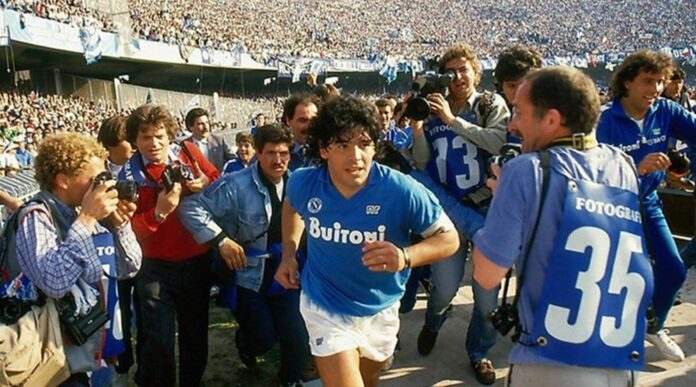
Then came Naples.
Argentina met Italy in the semi-final in the city where Maradona was already more than a footballer because of what he had done for Napoli. Argentina drew with Italy and won on penalties, and the host nation’s party ended in the city that had loved Argentina’s captain as one of its own.
In the final, West Germany brought order, power and punishment. Jürgen Klinsmann and the rest gave the tournament its champion. A late penalty made it 1-0, and Maradona cried. It was not a beautiful final, but it was unforgettable.
Significance of SA-Mexico tie
That is why tonight matters.
Mexico against South Africa is not just a fixture. It is a loop. In 2010, South Africa opened its own World Cup against Mexico at Soccer City, and Siphiwe Tshabalala’s goal became one of those rare national moments that needs no explanation. Now, 16 years later, South Africa opens another World Cup, this time in Mexico City.
For the village boy from Ramatlabama, this match completes a long journey that began with a black-and-white television and a map of Italy turning into a soccer boot.
Tonight, South Africa is not watching from outside.
It is on the pitch.
- Before South Africa plays Mexico tonight in the opening game of the 2026 FIFA World Cup, it is worth going back to a winter night in Ramatlabama, near Mafikeng, where the World Cup first arrived not as a tournament but as a rumour from another planet.
- There was no satellite package, no touch-screen schedule, no instant team news, no clever phone lighting up with formations.
- There was a black-and-white television, a cold evening, and a 10-year-old village boy who had switched it on because winter reduced the recreational options outside.
- Yet somehow, through that black-and-white box, the boy could see colour.
- He could see the yellow of Brazil, the sky-blue of Argentina, and the green, red and yellow of Cameroon.


