


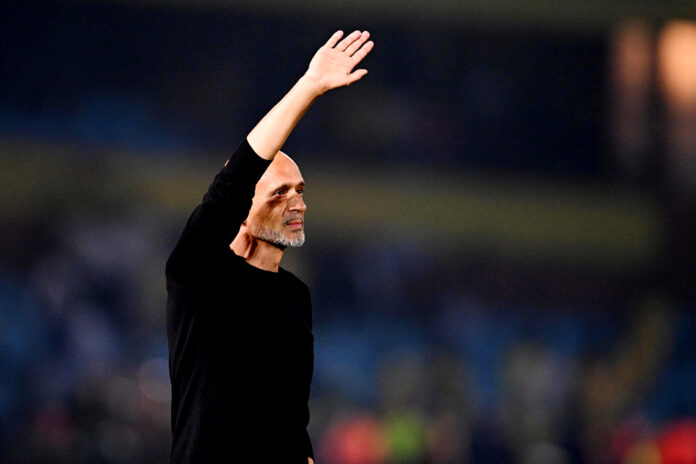
Miguel Cardoso won the Champions League, and that gives him a place in Mamelodi Sundowns history. That fact is safe.
Cardoso delivered the trophy Sundowns wanted most. He ended the long wait after Pitso Mosimane’s 2016 triumph, and he gave the club the continental authority it had chased for years.
But football is not judged only by the medal table. It is also judged by method, identity, development and what a team becomes while it is winning.
That is where Cardoso’s Sundowns still has questions to answer. He won Africa, but he also got a lot wrong.
In his recent Sundowns podcast interview Cardoso speaks like a coach of structure. He talks about possession, playing from the back and the football of passing the ball. He speaks about detail, preparation, control, pressure and the special demands of Champions League football.
He says the Champions League is a particular competition and that there is a way to play it.
That is true.
Africa is not won by soft football. It is won by teams that can travel, suffer, absorb pressure, survive hostile stadiums and still find the decisive moment. Cardoso understood that part. Sundowns did not win the Champions League because they were always beautiful. They won it because they became hard to kill.
But that does not settle the argument.
Downs built to dominate
Sundowns are not an ordinary club. They are not built merely to survive. They are built to dominate. Their standard is not only victory. Their standard is victory with a recognisable football identity.
Under Cardoso, that identity has not always been clear.
His Sundowns have looked detailed but not always connected. They have looked organised, but not always fluid. They have looked capable of finding moments but not always capable of producing the old feeling that the goal was coming because the machine had started moving.
The Sundowns style is built on short passes and combinations. Alex “Barnes” Bapela and Charles Motlohi gave an earlier generation its rhythm. Raphael Chukwu and Daniel Mudau gave defenders a different kind of punishment. Josta Dladla and Vuyo Mere gave width, pace and forward thrust. Later came the modern relationships: Percy Tau, Anthony Laffor and Sibusiso Vilakazi, and then the famous Castro-Billiat-Dolly language of Leonardo Castro, Khama Billiat and Keagan Dolly.
Those were not just good players standing next to each other. They were football relationships. They gave Sundowns a memory like the breathtaking 44 passes. They made the attack feel rehearsed without looking mechanical. The pass, the run, the overlap and the finish often arrived like parts of the same sentence.
Cardoso’s team has not always had that.
Too often, his attack has looked like a team waiting for the right individual to solve the moment. A pass, a set piece, a strike from distance, a goalkeeper’s intervention, a forward’s isolated action. Those moments matter, and they win finals. But they are not the same as a team whose combinations suffocate opponents over 90 minutes.
Nuno Santos and Miguel Reisinho
That is why the Nuno Santos and Miguel Reisinho episodes matter.
Nuno Santos was a new signing, and he was quickly trusted. Miguel Reisinho arrived and was also pushed straight into the football conversation. The point is not that new signings must be frozen out. Sundowns do not sign players to sit in tracksuits. Quality players must play.
But if the heart of the project is chemistry, then a player cannot simply arrive and immediately understand the team’s inner rhythm.
He cannot know the distances in two sessions. He cannot know every pressing trigger. He cannot know when the fullback will overlap, when the midfielder will hold, when the striker wants the pass to feet, when the winger wants the ball into space, and when the team must kill the tempo.
Those things are not downloaded at OR Tambo.
Chemistry versus profile
So when Cardoso throws a new player quickly into the match squad, he tells us what he values most in that moment. He is not selecting chemistry. He is selecting a profile.
He is choosing the player who can give him a specific tool now.
That is not automatically wrong. It may even be why he won Africa. But it weakens the claim that this is mainly a triangles-and-combinations project.
Cardoso’s Sundowns is closer to structured pragmatism than romantic possession football. He wants passing, but he does not worship it. He wants combinations, but he will not wait for them. He wants control, but he is comfortable if the match is settled by a player who simply has the quality, nerve or body type required for the moment.
That approach has a cost. The cost is chemistry.
At times, Cardoso has looked like a coach still searching for his best mechanism. The team has won, but it has not always settled. Players have come in, dropped out, returned, disappeared and resurfaced. That can keep a squad alert, but it can also stop relationships from maturing.
Clear relationships ensure certainty
Great Sundowns teams had certainty. Not because the same eleven played every week, but because the football relationships were clear.
Under Cardoso, the structure is visible, but the relationships are not always convincing.
That is why the Champions League win must be read properly.
It was a major achievement. It proved Cardoso can prepare a team for the hardest nights in African football. It proved he can manage pressure, protect a result and win a continental war.
The trophy proves he can win.
Cardoso has earned respect, but he has not earned immunity. Sundowns should celebrate the second star, but they should not let the star silence every question.
The question now is not whether Cardoso is a Champions League-winning coach. He is.
The question is whether he can build a Sundowns team that wins without losing the club’s deeper football soul.
Because the badge has changed. Now the football must catch up.
- Miguel Cardoso led Mamelodi Sundowns to a Champions League victory, ending a long title drought since 2016 and securing his place in the club’s history.
- While Cardoso’s team showed strong structure, control, and tactical preparation, the playing style sometimes lacked fluidity, clear chemistry, and the distinct Sundowns identity built on intricate passing and combinations.
- New signings like Nuno Santos and Miguel Reisinho were introduced quickly, highlighting Cardoso’s preference for immediate tactical tools over long-term team chemistry development.
- Cardoso’s pragmatic approach focuses on winning through structured play and individual moments rather than the fluid, possession-based football Sundowns traditionally embody.
- The Champions League win confirms Cardoso’s ability to manage pressure and achieve major success, but questions remain about whether he can restore Sundowns’ signature playing style and deeper football soul.


