


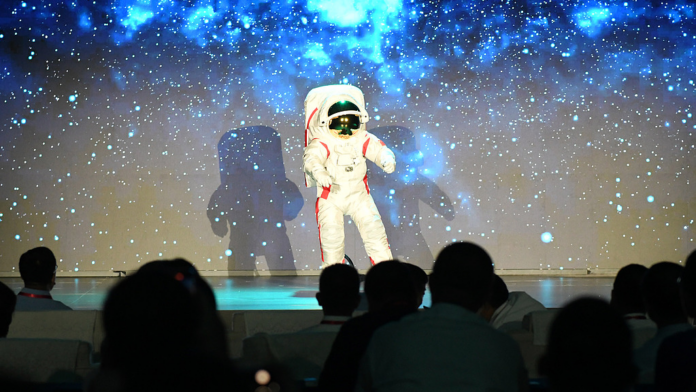
China has advanced its push for a crewed moon landing by 2030, with its lunar spacesuit and a bed rest experiment for long-term space stays both progressing, the country’s astronaut centre says.
The development of China’s moon-landing spacesuit Wangyu, meaning “gazing into the cosmos”, was progressing smoothly, with dozens of key technologies in place, said Zhang Wanxin, an expert at the Astronaut Centre of China, at an aerospace medical engineering conference in north China’s Tianjin.
Since development began in 2020, efforts on Wangyu have focused on meeting the demands of complex lunar-surface operations and extreme environmental challenges, Zhang said on Saturday, noting that the lunar spacesuit was designed to be lightweight, miniaturised, highly efficient and safe.
Beyond spacesuit development, China is also advancing astronaut health research, having completed the “Dixing-3” bed rest experiment to address physiological protection challenges associated with long-term space stays and crewed lunar landing missions.
Qu Lina, a centre expert, said the experiment began in May this year. Volunteers were divided into groups and spent 15 or 30 days in bed. During the experiment, they completed daily activities such as eating, washing, sleeping, urinating and defecating while lying in bed.
Results showed that the experiment effectively protects the human bone, muscle and cardiovascular systems and it will provide technical support for long-term space stays and crewed lunar landing missions.
- China aims to achieve a crewed moon landing by 2030 with advancements in lunar spacesuit technology and astronaut health research.
- The lunar spacesuit, named Wangyu, has been in development since 2020 and is designed to be lightweight, miniaturised, highly efficient, and safe for complex lunar-surface operations.
- Dozens of key technologies for the Wangyu spacesuit have been successfully developed, according to Zhang Wanxin from the Astronaut Centre of China.
- China completed the "Dixing-3" bed rest experiment starting in May 2023 to study physiological protection for long-term space missions and crewed lunar landings.
- Results from the bed rest experiment showed effective protection of human bone, muscle, and cardiovascular systems during extended periods of physical inactivity.


