


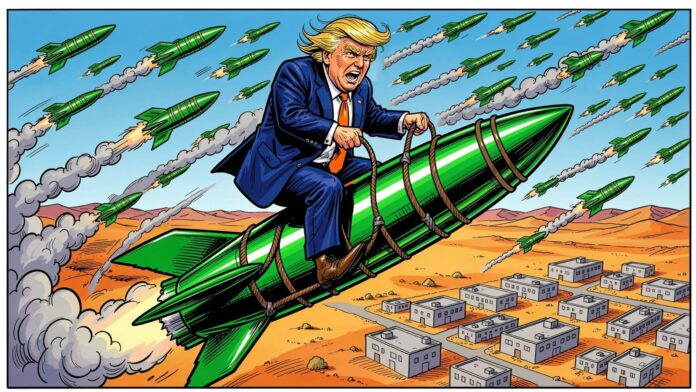
The US knew military action against Iran carried the risk of disrupting one of the world’s most important shipping routes. Analysts warned before the strikes that renewed fighting could push oil prices higher and that import-dependent economies would bear much of the cost. Despite those warnings, the strikes went ahead.
Iran responded with attacks on US military installations in the region and threatened shipping through the Strait of Hormuz, while senior Iranian officials said normal passage would not resume while American military operations continued.
Shipping through the waterway slowed significantly as insurers, shipping companies and governments assessed the risks. Because roughly a fifth of the world’s seaborne oil passes through the Strait of Hormuz, any prolonged disruption inevitably places upward pressure on global energy prices.
‘Agreements violated’
Iranian parliamentary speaker Mohammad Bagher Ghalibaf argued that the US had violated agreements it had previously negotiated, saying the era of “bullying and extortion” was over.
Whether one agrees with Tehran’s position or not, there is no dispute that the US withdrew from the 2015 Iran nuclear agreement in 2018 and reinstated sanctions after having previously agreed to ease them. Critics argue that this history has weakened confidence in Washington’s long-term commitments during negotiations.
South Africa caught in crossfire
South Africa, which imports crude oil and bases its fuel prices on international benchmarks, is among the countries already feeling the consequences of rising oil prices despite having had no role in the conflict.
A spike in crude prices reaches South African motorists within weeks through higher fuel costs. Because road freight carries most of the country’s goods and the minibus taxi industry transports millions of commuters each day, higher fuel costs ripple through the economy, increasing the price of food, transport and other essentials.
That is only the indirect economic impact. Relations between Pretoria and Washington have also deteriorated over the past year. The US has taken a series of measures against South Africa, including the expulsion of South Africa’s ambassador and the imposition of tariffs, while senior American officials have publicly criticised Pretoria’s domestic and foreign policy positions, particularly regarding Israel, Iran and China. South Africa has maintained that its foreign policy is independent, non-aligned and determined by its own national interests.
Viewed individually, each American action has been presented as a response to a specific dispute. Viewed collectively, critics contend they reflect a broader strategy of increasing diplomatic and economic pressure on governments that resist Washington’s preferences. Whether one accepts that interpretation or not, there is little doubt that relations between the two countries have become increasingly strained.
Durability of American commitments questioned
The broader criticism is not new. The US withdrew from the Iran nuclear agreement in 2018, left the Paris Climate Agreement during President Donald Trump’s first administration before later rejoining it, withdrew from the Intermediate-Range Nuclear Forces Treaty, abandoned the Trans-Pacific Partnership, withdrew from the UN Human Rights Council and announced its intention to leave the World Health Organization during the Covid-19 pandemic.
Supporters argue these decisions reflected changing national interests and concerns over the effectiveness of those agreements. Critics, however, say the pattern has made allies and adversaries alike question the durability of American commitments.
The current crisis has reinforced those concerns. Critics argue that if agreements can be abandoned soon after they are signed or political priorities shift rapidly, future negotiating partners may become more cautious about relying on American assurances.
For South Africa, however, the debate is not merely diplomatic. If instability in the Gulf continues to drive up oil prices, South Africans will feel the consequences at filling stations, supermarket tills and in transport costs.
- The US proceeded with military strikes on Iran despite warnings about potential disruptions to the vital Strait of Hormuz shipping route, risking higher global oil prices.
- Iran retaliated with attacks on US bases and threats to block shipping through the Strait, leading to a significant slowdown in maritime traffic and increased energy price pressure worldwide.
- Iran accused the US of violating previous agreements, notably citing the US withdrawal from the 2015 nuclear deal and reinstatement of sanctions, undermining trust in Washington’s commitments.
- South Africa, heavily reliant on oil imports, is affected by rising fuel prices caused by the conflict, which drives up costs in transport, food, and essential goods, while also facing diplomatic strain with the US over differing foreign policy positions.
- The US’s pattern of withdrawing from international agreements has raised doubts about the reliability of its commitments, making allies and partners more cautious, with South Africa directly impacted economically by the Gulf instability.


