


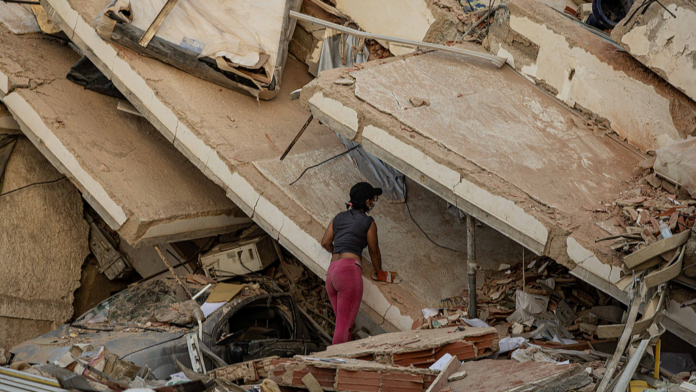
Deaths from Venezuela’s devastating twin earthquakes rose to at least 3,342 on Sunday as officials began to bury dozens of bodies left unidentified 11 days after the disaster.
The new tally released by the Venezuelan information ministry on Sunday also put the number of injured at 16,470 while the number of homeless rose to 17,345.
Since the earthquakes of magnitude 7.2 and 7.5 struck on June 24, Venezuela has recorded 995 aftershocks, according to the update.
The United Nations estimates the quakes caused $6.7 billion in damage – equivalent to 6% of Venezuela’s GDP.
In many affected areas, families are still trying to search for relatives in the rubble. “I’ve lost track of the days. You lose your mind, but I’m not leaving here because I know he’s there,” said Zuly, looking for her son in Catia la Mar district, in an interview with AFP.
UN agencies and many countries, including China, Mexico and Spain, have provided assistance and aid to help Venezuela recover from the earthquakes.
On Sunday, the first batch of emergency humanitarian earthquake relief supplies provided by the Chinese government as additional assistance to Venezuela was dispatched. The shipment mainly included generators, water purification equipment, disinfection equipment, solar lighting devices, tents and blankets. The supplies were transported by chartered flight to Caracas, the capital of Venezuela.
Attention turns to mourning deaths
Venezuelan interim President Delcy Rodríguez held a ceremony on Friday to present medals to international rescue teams, including their search-and-rescue dogs, in what appeared to signal the winding down of rescue operations.
International disaster response teams, including those from the United States and several South American countries, began wrapping up rescue efforts, team members said on Saturday. The Los Angeles County Fire Department’s urban search-and-rescue team also concluded its mission after the latest searches found no signs of life, while teams from Florida and Virginia were packing up to leave over the weekend, AFP reported, citing team members.
As international teams ended their search for survivors, attention shifted to mourning those who lost their lives and supporting the survivors.
Across Caracas and La Guaira, many attended Sunday church services to remember the victims.
On the campus of the Central University of Venezuela in Caracas, dozens of people gathered around a large Venezuelan flag surrounded by candles for a vigil.
Sanctions blamed to hamper rescue efforts
The quakes have had an even greater impact on Venezuela, as the country was already grappling with an economic crisis and political upheaval that had left its infrastructure and healthcare system severely weakened.
Prolonged trade blockades and economic pressure have hampered Venezuela’s development and hindered the country’s efforts to recover from the two deadly earthquakes, William Castillo, Venezuela’s deputy minister of anti-blockade policies, has told CMG.
Castillo said that although the US has recently granted temporary exemptions for earthquake relief, years of resource shortages have deeply disrupted the country’s industrial base.
He went on explaining that due to so-called over-compliance and shadow sanctions, many companies – including construction firms and utility companies – have stopped supplying Venezuela. This, in turn, has triggered collapse, repeated bankruptcies, and divestment from certain service sectors such as energy.
“I believe what we must dismantle completely is the sanctions barrier. We must use this tragedy and the very unfortunate situation our country is facing to take down that barrier, to scrap coercive measures and economic pressure policies, all of which have inflicted tremendous harm on our country and our people,” said Castillo.
Echoing Castillo’s view on the impact of US sanctions on Venezuela, Sarah Schiffling, deputy director of Finland’s HUMLOG Institute, which researches humanitarian logistics and supply chain management at the Hanken School of Economics in Helsinki, told Al Jazeera that the sanctions could have serious secondary effects that limit the flow of humanitarian assistance.
“Financial sanctions can make it difficult for NGOs to send money to the affected country to pay staff or suppliers,” she told Al Jazeera.
“There can also be additional administrative burdens that slow down the operations and make it more difficult to import goods and bring staff into the country.”
- Death toll from Venezuela's twin earthquakes has risen to at least 3,342, with 16,470 injured and 17,345 homeless; nearly 1,000 aftershocks recorded since June 24.
- The United Nations estimates the earthquakes caused $6.7 billion in damage, about 6% of Venezuela's GDP.
- International rescue teams are ending search operations, shifting focus to mourning victims and supporting survivors with vigils and memorials held nationwide.
- China and other countries have provided humanitarian aid, including emergency supplies like generators, water purification equipment, and tents.
- Venezuelan officials blame U.S. sanctions and economic blockades for hampering disaster recovery, citing disruptions in supply chains and difficulties for NGOs providing assistance.


