


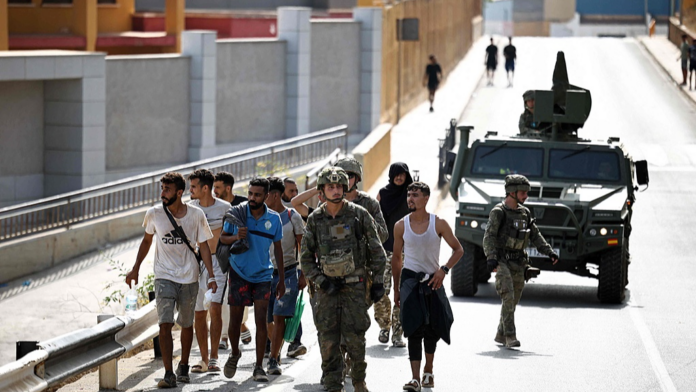
The European Union (EU) will hold an extraordinary videoconference on Tuesday to discuss the situation in Ceuta, a Spanish enclave in North Africa, according to Italy’s ANSA news agency.
The announcement over the weekend was made by Micheal Martin, the Irish prime minister whose country holds the rotating presidency of the Council of the European Union, following calls from Spain and a 22-country initiative led by Italy and Denmark for a coordinated European response to the migrant crisis.
Italy and Denmark on Saturday spearheaded a joint initiative calling for a coordinated European response to recent developments at the EU’s external border in Ceuta, according to a statement released by the Italian government.
The letter, signed by the leaders of 22 European countries, was sent to top EU officials. It expressed “serious concern” over the situation in Ceuta and stressed the need to prevent uncontrolled irregular crossings, combat migrant trafficking networks, eliminate factors that may incentivise new illegal entries and ensure a unified and effective European response.
“We are determined to prevent smugglers from challenging the integrity of the Union’s external borders,” the letter said.
“We have a duty to effectively deter and relentlessly combat illegal migration by coordinating our action, strengthening our external borders and addressing all policies that can serve as pull factors, such as the regularisation of a very large number of irregular migrants,” the letter added.
On the same day, Spanish Prime Minister Pedro Sanchez also called on the EU to convene an extraordinary meeting to coordinate a common response to the recent migrant crisis in Ceuta, while criticising what he described as the “selfish” attitude of some member states.
Sanchez said around 50 000 migrants had entered Ceuta irregularly but Spain restored control of the border in less than 48 hours, provided humanitarian assistance, returned virtually all of those who had crossed illegally and prevented any unauthorised onward movement to mainland Europe.
He said the efforts were made possible through close cooperation with Moroccan authorities and the support of other EU member states. He also highlighted Spain’s long-standing migration policy, which he said had made the country one of the EU’s most secure external borders.
Sanchez said that while most EU governments had expressed solidarity and offered assistance, others had chosen to “attack Spain” and call for its temporary exclusion from the Schengen Area.
The latest developments came after one of the largest irregular migration incidents on Spain’s southern border in recent years. According to the Spanish government, at least 67 people died during the crisis, while more than 48 000 of the nearly 50 000 migrants who entered Ceuta returned to neighbouring Morocco.
- The EU will hold an extraordinary videoconference to discuss the migrant crisis in Ceuta following calls from Spain and a 22-country initiative led by Italy and Denmark.
- The letter from 22 European countries expressed serious concern over Ceuta, urging a coordinated response to prevent irregular crossings, combat trafficking, and address pull factors encouraging illegal migration.
- Spanish PM Pedro Sanchez criticized some EU member states for a "selfish" attitude while highlighting Spain's swift response to irregular migration and cooperation with Morocco.
- Around 50,000 migrants entered Ceuta irregularly; Spain restored border control within 48 hours, returning nearly all migrants and preventing onward movement to mainland Europe.
- The crisis resulted in at least 67 deaths, with the majority of migrants returned to Morocco, sparking debates on solidarity within the EU and Spain's position in the Schengen Area.


