


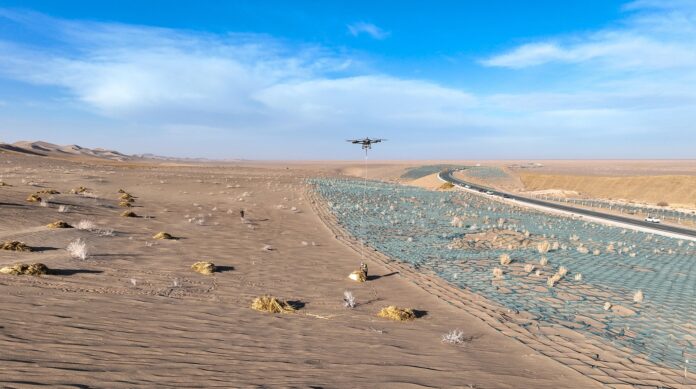
As the world marks the International Day of Combating Sand and Dust Storms on July 12, China is expanding the use of advanced monitoring technologies and deepening international cooperation to help address one of the world’s most widespread environmental challenges.
Sand and dust storms affect more than 150 countries and regions every year. According to the World Meteorological Organisation (WMO), around two billion tonnes of sand and dust enter the atmosphere annually, posing growing risks to public health, agriculture, transport and ecosystems.
The latest Airborne Dust Bulletin, released this month, highlights that climate change is increasing the likelihood of regional extreme dust events and underscores the importance of early warning systems.
Technology strengthens early warning
China has continued to improve its integrated sand and dust storm monitoring and forecasting system by combining Fengyun-4B meteorological satellites, ground-based observations, numerical weather prediction and artificial intelligence.
The China Meteorological Administration (CMA) provides operational dust monitoring, source tracing and impact assessment services covering major dust source regions across East Asia. During severe dust events in spring 2025, AI-assisted forecasting and satellite observations supported earlier warnings for transport, public health and disaster response, helping reduce the impacts of the storms.
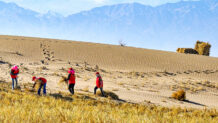
Hua Cong, the deputy director of the Environmental Meteorology Office of the CMA’s National Meteorological Centre, says scientific monitoring enables researchers to accurately identify dust sources and transport pathways, providing a stronger scientific basis for early warning and prevention.
Promoting international cooperation
Recognising that sand and dust storms are transboundary in nature, China has taken part in international cooperation under the WMO Sand and Dust Storm Warning Advisory and Assessment System.
As the host of the WMO Regional Specialised Meteorological Centre Beijing, China provides operational forecasting products and technical support for East Asia while sharing satellite observations and meteorological data with regional partners.
Cooperation with neighboring countries has also continued to deepen. In April 2026, China and Mongolia exchanged information on vegetation conditions, meteorological observations and forecast outlooks to improve regional preparedness. China has also strengthened cooperation with Central Asian countries through the China–Central Asia Cooperation Centre on Desertification Prevention and Control, promoting technology transfer, professional training and sustainable land management.
Building a shared future for dust storm governance
Climate change, drought and land degradation are increasing the complexity of sand and dust storm risks. In response, China is promoting an integrated approach that combines ecological restoration with technological innovation, early warning and international collaboration.
China’s newly revised Dust Weather Warning Standard, issued in 2026, expands warning categories to better protect public health and improve disaster preparedness. The country continues to support the UN Early Warnings for All initiative by sharing technologies, operational experience and forecasting expertise.
As the international community advances the UN Decade on Combating Sand and Dust Storms (2025 to 2034), China will continue working with all parties to strengthen scientific cooperation, enhance early warning capabilities and contribute practical solutions to global efforts to combat sand and dust storms.
- Sand and dust storms impact over 150 countries annually, with climate change increasing extreme dust events and related risks to health, agriculture, and ecosystems.
- China is enhancing its monitoring and forecasting system using Fengyun-4B satellites, ground observations, AI, and numerical weather prediction to improve early warnings.
- China actively participates in international cooperation under the WMO Sand and Dust Storm Warning Advisory and Assessment System, sharing data and forecasts with regional partners.
- Cooperation has deepened with Mongolia and Central Asian countries, focusing on vegetation monitoring, technology transfer, and sustainable land management.
- China promotes an integrated approach combining ecological restoration, technological innovation, and international collaboration, updating its Dust Weather Warning Standard and supporting global initiatives like the UN Early Warnings for All.


