


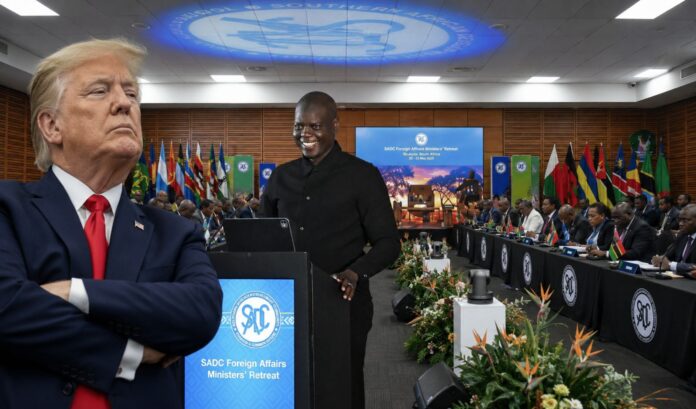
The appointment of veteran negotiator Roelf Meyer as South Africa’s new ambassador to the United States comes as Pretoria faces growing diplomatic and economic pressure from Washington over its foreign policy positions, including its genocide case against Israel before the International Court of Justice.
Meyer’s deployment to Washington is widely seen as an attempt by President Cyril Ramaphosa’s administration to stabilise increasingly strained bilateral relations while defending South Africa’s sovereign foreign policy positions.
But beyond bilateral diplomacy, government officials say South Africa is also strengthening regional alliances and multilateral partnerships to shield itself from growing geopolitical and economic turbulence.
Officials within the Southern African Development Community (SADC) are increasingly framing South Africa’s response to pressure from the United States around three pillars: sustained diplomacy, reliance on international law, and deeper regional integration.
Government representatives insist Pretoria is trying to avoid escalation while simultaneously strengthening alternative political and economic partnerships through African and Global South platforms.
SA will not compromise its sovereignty
Responding to questions about South Africa’s foreign policy posture and the country’s International Court of Justice case against Israel, Chrispin Phiri, spokesperson for the minister of international relations and cooperation, said Pretoria would not compromise its sovereignty.
“South Africa’s case against Israel before the International Court of Justice is now before the courts and must be dealt with in that forum,” said Phiri.
“Our bilateral relations with any country cannot be at the expense of our sovereignty.”
Phiri said South Africa’s foreign policy continues to be guided by multilateralism and international law.
“In executing our foreign policy, we advance positions that ensure that international law and the United Nations Charter are consistent guiding principles and that our relationship is mutually beneficial,” he said.
Pretoria has come under mounting scrutiny from sections of the US political establishment following its ICJ case against Israel, its growing alignment with BRICS nations, and ongoing geopolitical disagreements with Washington.
Tensions have also been fuelled by repeated claims by right-wing American groups alleging discrimination and violence against white Afrikaners.
The latest escalation in the Middle East following Donald Trump’s attacks on Iran has also heightened fears within SADC about worsening fuel prices, trade instability and broader economic shocks likely to hit developing economies hardest.
Despite this, government officials say South Africa remains committed to diplomatic engagement with the United States, particularly on trade matters linked to the African Growth and Opportunity Act.
Officials argue that South Africa’s continued inclusion in AGOA demonstrates that engagement with Washington “has yielded results to some extent”.
At the centre of Pretoria’s strategy is the insistence that international law must apply equally to all countries, regardless of size or political influence.
Government representatives have also defended South Africa’s right to maintain independent geopolitical relationships, arguing that the country retains the sovereign authority to pursue partnerships aligned with its national interests.
Economic and energy security mechanisms
South Africa now appears increasingly focused on insulating itself and the broader SADC region from external geopolitical shocks, particularly those affecting fuel prices, fertiliser costs and inflation.
Phiri said ongoing SADC discussions are exploring coordinated economic and energy security mechanisms aimed at reducing dependence on external markets and protecting the region from global instability.
“That is precisely why SADC foreign ministers are meeting,” he said. “If you look at a country like Angola, which is an oil-rich country, that is something we can really look at in terms of how we insulate ourselves as a region from the shocks we are seeing around the price of fertiliser and the price of oil.”
He said geopolitical instability was directly affecting the cost of living across the region.
“These inflationary increases ultimately affect consumers and make the cost of living much higher,” Phiri said.
SADC leaders are now looking at ways to deepen regional economic integration and leverage the bloc’s vast natural resources to industrialise the region and create jobs.
“SADC is one of the most integrated regions on the continent,” Phiri said. “We want to deepen that integration and leverage the strengths of all member states.”
The region possesses some of the world’s most strategically important minerals, including copper, platinum group metals and lithium—resources increasingly critical to the global energy transition and electric vehicle industries.
“If we are able to cohere around a stronger economic diplomacy strategy, we would really be able to industrialise this region in a manner that creates jobs and promotes prosperity for all the inhabitants of SADC,” said Phiri.
African solutions for African people
Pretoria is also placing significant emphasis on the African Continental Free Trade Area as part of its long-term strategy to strengthen intra-African trade and reduce dependency on traditional Western markets.
Government officials recently defended South Africa’s absence from the Africa Forward Summit, saying the country remained actively engaged in continental development initiatives through BRICS and African integration platforms.
Phiri said South Africa was pursuing “African solutions for African people” and shaping development priorities on its own terms.
“Whilst we may not have attended the Africa Forward summit, this does not mean we are not having these discussions amongst ourselves as African countries,” he said.
“We are looking at development on our own terms.”
Phiri added that Minister of International Relations and Cooperation Ronald Lamola had instead prioritised engagements at the BRICS summit in India, where discussions focused on trade, development and geopolitical stability across the Global South.
On the issue of rising foreign military involvement in African countries, government representatives declined to comment directly on arrangements involving other states such as Kenya but reiterated that South Africa maintained sovereign control over its own defence and security decisions.
“As for South Africa, we believe we are a sovereign state and we have our own military arrangements that are sovereign and developed,” Phiri said.
For Pretoria, analysts say the broader challenge now lies in balancing relations with major Western powers while strengthening regional and multilateral alternatives that reduce vulnerability to external political and economic pressure.
Defending SA’s constitutional values
Meyer’s role in Washington is, therefore, expected to focus not only on easing tensions with the United States but also on defending South Africa’s constitutional values, sovereign foreign policy positions, and long-term strategic interests.
In its final outcome statement following the SADC Ministers of Foreign Affairs Retreat in Skukuza, the regional bloc signalled a growing determination to reduce dependence on external powers and strengthen collective self-reliance amid rising global instability and pressure from powerful Western nations.
The ministers emphasised the need for stronger regional industrialisation, energy security, infrastructure development and coordinated economic diplomacy as geopolitical tensions intensify globally.
The statement also underscored the importance of defending multilateralism, sovereignty and international law, principles increasingly becoming central to SADC’s response to growing pressure from the United States and wider geopolitical disruptions linked to conflicts in the Middle East and elsewhere.
Rather than fragmenting under pressure, SADC leaders appear to be using the moment to tighten regional cooperation and accelerate efforts towards economic and political integration.
- Roelf Meyer has been appointed South Africa’s new ambassador to the US amid rising diplomatic and economic tensions, especially over South Africa’s genocide case against Israel at the International Court of Justice.
- South Africa aims to stabilize relations with the US while firmly defending its sovereign foreign policy, emphasizing diplomacy, international law, and regional integration within SADC.
- Pretoria is strengthening regional economic mechanisms to reduce reliance on external markets, focusing on energy security, industrialization, and leveraging SADC’s vast natural resources.
- South Africa is prioritizing African-led solutions, including the African Continental Free Trade Area and BRICS partnerships, to boost intra-African trade and development on its own terms.
- The government seeks to balance engagement with Western powers and strengthen multilateral and regional alliances to protect sovereignty amid global geopolitical and economic pressures.


