


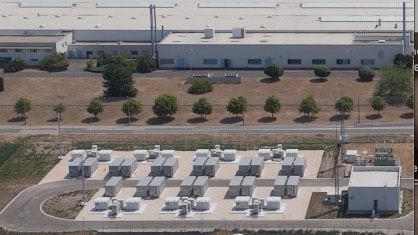
Hungary is expanding its renewable energy sector with its largest wind power buildout in more than a decade. But more solar and wind power also require new ways to keep the electricity grid stable. In western Hungary, one of the country’s largest battery energy storage systems is helping meet the challenge.
The battery park, operated by ALTEO Group near the city of Gyor, uses lithium-ion batteries built by China’s CATL. The facility can deliver 49.9 megawatts of power and store 99.8 megawatt-hours of electricity. The batteries respond to changes in grid demand within milliseconds, allowing operators to store excess electricity during the day and release it when demand rises.
Surplus energy production
“Hungarian energy production is very solar based right now. During the daylight, when the sun is shining, we have a surplus in energy production, so we can store that energy into the storage units and then discharge it back to the grid during the peak consumption hours during the night,” said Szilard Korhetz, the head of business development at ALTEO Group.
The company said about 90% of the electricity stored at the site comes from solar power. Each storage unit has an expected service life of 15 years. ALTEO estimates the project can reduce carbon dioxide emissions by about 17 000 tons each year.
Hungary has become one of Europe’s fastest-growing solar energy markets. The government now plans to increase wind power generation tenfold by 2030 as it seeks to expand renewable electricity production.
Battery storage
Energy experts say battery storage will play a larger role as more renewable power comes online because electricity generation and consumer demand often occur at different times.
“Photovoltaic together with storage technology which is installed, which has a very big advantage is that you produce your electricity between 9am to 5pm — but you can see that after five, life is not stopping, so electricity consumption will be there,” said Laszlo Szabo, the director of the Regional Centre for Energy Policy Research.
“If you have the photovoltaic generation, you can consume that energy at 9pm or 10pm when you watch a football match on television, and it can still be renewable energy-based because that energy is stored in this storage system.”
Despite the growth of renewable energy, Hungary relies on imported electricity and nuclear power to meet demand. Battery storage is expected to help integrate the sources into a more balanced electricity system.
“Roughly 25% is coming from solar. Of course, it’s very dependent on the season because it’s much higher during the sunny seasons,” Korhetz said.
As Hungary expands renewable energy production, battery storage is becoming a key part of the country’s energy strategy, helping ensure electricity generated during the day remains available when homes and businesses need it most.
- Hungary is undertaking its largest wind power expansion in over a decade while boosting solar energy, prompting a need for stable electricity grid management.
- ALTEO Group operates one of Hungary’s biggest lithium-ion battery storage systems near Gyor, capable of delivering 49.9 MW and storing 99.8 MWh of electricity from primarily solar power.
- The battery system stores excess solar energy produced during the day and releases it during peak evening demand, improving grid stability and reducing CO2 emissions by an estimated 17,000 tons annually.
- Hungary aims to increase wind power generation tenfold by 2030, with battery storage playing a crucial role in balancing the mismatch between renewable energy production times and consumption.
- Despite renewable growth, Hungary still depends on imported electricity and nuclear power, with battery storage helping to integrate diverse energy sources into a more reliable system.


