


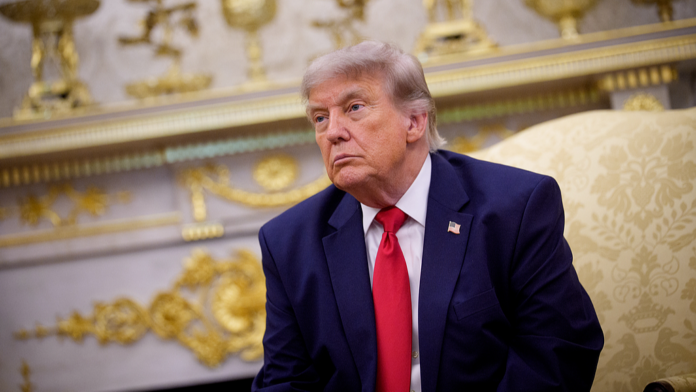
US President Donald Trump said on Monday that talks were underway with Iran, calling it the “last chance” for Tehran to end the five-month-old war, but Iran denied that any negotiations were being held or planned.
The contradictory statements suggest there is little prospect for a diplomatic resolution to the war anytime soon.
“We’re talking and we’re talking at the request of Iran, backed by Saudi Arabia, backed by UAE and backed by Qatar in particular, but others also,” Trump told reporters at the White House Oval Office.
“This is a last chance for them to sign a good document,” Trump said. “I think we’re going to maybe get something, but I want to give them every last chance before decapitation.”
Iran says no plans to host foreign delegations
Iranian Foreign Ministry spokesman Esmaeil Baghaei said in Tehran on Monday that Iran is currently not engaged in any negotiations with the US and Iran had no plans to host foreign delegations or send negotiators abroad in the coming days.
Baghaei added that the only talks underway were discussions with Oman over management of the Strait of Hormuz.
When asked about progress, Trump told reporters “you find out today or tomorrow … they’re going to go quickly one way or the other.”
He said that the two sides are talking about the reopening of the Strait of Hormuz, “having it open literally by tomorrow, completely open, and that’s phase one.”
“And phase two is we then will talk about the nuclear capacity … the denuclearization of Iran has to happen,” he continued, adding that “that’ll take a little while.”
Dispute over Strait of Hormuz
Gulf officials and analysts say Iran is betting it can outlast Washington by turning the Middle East’s trade routes, shipping lanes and energy infrastructure into pressure points that steadily raise the cost of confrontation, hoping to convince the United States and its allies that containing the crisis is more costly than accommodating Iran’s demands over the Strait of Hormuz.
“Their big advantage is that they can hurt the regional states and the global economy,” Michael Knights of the Washington Institute, told Reuters.
In a post on Truth Social later on Monday, Trump repeated his assertion that the US Navy had total control over the Strait of Hormuz, through which a fifth of global oil and liquefied natural gas flowed before the conflict.
The US Central Command said the US forces continue to “strictly enforce the US blockade against Iran” and have redirected 44 commercial vessels, disabled two, and boarded two as of Monday on X.
In an interview with Lebanon-based broadcaster Al Mayadeen on Monday, the military adviser to Iran’s Supreme Leader, Mohsen Rezaei, affirmed that Iran will not compromise over its control of navigation arrangements in the Strait of Hormuz.
Rezaei stressed that “under no circumstances will we allow any route other than the Iranian route to be opened in the Strait of Hormuz.”
He further warned, “Even if the United States sends a warship into the illegal route in the Strait of Hormuz, we will target it.”
Data released by global market intelligence firm Kpler on its X account on Monday showed that daily vessel traffic through the Strait of Hormuz declined consecutively from July 31 to August 2, with 23, 11 and nine vessels passing through the strait on the three days, respectively.
- US President Trump claimed talks with Iran, calling it Tehran’s "last chance" to end the war, but Iran denied any ongoing or planned negotiations.
- Iran’s Foreign Ministry stated no plans for hosting foreign delegations or sending negotiators abroad; current talks only involve Oman on Strait of Hormuz management.
- Trump suggested the reopening of the Strait of Hormuz as the first phase of talks, followed by discussions on Iran’s denuclearization.
- Iran insists on maintaining full control over navigation in the Strait of Hormuz and warned it will target US forces attempting to enter through unauthorized routes.
- US forces continue enforcing a blockade on Iran, having redirected, disabled, or boarded several commercial vessels; vessel traffic through the strait has declined sharply recently.


