


The US military said it struck Iran again, hours after a tanker was hit in the Strait of Hormuz, in the worst escalation since the two sides signed an interim peace deal two weeks ago.
Each of the warring sides has accused the other of violating the agreement reached two weeks ago to end the four-month-old conflict.
“There may come a point when we are no longer able to be reasonable and will be forced to militarily complete the job that we very successfully started. If that happens, the Islamic Republic of Iran will no longer exist!” US President Donald Trump posted on social media on Saturday.
US Central Command said its forces carried out fresh strikes after a Panama-flagged tanker was attacked by an Iranian drone early on Saturday. In Iran, state broadcaster IRIB said early on Sunday local time that explosions were heard in Sirik in southern Iran, without providing further details.
“Iran was given a chance to honour the ceasefire agreement but elected not to,” US Central Command said in a statement. It said the strikes were “in direct response to continued Iranian aggression against commercial shipping” and targeted Iranian military surveillance, communications, air defence, drone storage and mine-laying facilities.
A US defence official later reported that the strikes on Iranian targets were complete, according to Fox News.
Washington said earlier that it hit Iranian targets overnight. Iran said it responded on Saturday by striking targets linked to US forces.
Saturday’s attack on a tanker in the strait followed another on a cargo ship on Thursday that triggered the latest escalation. The waterway had begun to reopen after months of disruption.
Britain’s UKMTO maritime security agency said the tanker hit on Saturday had sustained damage to its bridge, with all crew members reported safe. The Joint Maritime Information Center, run by a coalition of navies protecting shipping, raised its security threat level as a result of recent incidents.
Iran has not directly commented on reports of specific attacks on ships. But Iranian state television reported that the Revolutionary Guards fired “warning shots” towards unspecified vessels attempting to pass through channels not approved by Iran and that this was now prompting other ships to seek Iranian permits before attempting to cross the strait.
Earlier, Iran’s foreign ministry said it launched “defensive” attacks on US-linked military targets, while Bahrain, which hosts the US Navy’s regional headquarters, reported an Iranian drone attack. The US military did not immediately respond to the reports.
Iran asserts control over vital strait
Iran has accused the US of not upholding the interim agreement, in particular by not sustaining a promised ceasefire in Lebanon, which US ally Israel invaded in March in pursuit of the Iran-aligned militant group Hezbollah.
Israel and Lebanon have repeatedly agreed to US-brokered ceasefires, the latest of which was announced on Friday. But these have had only limited overall impact, with Israel insisting it will not withdraw from territory it has seized and Hezbollah repeatedly rejecting calls to give up its arms as long as Israeli troops remain in place.
Lebanese state television reported an Israeli drone strike on Saturday in the Nabatiyeh area in the south, which has experienced Israeli strikes throughout the conflict. The Israeli military said it had targeted a person who posed a threat to its forces.
Hezbollah leader Naim Qassem rejected the day-old Israel-Lebanon agreement as a surrender, and said it was “null and void.”
With hundreds of thousands of Lebanese, mainly Shi’ite Muslims, still unable to return to homes in Israeli-occupied areas, anger over the agreement has spread beyond Hezbollah to the wider Shi’ite community.
Israeli Defense Minister Israel Katz praised the agreement, saying it allows Israel to maintain its occupation of a so-called security zone in Lebanon and bars the return of displaced residents.
Mohsen Rezaei, an adviser to Iran’s supreme leader, said Washington had violated the war-ending memorandum of understanding by supporting what he called proxy forces in the region and creating tension in the Strait of Hormuz.
Iran has also struck neighbouring Gulf states that host large US military bases. Iranian state television said the Revolutionary Guards had delivered “a decisive response” after US forces hit a communications tower in the port city of Sirik. Iran’s Mehr news agency said the Iranian port was operating normally with no damage reported to facilities or equipment.
Bahrain said Iran’s latest attacks violated the memorandum of understanding.
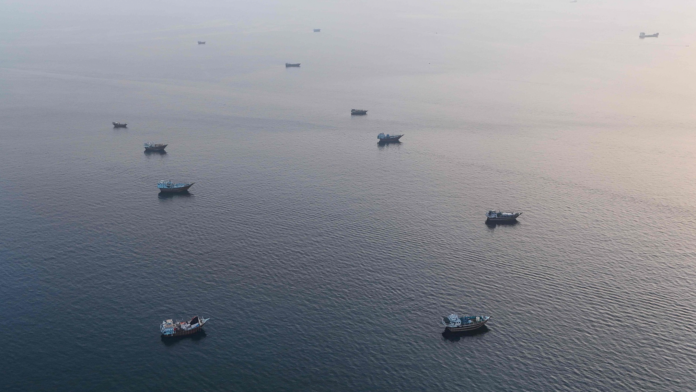
Hundreds of ships, including tankers laden with oil, have been blockaded inside the Gulf since the war broke out. As they began leaving through the strait over the past two weeks, oil prices have tumbled close to pre-war levels on the surge in supply.
Washington has been promoting a southern lane along the coast of Oman, while Tehran, which ultimately aims to charge fees for use of the strait, wants ships to use a northern route through its waters and under its control.
Ebrahim Azizi, the head of the Iranian parliament’s national security committee, said on Saturday that any violation of Iran’s shipping instructions would be met decisively.
US Vice-President JD Vance, Trump’s chief negotiator on the conflict, said the Americans had adhered to the ceasefire deal and blamed Iran for any return to conflict that might result from its actions.
“Iran signed a ceasefire agreement. We have honoured it. If they have disagreements about how the MOU is being applied, they can pick up the phone. But violence will be met with violence,” Vance said on X.
- The US military conducted strikes against Iranian military targets shortly after an Iranian drone attacked a Panama-flagged tanker in the Strait of Hormuz, escalating tensions despite a recent interim peace deal.
- Both the US and Iran accuse each other of violating the ceasefire, with Iran firing warning shots at vessels and the US responding with military actions targeting surveillance, communications, and drone facilities in southern Iran.
- The conflict is linked to ongoing regional tensions, including disputes involving Israel, Lebanon, and Hezbollah, with ceasefires frequently broken and both sides accusing the other of not honoring agreements.
- Iran asserts control over the Strait of Hormuz, demanding ships seek Iranian permits and opposing alternate shipping routes promoted by the US, intending to charge fees for passage through the strait.
- Regional countries like Bahrain condemn Iran’s attacks as violations of the ceasefire, while the US insists it has honored the agreement and warns Iran that further violence will be met with military response.


