


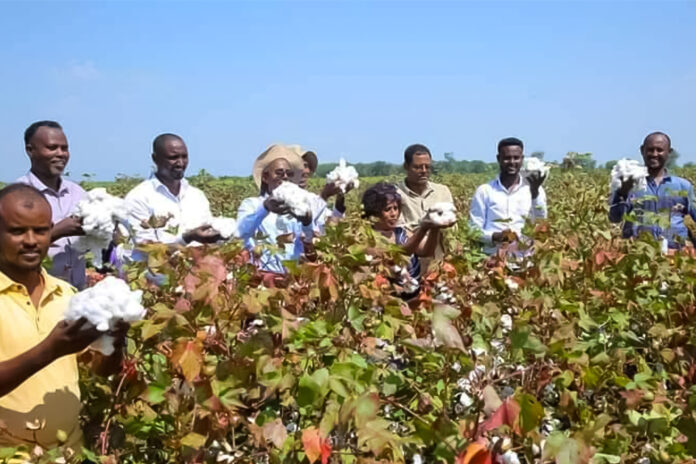
As the first rays of sunlight spread across the vast plains of Ethiopia’s Afar Region, Yossef Tewelde walks slowly between rows of cotton plants heavy with white bolls ready for harvest.
The morning air is already warming, and irrigation canals glisten beside the fields that have sustained his family for years.
Cotton more than another crop
For Yossef, cotton is more than another crop. It pays school fees, buys food, and represents a future he hopes will extend far beyond his farm.
“Cotton is our family’s main source of income,” he says, gently pulling open a mature boll. “When the rains come on time and we can access improved seed, production is good and we can pay school fees and support our household. But when rainfall is erratic or quality seed is unavailable, our yields fall sharply. We believe Ethiopia has the land and climate to produce much more cotton if farmers receive better irrigation, research support and stable markets.”
His cotton could one day be spun into yarn, woven into fabric, stitched into garments and sold in markets across Africa and beyond. But that journey depends on every link in the value chain from farmers and researchers to processors, manufacturers and exporters.
For decades, Ethiopia has invested in building that chain, seeking to transform itself from an exporter of raw cotton into one of Africa’s leading textile and apparel manufacturing hubs.
According to the Ethiopian Investment Commission, the country has around three million hectares suitable for cotton cultivation, abundant labour, competitive energy costs and growing industrial infrastructure, giving it many of the ingredients needed to build a globally competitive cotton-to-clothing industry.
Those advantages helped attract international textile manufacturers to industrial parks in Hawassa, Bole Lemi, Adama, Kombolcha and Mekelle, positioning Ethiopia as one of Africa’s emerging apparel manufacturing hubs.
But building factories is only one part of the equation. Research by the Aid by Trade Foundation’s Cotton made in Africa programme shows that although Ethiopia has around three million hectares suitable for cotton cultivation, only a fraction is under production. Many farmers continue to face challenges accessing improved seed, irrigation, extension services and stable markets, limiting both productivity and fibre quality.
The result is a striking contradiction: while Ethiopia has some of Africa’s greatest cotton production potential, many textile manufacturers still import cotton lint or yarn because local supplies do not consistently meet their quality and volume requirements.
From farm gate to factory floor
The cotton leaving Yossef Tewelde’s farm begins a journey that reflects Ethiopia’s industrial ambition. After harvest, seed cotton is transported to nearby ginneries, where fibre is separated from seed before being compressed into bales and sent to spinning mills and textile factories. There it is transformed into yarn, woven into fabric and stitched into garments.
It is along this journey from farm gate to factory floor that Ethiopia’s ambition to build Africa’s most integrated cotton-to-clothing value chain is put to the test.
For nearly two decades, Ethiopia has pursued an industrialisation strategy centred on adding value to locally grown cotton rather than exporting it as a raw commodity. Supported by abundant cotton-growing land, competitive energy costs, a growing labour force and investment in industrial parks, the strategy attracted international manufacturers looking to serve regional and global markets.
Yet inside Ethiopia’s textile factories, one challenge continues to dominate: securing enough high-quality local cotton.
But that journey depends on consistent supplies of quality fibre. “If farmers cannot produce enough quality cotton, the entire manufacturing chain feels the impact,” says Berhanu Megersa, director general of the Werer Agricultural Research Center.
The centre has developed improved cotton varieties that increase both yields and fibre quality, but Berhanu says limited funding has slowed seed multiplication and prevented these innovations from reaching farmers at scale.
Climate variability, limited irrigation and inconsistent access to improved seed continue to constrain production. Those challenges extend beyond the farm gate, affecting the quality and quantity of cotton reaching Ethiopia’s textile industry.
The manufacturing route
“Our first choice is always Ethiopian cotton because it shortens supply chains and supports local farmers,” says Abje Menegesha, Procurement Manager at Amibara Agricultural Development, a supplier to Ethiopia’s textile industry.
“However, domestic production still does not consistently meet our requirements in quantity and quality. We occasionally import lint or yarn to keep production running. Improving fibre quality, grading systems and contract farming would significantly increase local sourcing.”
Manufacturers say inconsistent fibre quality, contamination during harvesting, uneven grading standards and seasonal supply shortages continue to disrupt production and reduce competitiveness in export markets.
For textile entrepreneur Yasin Geresu, owner of World Cotton Factory, quality is now the industry’s defining challenge.

“The quality of locally produced cotton remains inconsistent, while production costs are high. Improving quality through better technology and supporting producers would make Ethiopian textiles more competitive internationally.”
Industry leaders believe stronger partnerships between farmers and manufacturers are essential. Contract farming, better quality standards and transparent pricing could help factories source more cotton locally while giving farmers more reliable markets.
“The problems of farmers and manufacturers are interconnected,” says Negash Goshu, President of the Textile Manufacturers Association.
“Cotton producers and textile manufacturers cannot operate independently. Their problems require continuous dialogue and joint solutions.”
That thinking is increasingly shaping government policy.
“Ethiopia possesses nearly three million hectares suitable for cotton production,” says Samson Assefa, Executive Director for Cotton Development at the Ministry of Agriculture.
“Our priority is to increase productivity, strengthen the cotton value chain, satisfy domestic textile demand and expand exports through improved seed, better market linkages and stronger stakeholder coordination.”
Integrated supply chain
The National Cotton Development Strategy aims to do exactly that by connecting farmers, processors, manufacturers and exporters into a more integrated supply chain, a priority echoed across Ethiopia’s textile industry.
Minister of Industry, Federal Democratic Republic of Ethiopia Melaku Alebel told Bird: “Our priority is to strengthen every stage of the cotton value chain, from improved seed and farmer productivity to ginning, spinning, textile manufacturing and exports. Ethiopia has substantial untapped production potential, but realizing that potential requires stronger research, quality control, better extension services and closer collaboration between producers and industry.”
Government officials increasingly acknowledge that factories alone cannot build a competitive textile industry. Reliable domestic cotton depends on sustained investment in research, seed multiplication, irrigation and extension services that improve both productivity and fibre quality.
Some trade analysts argue that Ethiopia’s investment in industrial parks outpaced improvements in agricultural production, leaving manufacturers without a consistent supply of quality cotton.
Others point to external shocks including the COVID-19 pandemic, rising freight costs, domestic conflict and the suspension of AGOA preferences as major setbacks. Most agree, however, that the next phase of Ethiopia’s industrialisation will depend on strengthening the links between farms, processors, manufacturers and exporters. Strengthening domestic supply chains is also central to Ethiopia’s regional ambitions.
Lessons for the continent
The African Continental Free Trade Area (AfCFTA) offers an opportunity to build on those efforts. By reducing barriers to regional trade, it could expand markets for Ethiopian yarn, textiles and garments while encouraging greater value addition within Africa.
Agricultural researcher Oumar Hassen believes the agreement could reshape the sector.
“Ethiopia illustrates both the opportunities and challenges facing Africa’s textile sector. The country has abundant land suitable for cotton and growing manufacturing capacity, yet productivity, logistics and quality remain constraints,” said Hassen. “AfCFTA could significantly expand regional textile trade, but long-term competitiveness will depend on research, infrastructure, reliable markets and policies that enable local cotton to compete with imported fibre.”
His assessment reflects a wider challenge across Africa. Although the continent produces millions of tonnes of cotton each year, much of it is still exported as raw fibre before returning as imported fabrics and clothing. Analyses by UNIDO, the African Development Bank and the International Trade Centre show that countries that process agricultural commodities domestically create more jobs, retain greater economic value and build more resilient industries.
Ethiopia’s experience offers an alternative. Rather than treating farming and manufacturing as separate sectors, it has invested in building an integrated cotton-to-clothing value chain. While progress has been slowed by global market disruptions and changing trade conditions, the country’s experience demonstrates that competitive textile industries begin with productive farms, strong research, reliable raw materials and close collaboration across the supply chain.
As Negash Goshu, president of the Textile Manufacturers Association, puts it: “Cotton producers and textile manufacturers cannot operate independently. Their problems are interconnected and require continuous dialogue and joint solutions.”
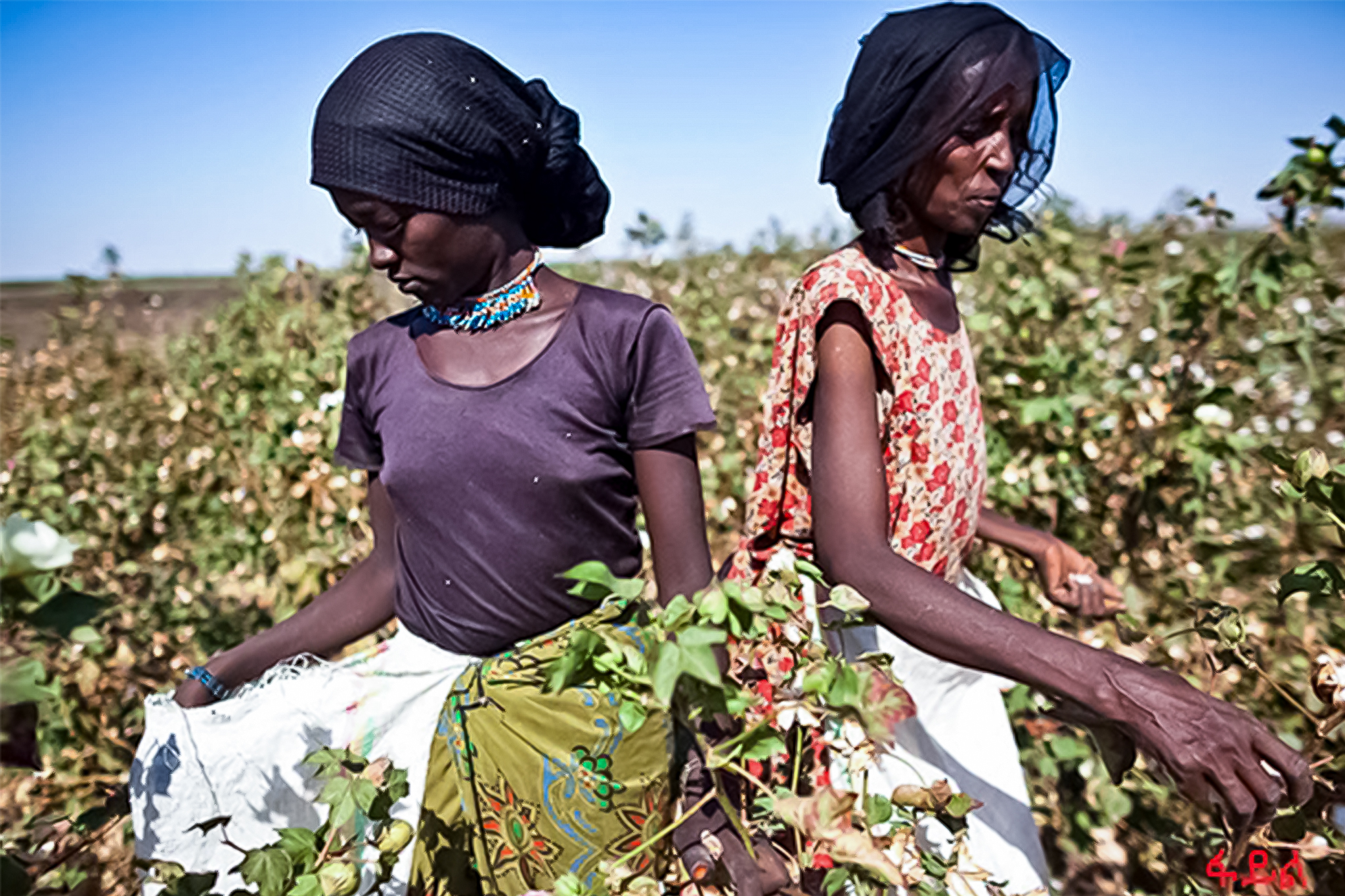
As the afternoon sun settles over Gewane, workers load freshly harvested cotton onto waiting trucks. Within days, the bales will pass through ginneries, spinning mills and textile factories. Some may eventually become school uniforms in Addis Ababa, fashion garments in Nairobi, workwear in Johannesburg or apparel sold in European retail stores.
For Ethiopia, that journey represents more than the movement of a crop. It is an opportunity to capture more value from its own cotton, create skilled manufacturing jobs and demonstrate how agriculture can drive industrial growth across Africa. If every link in the chain holds – from seed to spinning mill to shop shelf – Ethiopia’s cotton could become a blueprint for value addition across the continent.
- Ethiopia has significant cotton production potential, with around three million hectares suitable for cultivation and government efforts to develop a full cotton-to-clothing value chain.
- Challenges remain in cotton farming, including erratic rainfall, limited irrigation, inconsistent access to improved seeds, and poor fiber quality, which hinder meeting the demand of local textile manufacturers.
- Ethiopia’s strategy focuses on industrialization by adding value locally through investment in textile factories and industrial parks, but inconsistent domestic cotton supply forces some manufacturers to import raw materials.
- Stronger cooperation between farmers and manufacturers—through contract farming, better quality standards, research investment, and market linkages—is seen as essential to strengthen the industry.
- The African Continental Free Trade Area (AfCFTA) presents opportunities for expanding regional markets for Ethiopian textiles, but long-term competitiveness depends on improving domestic cotton productivity, infrastructure, and supply chain integration.


