


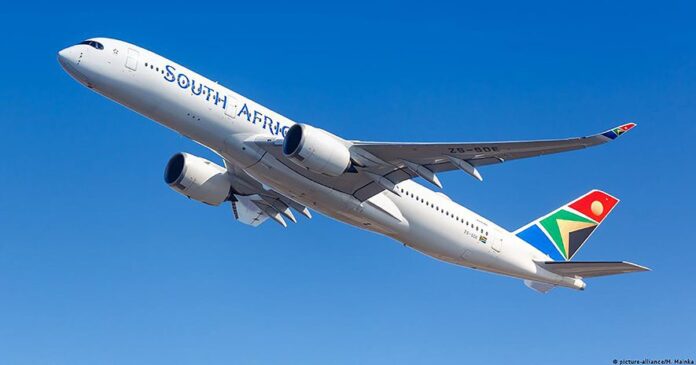
The Auditor-General of South Africa has warned that South African Airways (SAA) could face closure within the next 12 months if mounting financial and operational pressures are not addressed.
Briefing Parliament’s portfolio committee on transport on Tuesday, senior audit manager Thato Kunene said the state-owned entity is a going concern with material uncertainties, reflecting doubts about its ability to continue operating.
“What we mean when we say ‘material uncertainties’ is that certain significant things or conditions, or doubts, if they were to happen, might cause the entity to close within the 12 months,” said Kunene, adding that this could ultimately point to insolvency risks.
The warning comes despite SAA reporting a notable R8.8-billion revenue increase compared to the R6.5-billion generated in the 2023/2024 financial year.
Operating loss overshadows revenue hike
However, the improvement was outweighed by a faster rise in operating costs, resulting in an operating loss of R472-million, compared with R250-million previously. Minister of Transport Barbara Creecy challenged the profit made, highlighting that it was reliant on the sale of assets, including Heathrow landing slots, rather than operational revenue.
“In the financial year under consideration the entity remained in a stable state, there was a moderate profit that was declared but that profit primarily emerged from the sale of the Heathrow slot, and while there was some improvement in passenger numbers and in passenger revenue, I think that we are still a long way from being a profitable entity, which is where we would want to be,” said Creecy.
The struggling SAA has also received R1-billion cash injection from government in the year under consideration which, according to Kunene, has at least managed to cover the long-term loans.
Fruitless and wasteful spending
The report also flagged higher levels of irregular expenditure and fruitless and wasteful spending compared with the previous year. Irregular expenditure rose to R504-million from R474-million, while fruitless and wasteful expenditure increased to R2-million from R1-million.
These issues were attributed to a lack of consequence management. It was also noted that R100 000 in theft was recorded, but no case was reported to the police.
According to Kunene, the airline is not bringing in enough cash to keep up with its operating costs. She also pointed out that some financial reporting may present a more favourable picture than the underlying reality.
Liquidity pressures
“There are geopolitical issues that are happening now that are likely to impact the liquidity pressures of SAA. As a result of the fuel price changes, forex, and also even disruption in terms of the supply.
“So, we request that ongoing monitoring of the growing concern of the entity needs to be closely done as these key developments that are happening in Iran-US and Israeli strikes they are impacting the key aspects of the business.”
Concern over SAAT
The airline’s technical subsidiary, South African Airways Technical (SAAT), was described as operating in a high-risk control environment requiring urgent governance intervention.
“With SAAT we are unable to confirm whether it’s a going concern with material uncertainties or not. The reason is because the financial statement was so severe that we could not even audit most of the thins as mentioned,” said Kunene.
Among the most serious concerns are billing inefficiencies that have resulted in revenue leakages. Invoices are often not processed on time due to poor coordination between operational and finance teams. Late submission of supporting documents has led to incomplete audit trails, disputes with customers and revenue reversals.
Further concerns include payments being processed without adequate proof of delivery, increasing the risk of irregular expenditure, and poor integration between operational and financial departments, leading to siloed decision-making and weak controls.
SAAT’s position is further complicated by its reliance on SAA for survival, creating a cycle of financial dependency that amplifies risks across the group.
- The Auditor-General warned South African Airways (SAA) could close within 12 months due to significant financial and operational uncertainties, despite reporting increased revenue.
- SAA posted an operating loss of R472 million driven by rising operating costs, overshadowing an R8.8 billion revenue increase largely due to asset sales like Heathrow landing slots.
- Irregular expenditure rose to R504 million, and fruitless/wasteful spending increased, linked to poor consequence management and theft, with no police reports filed.
- The airline faces liquidity pressures exacerbated by geopolitical issues, fuel price volatility, and foreign exchange challenges affecting operations and cash flow.
- South African Airways Technical (SAAT) faces severe governance and audit issues, with billing inefficiencies, revenue leakages, and financial dependency on SAA, raising high operational risks.


