


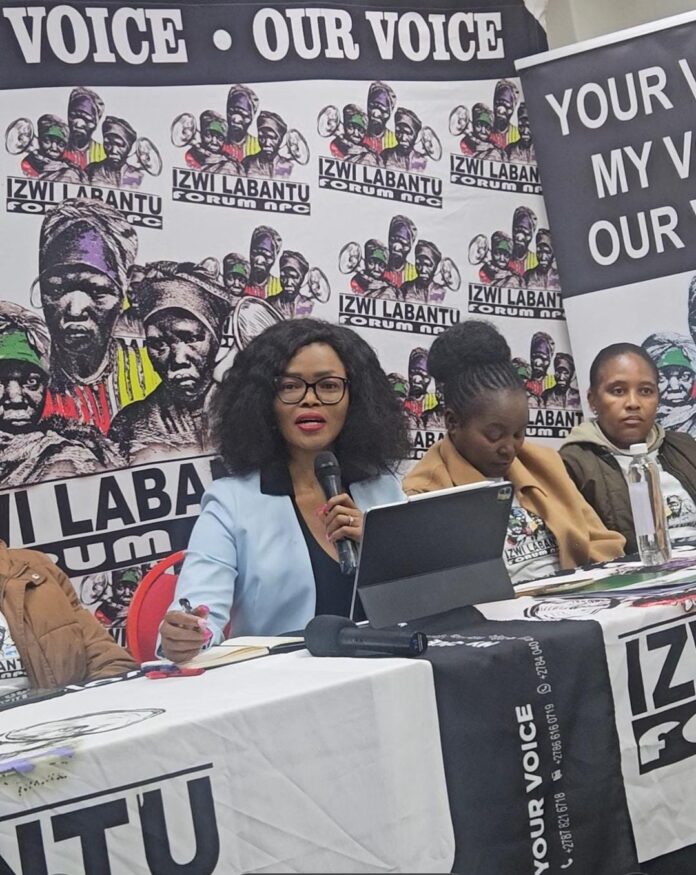
A group of Black emerging farmers, farmworkers, farm dwellers and rural communities have appealed to the South African Human Rights Commission (SAHRC), accusing the government and several state institutions of presiding over a “human rights crisis” that has left vulnerable communities facing evictions, violence, poverty and the loss of livelihoods.
Izwi Labantu Forum (ILF), a non-profit organisation representing hundreds of Black emerging farmers and rural communities across all nine provinces, lodged a formal complaint with the SAHRC on August 12, calling for an investigation into what it describes as the “systemic violation” of constitutional rights.
In the complaint Sunday World has seen, the ILF names deputy minister in the Presidency, Nonceba Mhlauli, head of the deputy president’s office, Mduduzi Mbada, land reform and rural development minister, Mzwanele Nyhontso, and agriculture department director-general, Mooketsa Ramasodi.
READ: Human rights commission probes NPA, DMRE over Lily Mine disaster
Others against whom complaints were lodged include former ministers of agriculture, Thoko Didiza who is currently the Speaker of Parliament, and John Steenhuisen, as well as Land Bank, Ithala Development Finance Corporation (IDFC) and the National Empowerment Fund (NEF).
In its complaint, the ILF says the crisis intensified after hundreds of Black emerging farmers marched to the Union Buildings on January 29 to hand over a memorandum containing 14 non-negotiable demands to the Presidency.
According to the complaint, Mhlauli received the memorandum on behalf of the deputy president, Paul Mashatile and undertook to ensure that the demands were addressed through the inter-ministerial committee on land reform and agriculture.
Sunday World has extensively reported about the impasse between the black farmers and the government, where there had been a back-and-forth drama, with no resolution or way forward to deal with issues concerned.
However, ILF claims in its complaint that despite subsequent meetings and correspondence, there has been no meaningful implementation of the demands.
READ: Black farmers give Ramaphosa 14 days to respond to land reform demands
Terms of reference for joint task team yet unsigned
The chairperson of ILF, Norma Mbatha said that terms of reference for a joint task team agreed upon in April remain unsigned.
“The result has been the systematic exclusion of intended beneficiaries, the collapse of production on black-owned and black-occupied land, the loss of employment for farm workers, and the exposure of farmers, farm workers and their families to eviction onto the streets,” said Mbatha.
The ILF also accuses Land Bank, IDFC and NEF of using recovery, repossession and enforcement measures that it says undermine the security of tenure and livelihoods of emerging Black farmers.
The organisation argued that the alleged conduct engages several constitutional rights, including equality, human dignity, freedom and security of the person, property rights and access to housing, food, water and basic services.
Based on its complaint, the ILF has called on the SAHRC to investigate the alleged failure to implement the 14 demands, the conduct of the officials and institutions named in its complaint, and the alleged channelling of agricultural funds through intermediary organisations.
ILF wants commission to probe overall impact of alleged failures
Mbatha also stated that her organisation demands the commission to probe the impact of the alleged failures on farmers and rural communities, including evictions, electricity cuts, lack of water and sanitation, insecurity, job losses and deaths of farm workers.
“Among the remedies sought by the ILF, are urgent protection for threatened farmers and farm workers, transparency around state land and agricultural funding, independent oversight of land allocation and agricultural support, protection for people who report alleged irregularities and accountability for officials and institutions,” said Mbatha.
The organisation is also demanding the restoration of electricity, water and sanitation services and measures to ensure equitable market access for black emerging farmers.
“We urge the commission to exercise its constitutional mandate under section 184 of the Constitution and to act decisively,” said Mbatha.
- Izwi Labantu Forum (ILF) lodged a formal complaint with the South African Human Rights Commission (SAHRC) on August 12, accusing the government and state institutions of a "human rights crisis" affecting Black emerging farmers, farmworkers, and rural communities.
- The complaint names officials including deputy minister Nonceba Mhlauli, land reform minister Mzwanele Nyhontso, agriculture director-general Mooketsa Ramasodi, and institutions such as Land Bank, Ithala Development Finance Corporation (IDFC), and the National Empowerment Fund (NEF).
- ILF claims that after delivering a memorandum with 14 non-negotiable demands to the Presidency on January 29, there has been no meaningful implementation despite meetings and correspondence.
- The organisation accuses Land Bank, IDFC, and NEF of recovery and enforcement actions that undermine the security and livelihoods of emerging Black farmers, violating several constitutional rights.
- ILF demands the SAHRC investigate the failures to implement the demands, the conduct of named officials and institutions, and the overall impact on farmers including evictions, loss of services, job losses, and insecurity.


