


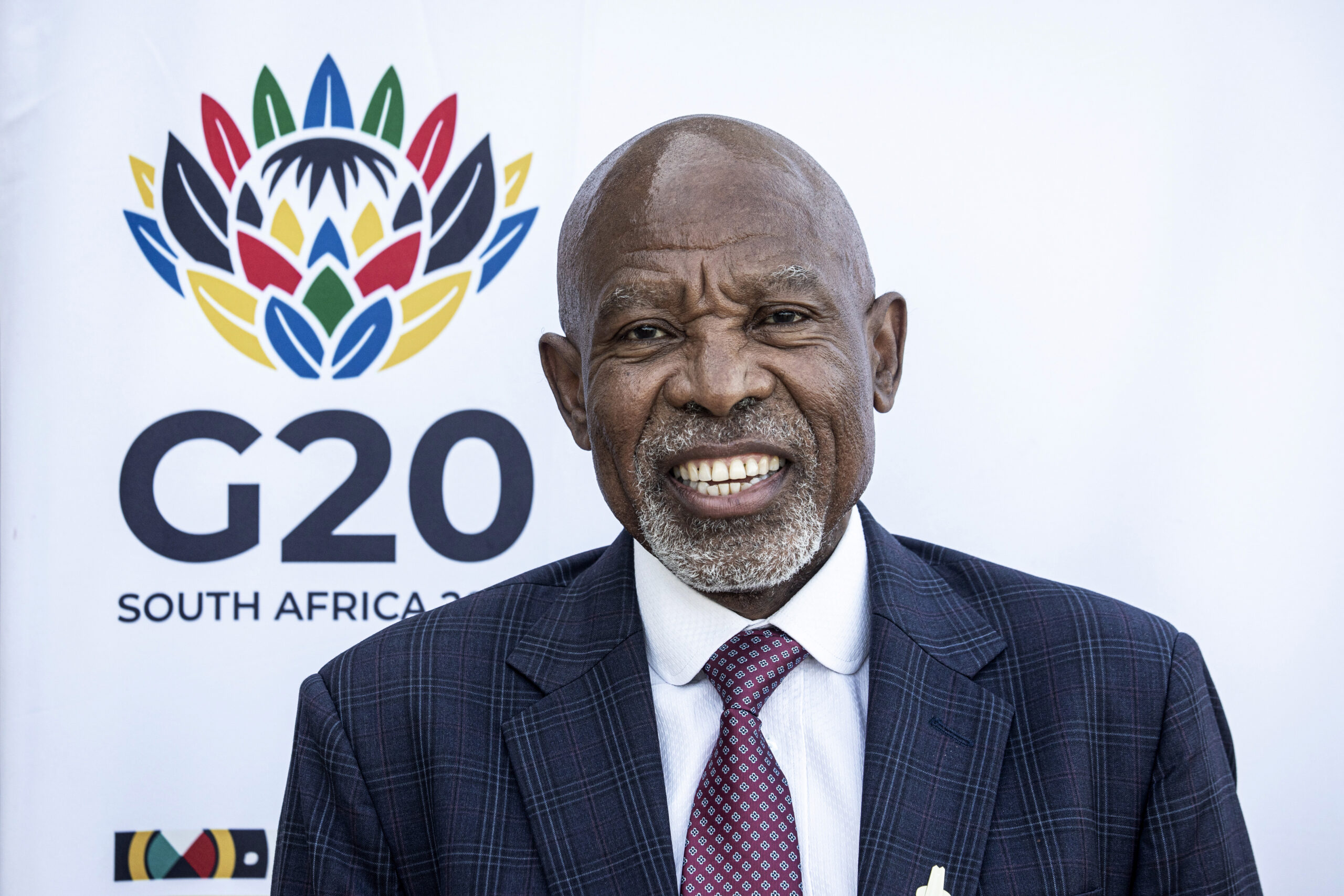
South African Reserve Bank Governor Lesetja Kganyago has come under sharp criticism over the country’s struggling economy.
The exchange, initiated by Kamvelihle Goba, who describes himself as an ANC activist, unfolded at the Reserve Bank’s headquarters in Pretoria this week.
Kganyago and his team were presenting the Monetary Policy Review for October before a near-capacity audience that included various stakeholders, including economists and students, when a tense question-and-answer session drew widespread attention.
Heated start to exchange
The drama began when Goba felt that Kganyago was overlooking him during the Q&A session.
“Please governor, I have already stood up, please note me governor because I need to be noted,” shouted Goba as he rose to his feet, immediately drawing the attention of the audience.
“No, no, no, please… if you are standing and shouting like that, you are leaving the microphone. I can’t hear you,” Kganyago responded, prompting laughter from those gathered in the auditorium.
“Press the microphone so that you can ask your question,” said a smiling Kganyago.
Goba replied: “Thank you governor for the second time… the last time I saw you…”
Brief clash over introductions
Before Goba could continue, Kganyago interrupted.
“Name? I meet people and, but you know I have a little bit of grey hairs and I forget a lot,” he said.
Goba attempted to continue: “I’ll be short governor, can I finish, you’ll enter, please?”
“Your name please, I am saying your name?” Kganyago insisted, asking him to identify himself.
Goba guns for inflation targeting
Goba then launched into a lengthy critique of the Reserve Bank’s monetary policy framework.
“I’m saying governor, don’t you think the fact that the SARB has been pursuing inflation targeting and only price stability as a framework in a country where it is the most unequal society in the world, where unemployment is ravaging… it’s nice when you say if and maybe you meet in six weeks and resolve issues.
“Our poverty is not punctuated, we don’t have that luxury of saying next week we don’t have money for food or transport because since we’ve been pursuing this inflation targeting framework since 1994, the lives of our people are getting worse.
In South Africa, electricity prices have gone up shockingly, fuel is not something that is easily affordable.
“Don’t you think it’s time we had an honest conversation about the private shareholding of the Reserve Bank and actually nationalising it to force it to pursue a dual mandate of targeting unemployment?”
“It doesn’t make sense that you have a R5-trillion economy and the SARB, which is the central bank, can still preside over a situation where students cannot afford to go to school because wealth distribution patterns do not favour the majority of this country.
“Don’t you think it’s an anomaly because South Africa is one of the few countries in the world, one of only eight central banks, that is not state-owned? The Bank of England was nationalised after 1946, and the Bank of France was also nationalised.
“Don’t you think that for us to escape this horror show, where wealth remains in the hands of a few and poverty still has a face that looks like me and you, we need to move beyond a situation where just six people and a handful of others are presiding over a majoritarian crisis that cannot be controlled?
“Our people are feeling the pinch now, and the middle class, which forms the majority, is shrinking and shrinking.”
“What is your question?”
At that point, Kganyago interrupted.
“It sounds like you are making your own presentation. What is your question?”
Goba responded:
“The question is: don’t you think it’s time to do away with inflation targeting as a framework, and actually pursue unemployment and inflation targeting as a joint mandate so that we also cushion those who can’t cushion themselves?
“Currently, this framework favours big businesses, large industries and holders of major capital assets. Thank you.”
Kganyago defends the Reserve Bank
Responding to Goba’s criticism, Kganyago dismissed the suggestion that South Africa’s economy had been failing continuously since 1994, saying such views reflected a misunderstanding of economic history.
“Because in the period from 1994 until the onset of the global financial crisis, this economy was growing,” he said.
“Shall I say to you, inflation targeting was not introduced in 1994. Inflation targeting was only introduced in 2000. And we’ve got evidence that shows that since the introduction of inflation targeting, at least up until 2009, this economy grew faster than before the introduction of inflation targeting.
“Inflation was lower than before inflation targeting, it was less volatile, and growth was also less volatile.”
Growth and employment before financial crisis
Kganyago pointed to economic performance in the years before the 2008 global financial crisis.
“Shall I remind you that from 2001 until the global financial crisis, this economy was growing at its fastest? At one stage we even reached a growth rate of 5.5%.
“And guess what happened during that period? For every one percent growth in economic activity, we were creating jobs at a rate of 0.6%.
“If you want to find fault with policies, you can’t say the fault was because we introduced inflation targeting.”
Blaming bad policy choices
Kganyago argued that South Africa’s sluggish growth after 2008 was driven by the global financial crisis and poor policy decisions.
Read more: Higher-denomination notes won’t solve inflation, Lesetja Kganyago tells shareholders
“We spent money pretending that we were richer than we actually were.
“We took the debt-to-GDP ratio of this country from 22% to above 70%. We made those choices. So don’t turn around and say the problem is the central bank.”
Nationalisation debate returns
Addressing calls to nationalise the Reserve Bank, Kganyago described the issue as a recurring and largely settled debate.
“It doesn’t matter how much information you provide, the zombie just keeps on coming back,” he said.
He added that the nationalisation conversation had originally been driven by foreign shareholders who stood to profit from the state’s acquisition of the central bank.
Unemployment is structural problem
Kganyago concluded by arguing that South Africa’s inequality problem is rooted primarily in unemployment rather than income differences among those who are employed.
“The reason for income inequality in South Africa is not that some people earn low incomes and others earn high incomes.
“It’s because there are people who are earning and people with no income because they are unemployed.
“The unemployment problem is structural in nature and therefore requires structural policies. You are not going to keep beating the central bank and hope that you can create employment.”
Read more: Kganyago blasts ‘seasonal’ SARB nationalisation push
- Lesetja Kganyago, Governor of the South African Reserve Bank (SARB), faced criticism from ANC activist Kamvelihle Goba over the Bank's inflation targeting policy during the Monetary Policy Review in Pretoria.
- Goba argued that SARB's focus on inflation targeting since 1994 has worsened inequality and proposed nationalising the Reserve Bank to include unemployment targeting as a dual mandate.
- Kganyago defended inflation targeting, stating it was introduced in 2000 and contributed to lower, less volatile inflation and faster economic growth before the 2008 financial crisis.
- Kganyago attributed post-2008 economic challenges to the global financial crisis and poor fiscal decisions, not the Reserve Bank's policies, and dismissed nationalisation calls as a recurring, settled debate.
- The Reserve Bank Governor highlighted that South Africa's inequality stems mainly from structural unemployment, currently at 33.6% in Q2 2026, rather than income disparities among employed individuals.


