


MTN is scaling its fintech operation, repositioning it from a mobile money service into a fully-fledged digital financial ecosystem as it targets a 50 million growth in customers.
The shift comes as the group scales its popular MoMo platform, which has become one of the continent’s largest fintech businesses, processing transactions worth $500-billion and handling 23.3-billion transactions since inception.
Speaking at the company’s Capital Markets Day, MTN Fintech CEO Serigne, Dioum said they have identified a huge gap as more than 90% of payments on the continent are still in cash, while at least 4% of adults have access to formal credit.
He said MTN MoMo had evolved since its 2009 launch and has expanded into merchant payments, banktech and application programme interface – a set of rules and protocols that allows different software applications to communicate with each other.
MTN’s fintech operation serves 69.5 million monthly active users across 14 markets, but is dwarfed by competitor Vodacom’s Safaricom and Mpesa, which reached a combined 103 million users.
Dioum said they were aiming to increase the number monthly active Momo users by between 40-million and 50-million, double its merchant base and increase the contribution of advanced services including lending, insurance and wealth products from 34% of revenue to more than 50%.
As more Africans start owning smartphones, Dioum said the company is building a platform that integrates payments, lending, e-commerce and financial services into a single digital environment. It has also partnered with Ant Group’s Alipay+, which was spun out of Chinese e-commerce giant Alibaba and has 1.3 billion users worldwide.
“This partnership marks an important milestone in our ambition to help shape Africa’s digital financial future through our One Big Tech strategy,” said Dioum .
Targeting at least 20 million new users in Nigeria alone, MTN and Alipay will introduce a super-app in Africa’s most populous country, which combines payments, savings and lifestyle services in one place. It is also expected to improve security, speed and user experience.
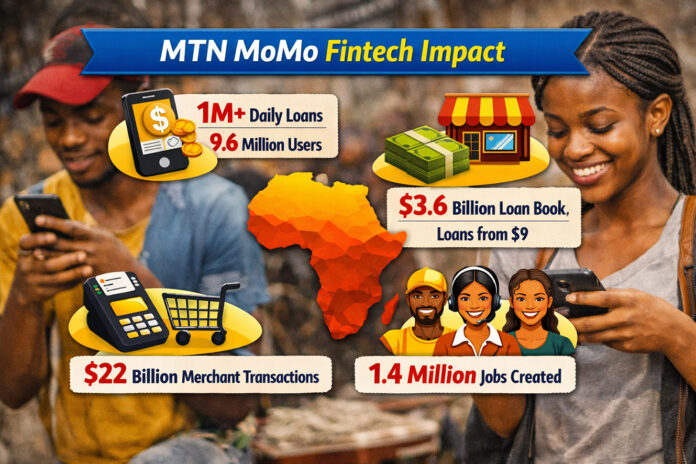
Dioum said MoMo disburses one million plus daily loans to 9.6-million users, with loan sizes as little as $9, targeting underserved consumers and small businesses, and growing its loan book to $3.6-billion. It has processed $22 billion in gross merchant transactions and created 1.4 million jobs through its network.
Ralph Mupita, MTN Group president and CEO, said the partnership with Alipay supports the goal of expanding digital inclusion and economic participation across Africa, while positioning MoMo as a next-generation fintech platform for consumers and businesses. “This partnership aligns with MTN Group’s ambition of leading digital solutions for Africa’s progress by leveraging scale, technology and strong global partnerships.
“It reflects our commitment to transforming the customer experience at scale by delivering a more seamless, secure and intuitive MoMo platform that expands economic participation.”
- MTN is transforming its MoMo platform from a mobile money service into a comprehensive digital financial ecosystem, targeting an increase of 40-50 million monthly active users across 14 African markets.
- MTN’s MoMo has processed $500 billion in transactions and currently serves 69.5 million users, aiming to double its merchant base and boost advanced service revenues (lending, insurance, wealth products) from 34% to over 50%.
- The company is collaborating with Ant Group’s Alipay+ to launch a super-app in Nigeria, integrating payments, savings, and lifestyle services, targeting at least 20 million new users in Africa’s largest economy.
- MoMo currently disburses over one million daily loans to 9.6 million users, focusing on underserved consumers and small businesses with a loan book of $3.6 billion and has generated 1.4 million jobs through its network.
- MTN’s partnership with Alipay+ aligns with its One Big Tech strategy to enhance digital inclusion, improve user experience, and position MoMo as a next-generation fintech platform driving Africa’s economic participation.


