


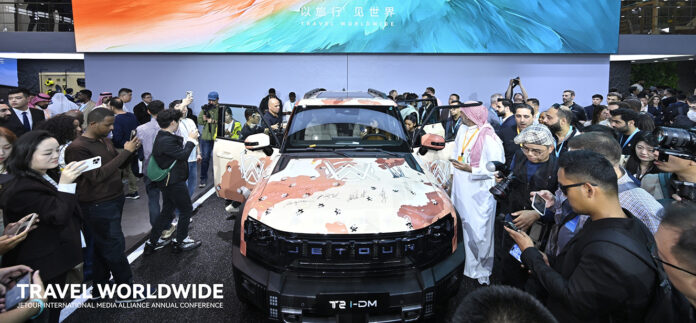
I travelled to Beijing to attend Auto China 2026 and Jetour’s Media Alliance (JMA) annual conference, invited by Jetour South Africa. This trip provided a unique perspective on the future of the global automotive industry and its implications for South Africa.
At JMA, Jetour unveiled its “Travel+” global strategy, signalling the next phase of its rapid international expansion and sharpening its ambitions in markets such as South Africa and the broader African continent. Central to this is a dual-brand approach that brings together Jetour and Soueast under a unified vision, with Soueast earmarked for a local debut in 2027.
Jetour’s ambition is already translating into a tangible investment in South Africa. The confirmation that the Jetour T-Series will be produced at the Rosslyn plant – acquired from Nissan by its parent company, Chery Holding International – marks a shift in the country’s manufacturing narrative.
Sunday World Motoring previously reported that by mid-2027, the facility aims to produce up to 50 000 units annually while retaining more than 3 000 jobs across manufacturing and the broader supply chain. In a country grappling with industrial stagnation and unemployment, this news is no small
development.
Beyond the Jetour story, Auto China 2026 itself underscored the sheer scale and momentum of China’s automotive dominance. With 380 000m2 of exhibition space and more than 1 400 vehicles showcased, including over 180 global debuts and 70 concept vehicles, it has become the industry’s most important global stage – not just in size, but in influence as well.
What is happening in China is not merely about scale – it is about speed, integration and intent. Auto China has evolved into a critical platform where global automakers converge not just to showcase products but to recalibrate strategies. Today, Beijing is increasingly setting the direction for the industry, making it a barometer of its future.
For South Africa, the implications are profound as Chinese brands already account for an estimated 40% of local vehicle sales. Having established themselves in the mainstream segment, these manufacturers are now focusing on the premium and luxury space, a territory traditionally dominated by legacy players like BMW, Mercedes-Benz and Volkswagen.
These incumbents were present in full force in Beijing, showcasing expansive displays and unveiling China-specific innovations alongside over a dozen global debuts. However, the competitive gap is narrowing.
Juergen Reers, senior managing director at Accenture and global lead for automotive and mobility reflected on the shift.
“It’s less about what sets individual models apart, from design to battery capacity, and more about how features once reserved for high-end vehicles are now filtering into mainstream models. This is the democratisation of features.”
Reers noted that advanced driver assistance systems, AI-powered interfaces and intelligent cabin technologies – once the preserve of premium brands – are rapidly becoming standard across price points. This raises uncomfortable questions for traditional luxury marques: if technology is no longer a differentiator, what justifies a premium price?
Volkswagen Group, widely regarded as the most assertive foreign player at the show, signalled its intent to regain ground in China with its largest-ever electric vehicle (EV) offensive, including four world premieres and plans for more than 20 new energy vehicles (NEVs) in 2026. It is a bold response, but one that underscores the pressure legacy brands are under in a market they can no longer afford to lose.
Perhaps most telling, however, was the growing influence of technology companies.
South Africa’s own industry leadership was present to witness these shifts first-hand.
Naamsa, the automotive business council’s interim CEO, Shinny Gobiyeza, led a multi-stakeholder study tour to Beijing, engaging Chinese industry leaders to extract lessons on localisation, skills development, and NEV adoption in line with the South African Automotive Masterplan (SAAM 2030).
“This collective representation reflects a unified commitment to advancing South Africa’s automotive sector through strategic collaboration, industrialisation and innovation.”
Crucially, Naamsa emphasised that China’s leadership in NEVs and advanced manufacturing presents a unique opportunity not just to observe but also to participate. That may well be the defining takeaway from Beijing.
- Attended Auto China 2026 and Jetour’s Media Alliance (JMA) annual conference in Beijing.
- Invitation extended by Jetour South Africa.
- Gained insights into the future of the global automotive industry.
- Explored the potential impact of global automotive trends on South Africa.
- Full article available in the e-edition of Sunday World via the provided link.


