


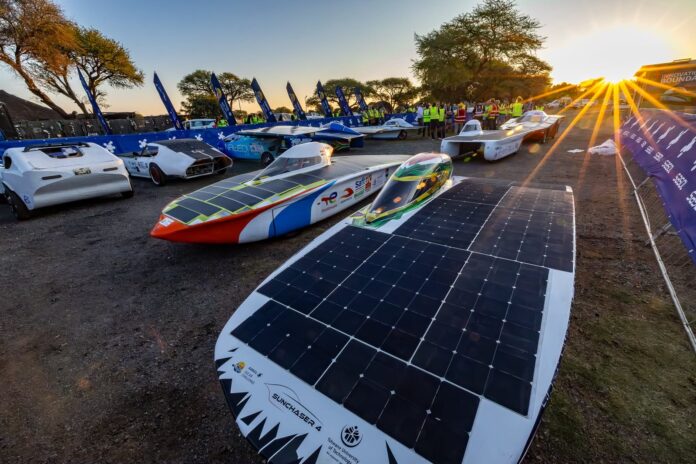
Ten teams of engineers, students and technology enthusiasts set off from Sasolburg, Free State, last Thursday for an eight-day test of solar power, engineering ingenuity and endurance that could offer a glimpse into the technologies underpinning the cars of tomorrow.
The ninth edition of the biennial Sasol Solar Challenge started at Boiketlong in Sasolburg, with teams embarking on a journey across South Africa before reaching the official finish line in Franschhoek, Western Cape, on September 17.
While the sight of futuristic, knee-high solar cars travelling on South Africa’s public roads makes for an unusual spectacle, the competition is about considerably more than covering kilometres. It serves as a rolling laboratory in which engineers test technologies ranging from highly efficient solar panels and electric motors to batteries, lightweight materials, aerodynamics and sophisticated energy-management systems.
READ: Record EV turnout signals changing face of Festival of Motoring
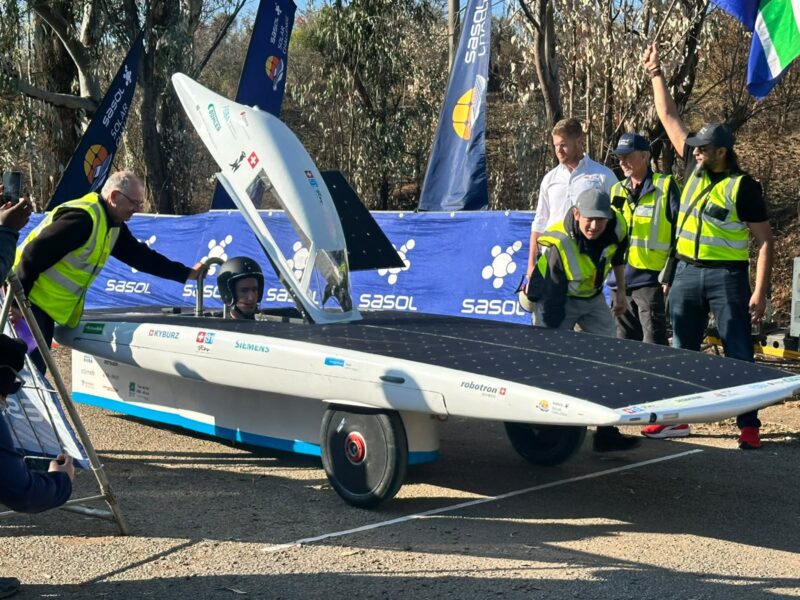
This year’s field comprises 10 local and international teams, including Team AgniRath from the Indian Institute of Technology Madras and Switzerland’s Solar Energy Racers with its SER6 challenger. South African universities are strongly represented, including North-West University, Tshwane University of Technology (TUT), Unisa’s College of Science, Engineering and Technology and the Central University of Technology’s Team Seilatsatsi. Other entrants include SolarFlair with its Razr solar car, sustainable mobility engineering team EVNXT and Mpumalanga’s Carpe Diem team.
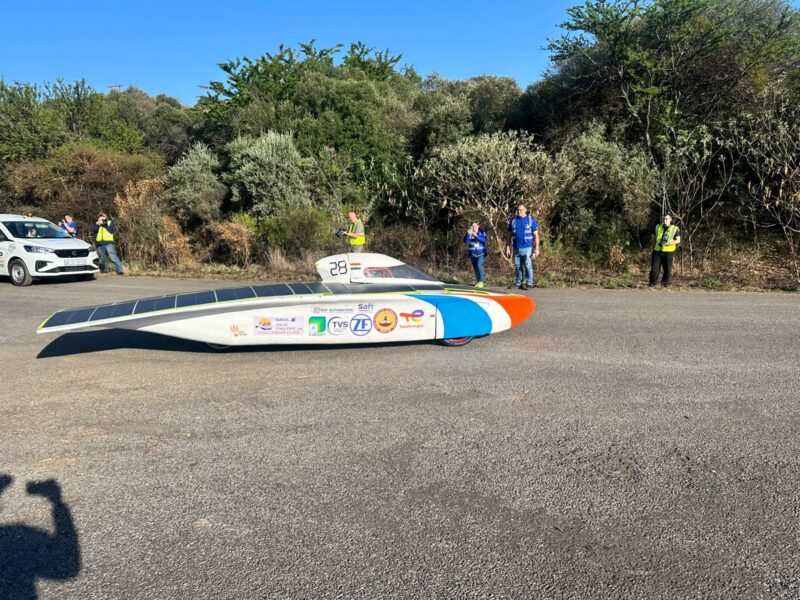
Perhaps one of the most significant entries, however, is Genuine JV, the only high-school team in this year’s competition. Its students, teachers and parents have worked together to build a solar-powered vehicle from scratch – putting school pupils alongside university engineering students and international competitors in a real-world technology challenge.
TUT, meanwhile, is competing with its SunChaser IV with backing from Ford Motor Company of Southern Africa. The manufacturer described the project as demonstrating “resilience and resourcefulness” and an example of what the future of local engineering could look like, saying its involvement was intended to support education, engineering and opportunities for young South Africans.
The first South African Solar Challenge was held in 2008. The competition has since attracted participants from countries including Japan, the Netherlands, Hong Kong, Hungary, Poland and Turkey, although the 2020 event was cancelled because of the COVID-19 pandemic.
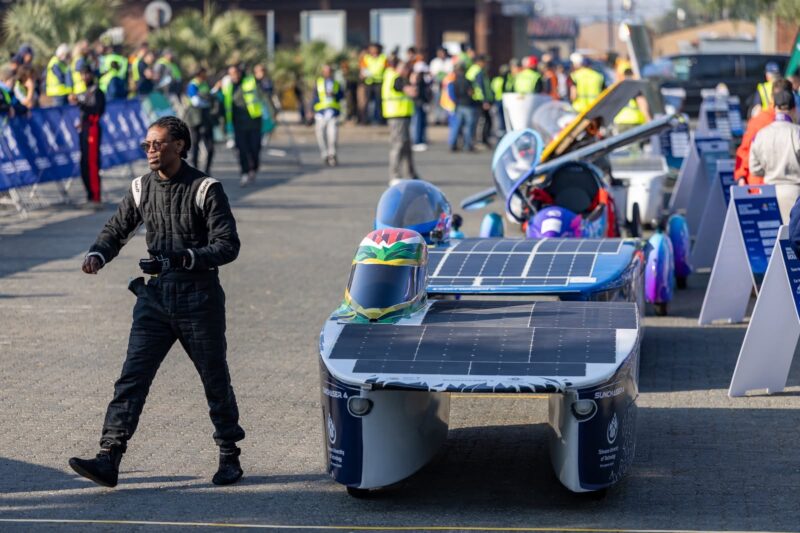
Solar racers competing in previous editions have covered more than 2,000km, but distance alone does not adequately describe the difficulty. Unlike vehicles circulating on a controlled racetrack, the solar cars share public roads with trucks, cars and other traffic while passing through towns and communities.
Teams also have to contend with South Africa’s dramatic variations in climate and geography. Baking sunshine can rapidly give way to storms and high winds, while road surfaces and elevations change throughout the journey. That unpredictability is partly what has made the South African event attractive to international competitors. It also places extraordinary emphasis on efficiency. Almost every component is purpose-built, from carbon-fibre structures and aerodynamic cockpits to electronics, batteries and electric drivetrains. Some university teams internationally have developed electric motors capable of efficiencies approaching 98%.
That research has relevance well beyond solar racing. Solar cars are ultimately electric vehicles, albeit highly specialised ones. Lessons learned through competitions such as this can contribute to advances in battery management, solar-cell efficiency, electric motors, composite materials and vehicle energy-management software.
These technologies are becoming increasingly relevant as the global automotive industry transitions towards electrified mobility.
South Africa is already seeing an intersection between renewable energy and electric transport. Privately developed solar-powered, off-grid EV charging stations, including those being rolled out by Zero Carbon Charge, demonstrate one potential application of combining renewable electricity generation with mobility infrastructure.
READ: ‘Game-changing’ solar-powered EV charging network set up along busy N3
Headline sponsor Sasol says its involvement should similarly be viewed within the broader energy transition. “As one of South Africa’s largest private procurers of renewable energy, Sasol is actively investing in renewable power and exploring pathways that support a lower-carbon future,” said Grace Nndwammbi, Sasol’s Senior Vice President for Corporate Affairs.
Nndwammbi said the challenge provided a platform to demonstrate renewable energy in practice while developing technical skills that could contribute to tomorrow’s economy.
“Importantly, the challenge is not about choosing between today’s needs and tomorrow’s solutions,” she said. “It is about fostering the innovation, curiosity and technical capability that will enable future generations to solve increasingly complex energy challenges.”
For spectators lining the route, the solar racers may resemble machines from a distant future. But as electric vehicles become more commonplace and renewable-energy technology improves, some of the engineering being tested between Sasolburg and the Western Cape could eventually migrate into mainstream vehicles.
The bigger question is whether one of the young South African engineers competing this week might ultimately take the concept further. After nearly two decades of local solar racing, the next compelling challenge may be not simply building a car capable of winning an endurance competition, but developing South African technology that helps make solar energy a practical part of everyday electric mobility.
- The ninth edition of the biennial Sasol Solar Challenge started last Thursday from Sasolburg, Free State, with ten teams competing in an eight-day solar-powered vehicle race across South Africa, finishing in Franschhoek, Western Cape, on September 17.
- Competing teams include local universities such as North-West University and Tshwane University of Technology (TUT), international participants like Team AgniRath from India, and the only high-school team Genuine JV.
- The event tests technologies like solar panels, electric motors, batteries, lightweight materials, aerodynamics, and energy-management systems on public roads with varying South African weather and terrain conditions.
- Tshwane University of Technology is supported by Ford Motor Company of Southern Africa, which cited the challenge as a demonstration of local engineering resilience and support for education and young South African talent.
- Sasol, the headline sponsor, emphasizes the event's role in promoting renewable energy innovation and skills development for a lower-carbon future and the broader energy transition.


