


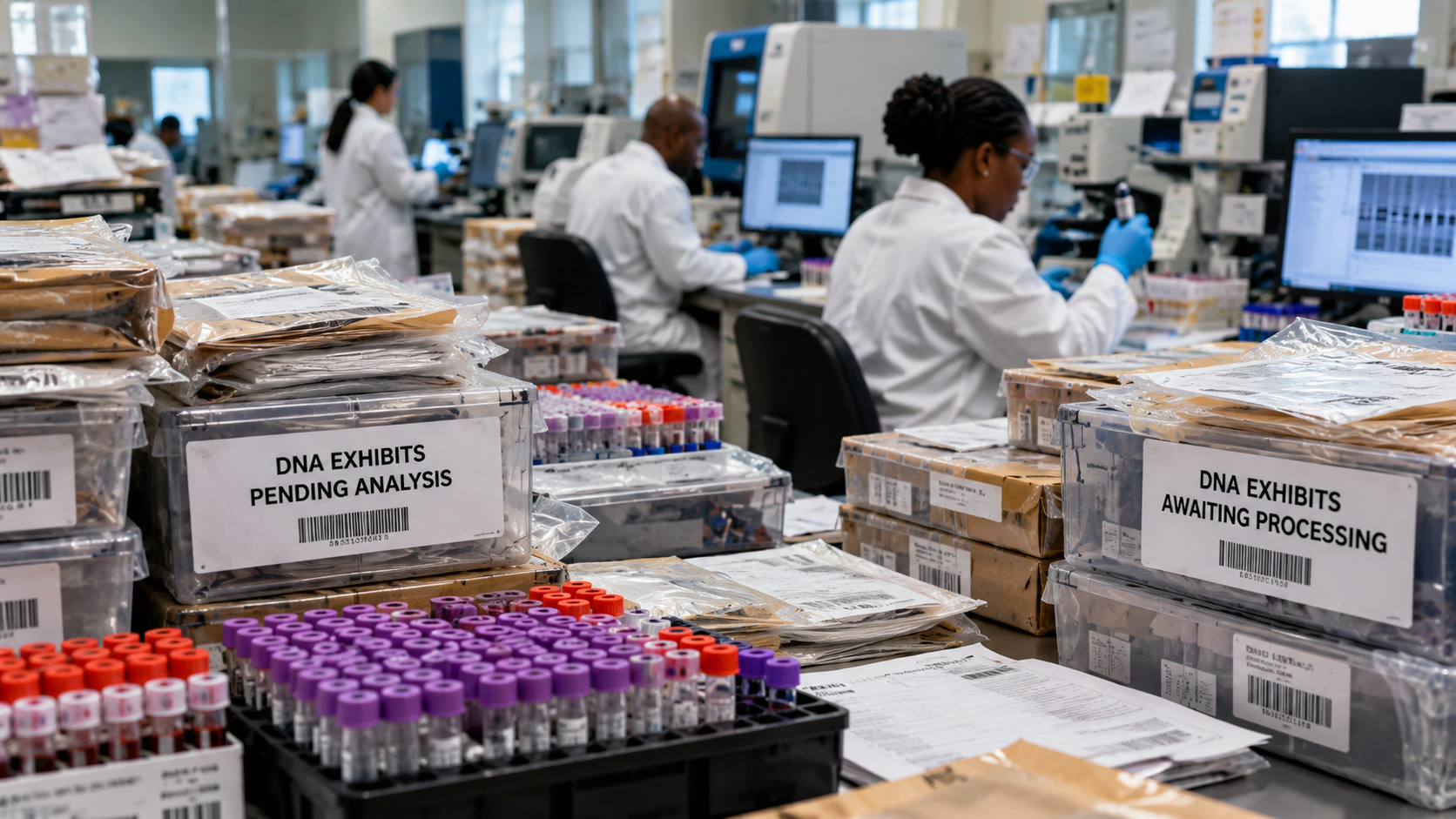
President Cyril Ramaphosa has given police 60 days to produce a plan to tackle South Africa’s forensic backlog as more than 228,000 DNA exhibit entries have already exceeded prescribed processing timelines.
The directive comes as a national inquiry probes allegations that one of the major obstacles may already be known – procurement failures involving basic materials forensic laboratories need to produce DNA profiles.
Official figures disclosed in a parliamentary reply in July showed that the South African Police Service (SAPS) had 298,710 DNA exhibit entries on hand, of which 228,017 had exceeded prescribed processing timelines.
READ MORE: SAPS forensic laboratories clearing backlog, says Cele
Unawarded tenders for basic materials, unsustainable emergency quotation process
Forensic DNA specialist Dr Vanessa Lynch has now placed procurement squarely under the spotlight in a submission to the Joint National Inquiry into the criminal justice system’s response to gender-based violence and femicide (GBVF).
Lynch is regional director for Africa at DNA for Africa and founder of The DNA Project. She previously served as deputy chair of the inaugural National Forensic Oversight and Ethics Board, which monitored the first five years of implementation of the DNA Act.
Her submission alleges that tenders for critical reagents and consumables have in some instances remained unawarded for about a year.
Without those contracts, Lynch said laboratories have resorted to emergency quotation and purchase-order processes capped at R1-million, with each taking approximately 12 weeks to approve.
“An order arrives, a limited number of cases is run, and the laboratories wait for the next approval. It is not a system. It is triage, repeated every three months,” she said.
During Tuesday’s inquiry proceedings, Advocate Sphezulu Zulu put the procurement question directly to the SAPS, asking the service to identify DNA-analysis consumable tenders that had been delayed, cancelled, expired or remained unawarded over the past five years and explain the reasons.
He prefaced the question by referring to concerns raised in Lynch’s submission.
The inquiry subsequently confirmed to Lynch that her submission had introduced a dimension not previously reflected in its presentation and that no other submission had raised those particular concerns.
SAPS undertook to provide additional procurement records, including information on unsuccessful bids and reasons for their outcomes. The inquiry will analyse the records once received.
Ramaphosa orders 60-day forensic plan
The developments came on the same day Ramaphosa ordered Acting Police Minister Firoz Cachalia, the national police commissioner and forensic authorities to present a funded plan within 60 days to reduce forensic backlogs.
The plan must establish the size and age of the backlog, shortages of personnel and equipment, resources required and dates by which the backlog will be reduced.
Ramaphosa also ordered that priority forensic samples involving the rape or murder of women and children be ring-fenced for urgent processing.
READ MORE: Ramaphosa announces list of interventions targeting GBV
Lynch argues that South Africa does not require new legislation or science to solve the problem.
Her submission recommends awarding outstanding tenders and service contracts, allowing accredited private and academic laboratories to conduct casework and database analysis, and publishing monthly laboratory throughput and turnaround times.
She also cautioned against treating outstanding buccal samples used for the DNA database as irrelevant to GBVF casework.
An unanalysed profile cannot be loaded and searched against the national database, Lynch said, potentially preventing police from connecting apparently unrelated crimes to serial offenders.
Her submission cites an Ekurhuleni serial rape investigation involving 97 rape-related incidents, 49 of which were connected through DNA database matches.
“The only thing now standing between an unidentified offender and his identification may be an unawarded tender and a purchase order awaiting approval,” Lynch said.
‘Women do not have another 60 days’
Women For Change operations and advocacy manager Merlize Jogiat said Ramaphosa’s announcement did not yet amount to the action activists had been demanding.
“I welcome the President’s acknowledgement that government has not done enough, but women cannot be protected by speeches and deadlines alone,” Jogiat said.
She said GBVF was declared a national disaster in November 2025, yet ten months later, government was announcing further audits, plans and reports about longstanding problems.
“What was still missing last (Tuesday) night was a transparent, fully costed implementation plan and a dedicated national disaster budget. Without that, this is more planning, not implementation.”
READ MORE: Women change profile pictures to colour purple in protest against GBV, femicide
Jogiat said the 60-day countdown should not become an achievement in itself while conditions remained unchanged for victims.
“Women do not have another 60 days. Some of them do not even have hours,” she said.
She said government should publicly disclose measurable results, including forensic samples processed, arrests, stalled cases returned to court, prosecutions, convictions, departmental allocations and actual expenditure.
“Women need implementation, accountability and measurable results. Anything less will be another failure dressed up as progress.”
- President Cyril Ramaphosa has ordered the South African Police Service to produce a funded plan within 60 days to address the forensic backlog, which includes over 228,000 DNA exhibit entries exceeding processing timelines.
- Forensic specialist Dr. Vanessa Lynch criticized procurement failures, noting that tenders for critical DNA testing materials have sometimes gone unawarded for about a year, forcing labs to rely on slow emergency purchasing processes.
- The national inquiry into gender-based violence and femicide has requested procurement records from SAPS, including details of delayed or unawarded DNA-analysis consumable tenders over the past five years.
- Ramaphosa directed that forensic samples related to rape or murder of women and children be prioritized for urgent DNA processing in the new backlog reduction plan.
- Advocacy groups such as Women For Change have called for immediate implementation, transparency, and measurable results, warning that victims cannot wait 60 days for action on forensic backlogs.


