


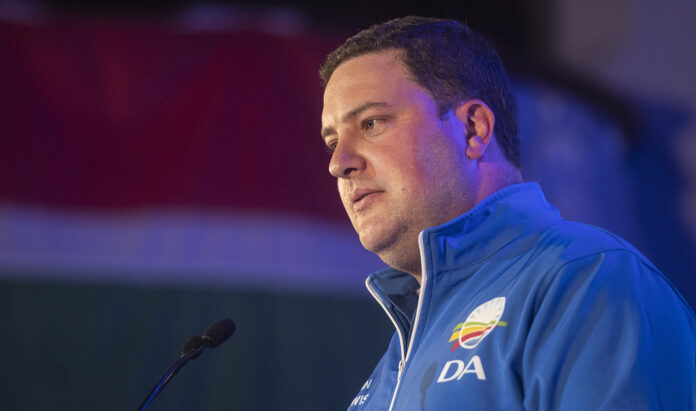
The African National Congress (ANC) has launched a blistering attack on the Democratic Alliance (DA) after the party sought to reorganise its representatives in the Government of National Unity (GNU). The ANC has accused its coalition partner of hypocrisy, constitutional opportunism, and using key economic portfolios as pawns in internal political battles.
The ANC’s extraordinary rebuke follows the DA’s announcement that it wants changes to its deployment in President Cyril Ramaphosa’s cabinet. This move has reignited tensions inside the fragile GNU and raised questions about the boundaries of power-sharing in South Africa’s coalition era.
The controversy stems from a proposal unveiled by new DA leader, Geordin Hill-Lewis, this week, in which the party requested changes to its representation in the GNU.
Coalition partners’ powers in question
Among the most notable proposed changes is the redeployment of former DA leader and Agriculture Minister John Steenhuisen from Cabinet to a deputy minister position, alongside a broader reconfiguration of the party’s ministers and deputy ministers.
The proposed shake-up has drawn widespread attention because cabinet appointments and dismissals remain the constitutional prerogative of the president.
While GNU parties are expected to nominate candidates for positions allocated to them, the DA’s decision to publicly announce its preferred changes has fuelled debate about the extent to which coalition partners can influence the composition of the executive.
The developments also revive tensions that surfaced last year when the DA publicly challenged Ramaphosa following the dismissal of former deputy minister Andrew Whitfield and demanded action against several ANC ministers facing allegations of misconduct.
At the time, the president rejected what was widely seen as an ultimatum from his coalition partner, insisting that executive appointments and removals fell within his constitutional authority.
‘Uncomfortable contradiction at heart of DA politics’
In a strongly-worded statement issued on Wednesday, ANC acting national spokesperson Nonceba Mhlauli said the DA’s conduct exposed “an uncomfortable contradiction at the heart of the DA’s politics”.
“This is the same party that constantly claims to be the champion of constitutionalism but has repeatedly attacked, questioned, and undermined President Cyril Ramaphosa whenever he exercises powers expressly entrusted to him by the constitution,” Mhlauli said.
The ANC’s intervention comes against the backdrop of a long-running dispute between the two parties over executive authority.
Last year, the DA publicly challenged Ramaphosa following the removal of one of its deputy ministers and demanded action against several ANC ministers facing controversy, a move widely viewed as an attempt to influence presidential powers.
Now, the ANC argues, the DA wants South Africans to accept its own deployment decisions without scrutiny.
“Yesterday (Wednesday) we saw the DA make public announcements presented as a directive to the president and expect South Africans to quietly accept its own deployment decisions without question,” Mhlauli said.
“This selective respect for the Constitution reveals a party that embraces constitutional provisions when they advance its interests and resists them when they do not benefit them.”
DA’s commitment to GNU principles
The governing party also questioned the DA’s commitment to the principles underpinning the GNU, warning that coalition partners cannot selectively recognise constitutional provisions while claiming loyalty to the power-sharing arrangement.
“One cannot claim commitment to the GNU while selectively recognising only those constitutional provisions that advance narrow party political interests,” Mhlauli said.
The ANC went further, using the controversy to attack the DA’s broader political philosophy and opposition to transformation policies.
According to Mhlauli, the blue party’s latest manoeuvres expose the weakness of its long-promoted “Open Opportunity Society for All”.
“The DA seeks support from black communities across South Africa and speaks endlessly about equal opportunity but does not reflect this anywhere,” she said.
“South Africans recognise that there can be no equal opportunity between those who inherited privilege and those who inherited poverty and exclusion from years of colonialism and apartheid.”
ANC takes swipe at DA’s BBE stance
The ANC accused the DA of consistently opposing measures aimed at addressing historical inequalities, including broad-based Black economic empowerment.
Particularly striking was the ANC’s criticism of what it described as the DA’s willingness to use strategic economic portfolios as instruments of internal party politics.
“The Department of Trade, Industry and Competition (DTIC) is not just another government department to be exploited as a dumping ground for their under-performers or factional opponents,” Mhlauli said.
“The DTIC sits at the centre of industrialisation, localisation, investment promotion, economic transformation, job creation and inclusive growth.”
Only Ramaphosa has constititutional authority
As speculation swirls around possible changes to the DA’s cabinet contingent, the ANC said President Ramaphosa alone retains the constitutional authority to appoint and remove members of the executive.
Mhlauli said the ANC remains committed to working with all parties represented in Parliament but insisted that constitutional powers must be respected.
“The ANC remains committed to the transformative vision of building a united, non-racial, non-sexist, democratic and prosperous South Africa,” she said.
“We will continue advancing policies that expand opportunity, deepen inclusion and ensure that freedom has a meaningful impact in the lives of the people.”
Read More: President Ramaphosa warns GNU ministers to stop claiming party wins
- The African National Congress (ANC) has launched a blistering attack on the Democratic Alliance (DA) after the party sought to reorganise its representatives in the Government of National Unity (GNU).
- The ANC has accused its coalition partner of hypocrisy, constitutional opportunism, and using key economic portfolios as pawns in internal political battles.
- The ANC’s extraordinary rebuke follows the DA’s announcement that it wants changes to its deployment in President Cyril Ramaphosa’s cabinet.
- This move has reignited tensions inside the fragile GNU and raised questions about the boundaries of power-sharing in South Africa’s coalition era.
- The controversy stems from a proposal unveiled by new DA leader, Geordin Hill-Lewis, this week, in which the party requested changes to its representation in the GNU.


