


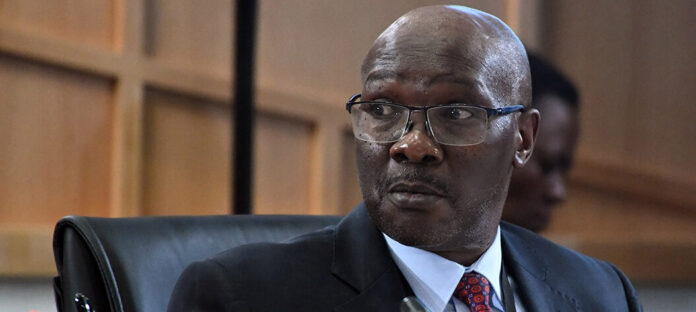
Investigating Directorate Against Corruption (IDAC) head Advocate Andrea Johnson on Tuesday amended a key portion of her 2025 statement before the Madlanga commission of inquiry, replacing an account that suggested crime intelligence head Lieutenant General Dumisani Khumalo was arrested as he was about to leave Johannesburg with an unknown date of return.
The amendment emerged as Johnson testified about IDAC’s investigation into alleged contraventions of the Prevention and Combating of Corrupt Activities Act (PRECCA), fraud and related offences.
Johnson refutes Khumalo was arrested in ‘dramatic fashion’
“The evidence before this commission is that Lieutenant General (Dumisani) Khumalo was arrested in a dramatic fashion. Nothing can be further from the truth,” Johnson said.
She told the commission Khumalo was arrested on June 26, by two IDAC investigators after arriving at OR Tambo International Airport.
Johnson was then taken through her original October 2025 statement, in which she had said investigators arrested Khumalo after discovering that he was about to leave Johannesburg.
“I do not remember what his alleged destination was. We also did not know when he was scheduled to come back. At the time, his co-accused persons had already been invited to come and report at the Brooklyn Police Station,” the original statement read.
Johnson requested that the passage be deleted and replaced with a revised version.
“Lieutenant General Khumalo was arrested after he had landed at Oliver Reginald Tambo International Airport. I do not recall where he was travelling from. I was informed that, at the time, his co-accused had already been invited to report to the Brooklyn Police Station.”
The amendment marked a significant change in her account, replacing an assertion that investigators acted because Khumalo appeared to be leaving Johannesburg.
Lawful and professional arrest
Johnson insisted, however, that the circumstances of the arrest remained lawful and professional.
“He cooperated and was taken there. There was nothing dramatic about it. He was not threatened and was accorded all the respect that could be accorded a person of his profile,” she said.
She added that investigators even stopped at a filling station to buy Khumalo a drink at his request before taking him to the police station.
According to Johnson, Khumalo later thanked the investigating officer for the respectful manner in which he and his co-accused had been treated.
“This talks to anything but the conduct of a unit that is motivated by ulterior motives, other than to address alleged criminality,” she said.
Johnson also rejected suggestions that Khumalo had been targeted because of his role in the Political Killings Task Team (PKTT).
False that Khumalo’s arrest linked to PKTT
“I would be remiss if I did not dismiss the suggestion that Lieutenant General Khumalo was arrested because he was the coordinator of the Political Killings Task Team. This suggestion is anything but true. It is false, as it is unfortunate.”
She added: “At no stage was I, as head of IDAC, aware that Lieutenant General Khumalo had anything to do with the PKTT, let alone being its convenor. In any event, even had I been aware of same, such would have been irrelevant because of the reasons for his arrest.”
Johnson told the commission that the Khumalo investigation had been referred to IDAC by Member of Parliament Fadiel Adams in terms of the National Prosecuting Authority legislation.
Commission chairperson Judge Mbuyiseli Madlanga questioned Johnson on the legal basis for transferring referrals from the head of IDAC to investigating teams.
Johnson conceded she could not immediately point to a legislative provision authorising the process, describing it instead as a practical administrative arrangement. She said IDAC had since developed a draft operational manual after becoming a permanent structure.
Johnson denies knowledge of O’Sullivan referral
Commissioner Advocate Sandile Khumalo then challenged Johnson’s evidence, noting that security investigator Paul O’Sullivan had previously testified that he referred the matter to IDAC in November 2024 and that the commission was also aware of a referral from then police minister Senzo Mchunu’s office during the same period.
“Which of the three came first, and you gave to the people below you who were supposed to look at it?” he asked.
Johnson denied any knowledge of a referral by O’Sullivan.
“I am unaware of any referral, with regard to this matter, from Mr O’Sullivan. I do confirm that the minister’s office did write a letter to us, but I cannot recall Mr O’Sullivan being involved with regard to this matter,” she said.
Under further questioning, Johnson conceded that the minister’s letter preceded the affidavit later submitted by Adams. She added that the South African Police Service had already opened four dockets relating to the matter, prompting IDAC to obtain the case files for further consideration.
ALSO READ: MKP challenges appointment of IDAC ombud over alleged political ties
- Advocate Andrea Johnson, head of IDAC, amended her 2025 testimony to clarify that Lieutenant General Dumisani Khumalo was arrested at OR Tambo Airport on June 26, not while leaving Johannesburg as originally stated.
- Johnson emphasized the arrest was lawful, professional, and respectful, with no dramatic or threatening conduct involved.
- She firmly denied claims that Khumalo's arrest was linked to his alleged role in the Political Killings Task Team, calling such suggestions untrue.
- The investigation into Khumalo was referred to IDAC by MP Fadiel Adams; Johnson could not initially cite legal provisions for case transfers within IDAC but mentioned a draft manual now exists.
- Johnson denied knowledge of a referral by security investigator Paul O'Sullivan, though she confirmed the police minister's office made a prior referral and police had opened multiple dockets on the matter.


