


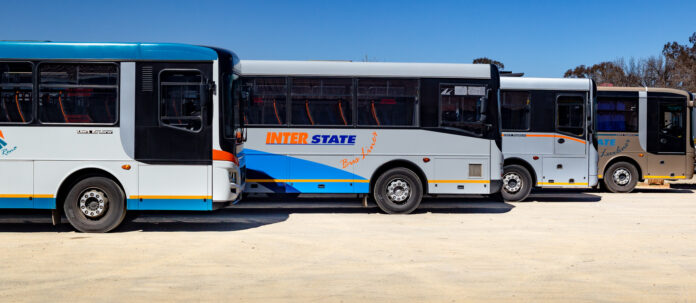
A bitter legal battle over subsidised bus services in the Free State is heading for the Supreme Court of Appeal (SCA), with two transport companies challenging what they describe as the government’s decades-long failure to subject the lucrative contracts to a fresh competitive tender.
Zeus Shuttles and Coaches and Lungi and Sons Services have been granted leave to appeal against a judgment of the Bloemfontein High Court dismissing their challenge to the continued contractual arrangements between the Free State government and Itumele Bus Lines (IBL), also known as Interstate Buses.
The companies argue that the dispute is not simply about one contract but about what they describe as the government’s prolonged failure to comply with constitutional and statutory procurement requirements. The appeal application was launched in June after judges Johannes Petrus Daffue and Joseph Mhlambi delivered judgment on May 18, 2026.
On September 18, the applicants were granted leave to appeal.
27-year-old bus tender under scrutiny
At the heart of the dispute is the continued provision of subsidised passenger bus services by IBL and its predecessors.
The applicants contend that the original tender dates back to the late 1990s and that the last proper competitive tender process took place about 27 years ago.
They argue that, instead of putting the services out to competitive public tender, government has continued the relationship through extensions and negotiated arrangements.
READ: Emerging bus operators seek share of transport subsidies
Their complaint is, therefore, not merely an attempt to cancel a specific contract awarded to IBL.
They argue that the high court failed to appreciate that their main case concerned what they called government’s “general dereliction” of its statutory duty to procure the services through a lawful process.
The companies further contend that the continued month-to-month extensions of IBL’s contract constitute a “continuing wrong” because government allegedly continues to procure the services without conducting a fresh competitive tender.
They argue that government failed to place sufficient evidence before the court explaining why it had not complied with the Constitution, the National Land Transport Act and other applicable legislation.
Companies challenge reliance on ministerial approval
Section 217 of the Constitution requires organs of state procuring goods or services to do so through a system that is fair, equitable, transparent, competitive and cost-effective.
The applicants argue that repeated extensions cannot automatically become lawful simply because they were authorised administratively or through a decision of the Minister of Transport or the Transport MinMec.
Their appeal specifically challenges reliance on a Minister and Members of Executive Council (MinMec) resolution approving the extension of existing subsidised bus contracts.
The companies argue that ministerial approval could not, on its own, cure an alleged failure to comply with constitutional and statutory procurement requirements.
They also challenge the high court’s approach to whether the conduct being challenged amounted to administrative action.
READ: Court interdicts Free State transport MEC Jabu Mbalula from blocking scholar buses
In their court papers, the applicants said their position was that government was effectively continuing to procure bus services every month through the extended arrangement and that these ongoing decisions were, therefore, subject to legality and administrative-law scrutiny.
A central issue in the appeal is what the applicants describe as government’s failure to explain why the arrangements have continued for so long.
Government accused of failing to explain delays
The companies argue that the high court recognised the absence of a proper explanation but nevertheless dismissed their challenge.
They say government should have been required to explain what steps had been taken to comply with the law, what obstacles had been encountered and why a new procurement process had not been completed.
The applicants say they had even considered seeking a structured interdict that would have required government to explain its position and take steps towards compliance.
They argue that the purpose of the statutory provisions governing extensions was to ensure continuity of public transport while government prepared a proper procurement process, not to allow interim arrangements to continue indefinitely.
Department’s own legal challenge dismissed
The bus tender dispute is complicated by a separate self-review application brought by the Free State Department of Community Safety, Roads and Transport.
The department, led by MEC Jabu Mbalula, sought to have the October 1, 2019, extension of IBL’s contract declared invalid and set aside.
It also sought an order declaring that it was not liable for payments made to IBL from November 1, 2019, together with audited financial statements showing the income and profits generated from the extended contract.
However, the department only launched its self-review application in September 2024 — about five years after the disputed extension.
The high court described the delay as “reprehensible”, while noting that legality reviews still have to be brought without undue delay.
READ: Accident between Interstate bus and truck claims seven lives
It stated that prolonged uncertainty over the legality of government decisions could prejudice parties who rely on those decisions and affect the functioning of government institutions.
The department’s own application was subsequently dismissed after it failed to file a replying affidavit and heads of argument and had no legal representation when the matter was called.
The judgment records that IBL’s legal representatives were present, while no one appeared for the department.
The court was told that the State Attorney had not received instructions to appoint counsel.
The self-review application was dismissed with costs, including the costs of two counsel.
Mangaung’s role raises public transport concerns
The high court also found that the Mangaung Metropolitan Municipality should have been joined to the proceedings because it had a direct and substantial interest in any order affecting bus services in its area.
The municipality is a contracting authority under the National Land Transport Act and would have played a role in arranging replacement services if IBL’s contract had been set aside.
This issue could become important if the appeal succeeds, given the potential impact on subsidised public transport in the province.
SCA to consider limits of contract extensions
The companies now want the SCA to determine whether the high court correctly interpreted the legal framework governing subsidised bus contracts and their extensions.
They argue that the National Land Transport Act permits certain negotiated or interim arrangements, but that such mechanisms cannot lawfully be used as a substitute for competitive procurement indefinitely.
The applicants argue that allowing such arrangements to continue indefinitely would undermine the constitutional principles governing public procurement.
The long-running battle will now move to the next level, with the SCA potentially having to decide how far government can go in extending old public-service contracts before the constitutional duty to conduct a fresh competitive procurement process takes over.
- Transport companies Zeus Shuttles and Coaches and Lungi and Sons Services have been granted leave to appeal to the Supreme Court of Appeal (SCA) against the Bloemfontein High Court's dismissal of their challenge to the Free State government's bus contracts with Itumele Bus Lines (IBL).
- The dispute centers on the continued provision of subsidised bus services by IBL based on a tender process last competitively conducted about 27 years ago, with ongoing month-to-month contract extensions instead of new competitive tenders.
- The applicants argue that government failed to comply with constitutional and statutory procurement requirements, including Section 217 of the Constitution, which requires fair, equitable, transparent, competitive, and cost-effective procurement systems.
- The Free State Department of Community Safety, Roads and Transport's self-review application challenging an extension of IBL's contract from 2019 was dismissed due to undue delay and a failure to provide necessary legal filings and representation.
- The high court found Mangaung Metropolitan Municipality should have been joined to the proceedings due to its direct interest in bus services, and the SCA will now consider the legal limits of contract extensions versus constitutional obligations for fresh competitive procurement.


