


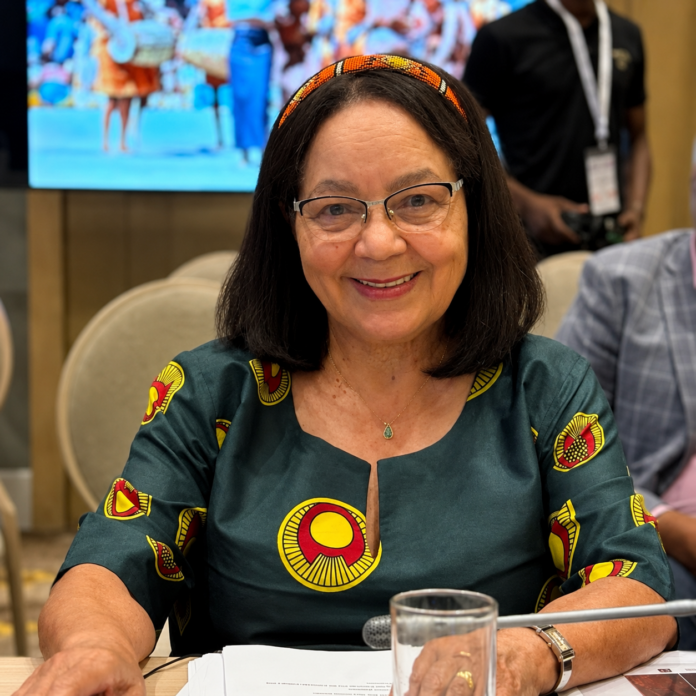
Patricia de Lille’s GOOD Party has been slapped with hefty fines after the Electoral Court found it failed to disclose a R900,000 donation used to bankroll T-shirts and other campaign material ahead of the 2021 local government elections.
In a bruising judgement handed down on Wednesday, the court rejected the party’s explanation of the money as “far-fetched and untenable” and found that property company Electrox Properties had effectively paid R900,000 towards GOOD’s election campaign expenses.
The Electoral Commission of SA hauled GOOD, its secretary-general Brett Herron, and several companies and individuals before the Electoral Court over the disputed payment.
The controversy dates back to August and September 2021, when GOOD purchased T-shirts and other political marketing material from Kairos Communications worth R1.97 million.
READ: Ramaphosa ordered to pay activists for 2024 political funding court battle
But R900 000 of that bill was not paid by GOOD.
The court found Electrox Properties paid the money on the party’s behalf, effectively making it a donation under political funding legislation.
Neither GOOD nor Electrox disclosed it to the Electoral Commission.
GOOD was consequently fined R50 000 for breaching section 9 of the Political Funding Act.
The party and Herron, its accounting officer, were also ordered to jointly pay another R40 000 for failing to properly account for the money.
Electrox was separately fined R40 000.
The judgement exposes an intriguing money trail involving campaign T-shirts, a whistleblower and R900,000 which moved between companies while apparently settling GOOD’s election bill.
The case began after former national organiser at the GOOD Party, Shaun August, approached the Electoral Commission in June 2023.
August, who had been responsible for negotiating the procurement of the campaign material, alleged GOOD had received sponsorship towards the material but failed to declare it.
Independent investigators were subsequently brought in.
Their investigation found Electrox paid R900,000 to Incorp Trade and Investment, described in the judgment as a sister company of Kairos.
Kairos nevertheless acknowledged the money and credited it against GOOD’s campaign-material bill.
Judge Leicester Adams said the evidence showed the T-shirts were delivered to GOOD and used during its 2021 campaign.
The court found:
“The simple point of this matter is that the GOOD Party received the donated t-shirts, which it did not itself pay for,”
GOOD disputed that it had received the R900,000 donation.
It argued, among other things, that the arrangement involved August and businessman Saravan Devaraj Govender rather than the party itself.
But the court found GOOD could not simply distance itself from August because he had been a senior party official responsible for purchasing its campaign material.
The court also noted Herron had been copied into much of the correspondence surrounding the R900,000 payment.
Another explanation was that Electrox’s payment related to tiles for a project in the Eastern Cape.
That version also failed to convince the judges.
Adams said the explanation “rings hollow”, while evidence offered to support the tiles’ version related to material purchased months after the R900,000 payment.
The judgement highlighted another glaring hole in GOOD’s defence: it could not demonstrate how it had paid for the campaign material itself.
READ: Probe flags R33m diverted MK Party funds
“What is conspicuously missing from the GOOD Party’s affidavits is an explanation of how it paid for the t-shirts worth R900 000.00 it received from Kairos Communications and proof of such payment,” the judgement reads.
The court found GOOD, Herron and Electrox had all breached their obligations under political funding legislation.
In determining the penalties, the court stressed that political funding transparency allows voters to know who bankrolls political parties and guards against donors later exerting influence over public representatives.
Significantly, Adams said the matter was more serious than an innocent administrative oversight.
“This is not a minor case where respondents may have overlooked their obligations and unwittingly contravened the Act,” he said.
According to the investigation report, Adams added, “it appears that there was a deliberate attempt to conceal the donation.”
The court said a strong message had to be sent that transparency in political funding was compulsory.
GOOD, Herron and Electrox were therefore hit with combined penalties totalling R130,000, although the R40,000 imposed on GOOD and Herron is joint and several.
Each party was ordered to pay its own legal costs.
- Patricia de Lille’s GOOD Party was fined R50,000 for failing to disclose a R900,000 donation used for campaign T-shirts and materials in the 2021 local elections.
- Electrox Properties paid R900,000 towards GOOD's campaign expenses without disclosure, leading to a R40,000 fine.
- GOOD’s secretary-general Brett Herron was fined jointly with the party R40,000 for failing to properly account for the money.
- The Electoral Court found that GOOD and associated parties deliberately concealed the donation, rejecting their explanations as implausible.
- The case originated after whistleblower Shaun August alleged undisclosed campaign sponsorship, triggering an investigation and subsequent penalties.


