


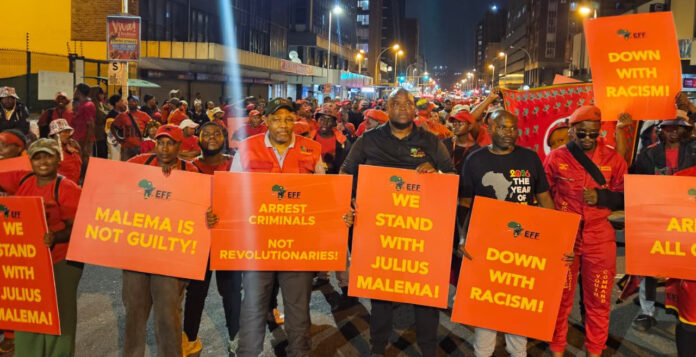
The Economic Freedom Fighters (EFF) is criticising the custodial sentence handed down to its president, Julius Malema, insisting that it does not align with the facts presented in court or the broader context of the incident.
The party’s statement, released on Thursday following Malema’s sentencing, maintains that no one was injured and that the firearm discharge occurred in a celebratory political setting rather than an act of violence.
Disproportionate sentence
“The EFF further notes the imposition of a custodial sentence, which we view as disproportionate and inconsistent with both the facts and the broader context of the incident,” the statement reads.
The EFF also argues that a custodial sentence serves no rehabilitative or deterrent purpose and instead amounts to political suppression.
“The defence challenged the proportionality of imprisonment, arguing that a custodial sentence would serve no legitimate purpose of justice, deterrence, or rehabilitation, but would instead amount to the suppression of political dissent,” the statement says.
Custodial sentence
A custodial sentence is a type of punishment where a convicted person is ordered by the court to be held in a prison or correctional facility for a specified period, rather than paying a fine or receiving a non-custodial penalty.
The court imposed a five-year prison term for count one and an additional two years for count two, both tied to reckless endangerment. However, this is a concurrent sentence.
For counts three, four and five, he was fined R20,000 each or faces six months’ imprisonment for every unpaid fine.
The charges include unlawful possession of a firearm and ammunition, as well as discharging a firearm in a built-up area without valid justification. Two counts of reckless endangerment, involving risk to people or property, formed the basis of the custodial sentences.
‘Intentions to criminalise a revolutionary political voice’
The party argues that the matter unfolds in a “highly politicised environment” aimed at criminalising a revolutionary political voice.
“The EFF reiterates that this case has always been pursued in a highly politicised environment, with clear intentions to criminalise a revolutionary political voice that represents the aspirations of the oppressed and marginalised,” the party says.
The party further claims that the National Prosecuting Authority (NPA) demonstrates what it describes as an “extraordinary and deeply suspicious appetite for imprisonment,” while failing to secure convictions in more serious violent crime cases.
“The NPA, in its pursuit of this matter, demonstrated an extraordinary and deeply suspicious appetite for imprisonment,” the EFF says.
It argues that arguments presented by its legal team, led by Advocate Tembeka Ngcukaitobi, show there is no intention to cause harm. The party raises further concerns about alleged procedural irregularities in the handling of evidence and the treatment of a co-accused, arguing that these issues undermine the credibility of the prosecution.
“The discharge of the firearm occurred in a celebratory context during a political gathering and not as an act of violence or criminal recklessness.”
- The Economic Freedom Fighters (EFF) criticizes Julius Malema’s custodial sentence, calling it disproportionate and inconsistent with court facts and the incident’s context.
- The EFF states no injuries occurred and the firearm discharge was celebratory at a political event, not an act of violence.
- Malema received concurrent prison terms totaling five years for reckless endangerment, plus fines or additional jail time for firearm-related offences; the conviction stands but the sentence is under appeal.
- The party condemns the ruling as political suppression aimed at criminalizing a revolutionary political voice representing oppressed communities.
- The EFF accuses the National Prosecuting Authority of bias, raises concerns about procedural irregularities, and asserts the sentence serves no justice or deterrent purpose.


