


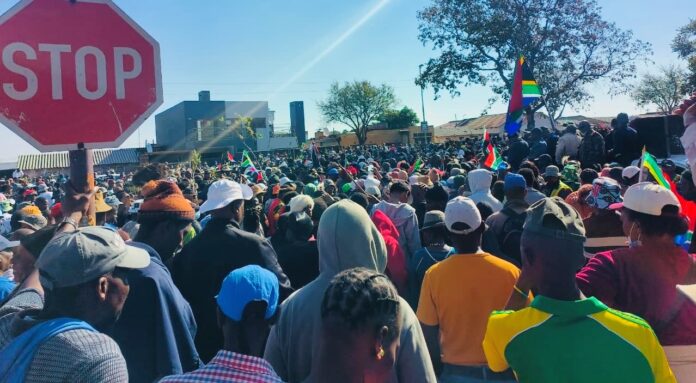
An ignorant bystander would have been justified in thinking it’s a group of amabutho headed to war.
But it was a spirited group of hostel dwellers who marched for two hours from Nancefield Hostel to Jabulani, which was the meeting point for all anti-undocumented immigrant marchers in South Africa’s biggest township.
Despite the knobkerries, spears, sticks, and sjamboks that were hoisted in the air during the long walk, it ended peacefully at the final meeting point with the handing over of the memorandum of demands to authorities.
Foreign nationals close spaza shops
Along the route, sandwiched by metro police in front and Saps at the back, which took dramatic and unexplained detours along the way, with the crowd highly charged by the amabutho’s war cries, spaza shops owned by foreign nationals were closed.
Onlooking from the yards where these shops are situated were the landlords who make a living from the spaza shops run from their garages.
Such is the sharp contradiction between those demanding that illegal foreign nationals running businesses in the country pack up and go back to their countries of birth and those making a decent income from housing them for business.
Landlords stand to lose
This scribe interacted with several property owners who are renting out their garages, which have been converted into spaza shops operated by foreign nationals.
The common denominator in their message: they cannot join the anti-undocumented immigrants’ wave, for it spells poverty for them.
Some are renting their garages for up to R5 000 a month in rent that they collect from the foreigners operating the spaza shops.
“If I join in saying abahambe, it means I am speaking poverty unto me because who is going to give me R4000, which is the rent I collect from my friend who is running his spaza shop?” said one property owner in Soweto who asked to remain anonymous, fearing reprisals from the mob.
The protestors, whenever they saw a sign of a spaza shop, would exclaim, ‘Bakuphi? Bakhipheni’ (Where are your tenants? Bring them out),” which was largely ignored by visibly scared and concerned owners of properties who are at risk of losing business.
‘Business unusual’
For those seeking to carry on with their day undisturbed, it was not a typical day.
Only a few bottle stores, allegedly owned by South Africans, were open along the way.
For those wanting to buy daily necessities such as bread and other things, Jabulani Mall or the one-stop shops at filling stations were the only option.
Those operating Uber Drive, ferrying people on a daily basis, were badly affected.
One Uber driver complained, “I doubt I will be able to cash in the amount that my boss expects from me every day for today because the situation of the roads was a nightmare today. I ended up parking the car at some point because it was either that or wasting petrol taking an alternative route away from the protestors.”
For the protestors, they could not be bothered with two war cries repeatedly reverberating in the streets as they marched.
It was “elethu izwe, owani umbango (this is our country, we are not prepared to share)” and “humuleni khuza abantu bakho, asilesabi thina igazi (government, be careful; we are not scared of bloodshed).”
March winds up peacefully
But despite the amabutho war cries, which might appear intimidating at face value, the march would conclude peacefully in Jabulani with the handing over of the memorandum.
It did, however, almost get out of control when those accepting the memorandum committed that the complaints of the protestors would be addressed in 30 days.
The crowd reacted angrily with demands of “seven days” as the new deadline for authorities to address their concerns.
The demands on the table are firm: all illegal foreigners operating in the country should leave, and the government should prioritise the economic empowerment of South African citizens.
Spaza Shops Fund
One of the state departments under the spotlight in this regard is that of small business development.
After weeks of sustained social media pressure on Minister Stella Ndabeni to publish the list of businesses owned by South Africans that have benefitted from the R500-million Spaza Shops Fund, the demand has now been made officially among the list of demands in the memorandum to government.
The R600 million set aside for security measures for June 30 protests might also backfire because protestors are now demanding that these funds be instead redirected towards youth empowerment.
The protest itself was for some time for some action instead of loitering in the streets, doing nothing all day, owing to the unemployment crisis in the country.
For the school kids who are currently on mid-year school holidays, it was a moment to deal with their boredom.
Others were going about their daily business as if nothing were happening.
The protestors have vowed to intensify their protest action indefinitely going forward if their demands are not met timeously.
Visit SW YouTube Channel for our video content
- A large group of hostel dwellers marched peacefully for two hours in South Africa's biggest township, protesting against undocumented immigrants and demanding their removal.
- Along the protest route, spaza shops owned by foreign nationals were closed, highlighting tensions between protesters and landlords who rely financially on renting out properties to these shop owners.
- The protest disrupted daily activities, with most shops closed and transportation, including Uber services, severely affected.
- Protesters demanded government action within seven days to prioritize economic empowerment for South African citizens and ensure all illegal foreigners leave the country.
- Among the demands were transparency on the R500-million Spaza Shops Fund beneficiaries and reallocation of R600 million set aside for security towards youth empowerment, with plans to intensify protests if demands are unmet.


