


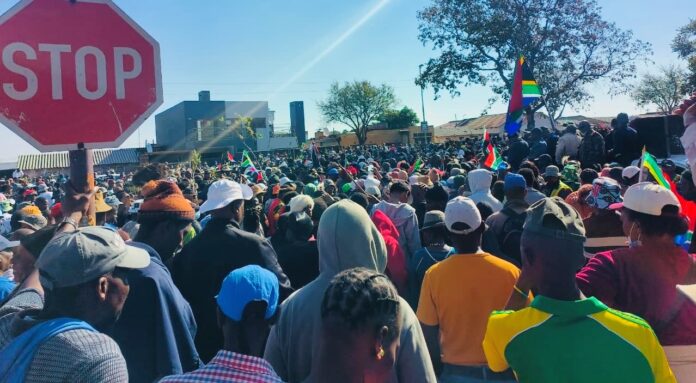
Government has pledged to provide South Africans with quarterly progress reports on efforts to manage legal and illegal migration after nationwide anti-illegal immigration marches that unfolded largely peacefully on Tuesday.
Deputy government spokesperson William Baloyi told the national broadcaster, SABC, that the demonstrations across the country had remained “relatively calm”, with marchers conducting themselves in a “behaved and dignified manner” while submitting petitions and memoranda to government representatives deployed in all nine provinces.
Baloyi said the public should rely on verified information from the public broadcaster amid the spread of misinformation.
Marches ‘relatively calm’
“As we speak, the situation is relatively calm. The marchers are marching in a very, very behaved and dignified manner. They are currently even submitting their petitions and their memoranda,” he said.
Members of the executive were dispatched across the country to receive memoranda from protesters as the government sought to engage directly with concerns over illegal immigration, crime and border management.
Baloyi confirmed that law enforcement agencies had made several arrests during the demonstrations.
Employers ‘harbouring undocumented immigrants’
He said the arrests included cases of alleged incitement as well as employers accused of harbouring undocumented immigrants.
“There are several arrests that the law enforcement agencies have done. They range from inciting to, also, the most important one which we want to send out to employers, harbouring undocumented immigrants,” he said.
Baloyi said police would continue monitoring the protests to ensure organisers and participants complied with agreed conditions governing peaceful demonstrations.
“The law is not going to lose sight of making sure that all the marchers adhere to the agreed principles of marching peacefully, no violence, no violation of laws,” he said.
Traditional weapons not licence for violence
Responding to concerns over protesters carrying sticks and other traditional weapons during some marches, Baloyi said South Africa’s multicultural traditions should not be confused with unlawful conduct.
He said many cultural communities traditionally carried sticks and other customary weapons during ceremonies and public gatherings.
“There are certain sections of society that, by their tradition, carry what we call traditional weapons. Traditional weapons should not be equated to illegal weapons or people being armed to kill,” Baloyi said.
He added that operational decisions on whether weapons were being carried or used illegally rested with law enforcement authorities, who were monitoring the situation closely.
South African brand affected
Baloyi also addressed concerns about the international impact of the demonstrations, acknowledging that South Africa’s reputation had suffered.
“We do acknowledge that Brand SA has been affected greatly,” he said.
He said government, through the Department of International Relations and Cooperation, was engaging governments across the Southern African region and the continent to explain developments in South Africa.
Baloyi said South Africa was serving as the interim chair of the Southern African Development Community and preparing to assume the bloc’s rotating chairmanship.
He said diplomatic engagements were under way with regional counterparts while President Cyril Ramaphosa had appointed special envoys to engage other countries and explain the government’s approach.
Baloyi said government was not opposed to migration but insisted that immigration into South Africa had to take place legally and in a regulated manner.
He said authorities were increasingly processing migrants at ports of entry instead of allowing people to enter the country before regularising their status.
Although Ramaphosa had previously described the marches as unnecessary, Baloyi said government respected South Africans’ constitutional right to protest peacefully.
He said concerns raised by demonstrators would not be ignored.
Quarterly updates
“I can assure South Africans that their issues are not falling on deaf ears. Government is going to proceed with its ongoing processes of dealing with these issues,” Baloyi said.
In what amounts to a new public accountability commitment, Baloyi said government would provide quarterly updates on measures being implemented to tackle legal and illegal migration.
“We are going to, on a quarterly basis, give the nation an update of what we are doing to deal with the issue of legal and illegal migration,” he said.
He also called on communities to work with government, saying many of the issues raised by protesters originated within communities and required collective action to resolve.
- The South African government pledged to provide quarterly progress reports on managing legal and illegal migration following largely peaceful nationwide anti-illegal immigration marches.
- Demonstrations remained calm, with protesters submitting petitions to government representatives, while law enforcement made arrests for incitement and employers allegedly harboring undocumented immigrants.
- Authorities stressed that carrying traditional weapons during marches reflects cultural practices and is not a license for violence, with police monitoring compliance with peaceful protest conditions.
- The government acknowledged damage to South Africa's international reputation and is engaging regional and continental partners to explain the situation, emphasizing regulated legal migration.
- Despite President Ramaphosa previously calling the protests unnecessary, the government respects constitutional protest rights and affirmed demonstrators' concerns will be addressed.


