


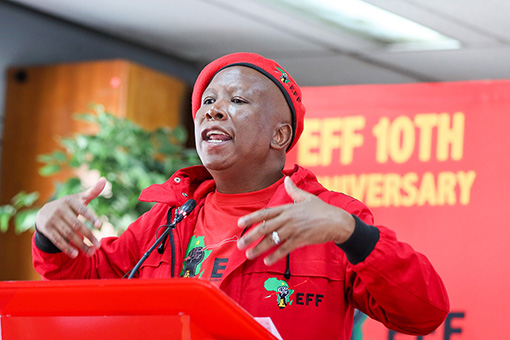
EFF leader Julius Malema has accused the state of enabling violence against foreign nationals during anti-illegal immigration marches, warning that growing hostility towards African migrants threatens continental unity.
Speaking to the media after the EFF’s Africa Day Summit in Pretoria on Thursday, Malema said law enforcement authorities were failing to act against people who were openly assaulting immigrants during protests.
“All these committing these crimes are accompanied by police and the state broadcaster and mainstream media are giving them unlimited airtime to spread hate and to incite violence,” Malema said.
“We have seen in many videos where people manhandle others in front of the police.”
‘Attacks on immigrants unacceptable’
Malema described the treatment of immigrants as unacceptable and said some of the actions seen during recent demonstrations amounted to assault.
He questioned why police had not intervened more decisively, saying even highly regarded policing units such as those in KwaZulu-Natal were capable of responding effectively if there was political will to do so.
The EFF leader’s remarks come amid rising tensions over illegal immigration and renewed anti-foreigner sentiment in parts of the country, which recently triggered the repatriation of Ghanaian nationals from South Africa.
‘Ghana response not helpful’
While criticising attacks on immigrants, Malema also expressed reservations about the Ghanaian government’s reaction to the situation, saying it may have created the impression that all South Africans were hostile towards foreign nationals.
“The Ghana response was not necessary because it gives an impression that we are all like that. It is only one section of society that needs to be contained by the police. President of Ghana should have given us some time to resolve this matter.”
In addition to initiating repatriations of Ghanaian nationals, John Mahama has also urged the African Union to discuss the recent developments at its sitting in Egypt June.
‘Afrophobia’ condemned
In his Africa Day address, Malema broadened his criticism to what he termed “Afrophobia”, arguing that Africans were increasingly turning against one another instead of confronting the deeper causes of poverty and inequality.
The event was attended by representatives from various embassies including Guinea the Democratic Republic of Congo as well as Mozambique who also championed the principle of united Africa.
Rejecting the term xenophobia, Malema said hostility directed at African migrants reflected divisions created during colonialism.
“What some call xenophobia against fellow Africans is in truth Afrophobia. It is the hatred, suspicion, exclusion, and criminalisation of African people by fellow Africans themselves.”
Call for greater African unity
Malema used the speech to call for greater African unity, economic integration and visa-free movement across the continent.
“The dream of a united Africa is not impossible. It is possible to establish a common African currency, integrated transport systems, visa-free movement across the continent, and African-controlled financial institutions.”
The EFF leader argued that ordinary Africans were being encouraged to blame migrants for unemployment and economic hardship while ignoring structural inequality, corruption and economic exclusion.
“An unemployed South African and an unemployed Zimbabwean are both victims of the same global system of inequality,” he said.
Malema concluded by urging African leaders to strengthen continental cooperation, invest in industrialisation and protect the vision of Pan-African solidarity championed by liberation leaders such as Kwame Nkrumah and Haile Selassie.
“The task before us is clear,” he said. “Unite Africa, industrialise Africa, democratise Africa, defend Africa, and liberate Africa economically.”
- EFF leader Julius Malema accused the state and police of enabling violence against African migrants during anti-illegal immigration protests, criticizing their failure to intervene.
- Malema condemned attacks on immigrants as unacceptable and criticized the Ghanaian government's response for portraying all South Africans as hostile towards foreigners.
- He expanded the issue beyond xenophobia, coining the term "Afrophobia" to describe intra-African hatred fueled by colonial divisions.
- Malema called for greater African unity, economic integration, visa-free movement, and investment in industrialization to address poverty and inequality.
- He urged African leaders to strengthen continental cooperation and uphold Pan-African solidarity, emphasizing that migrants and locals alike suffer from systemic economic issues.


