


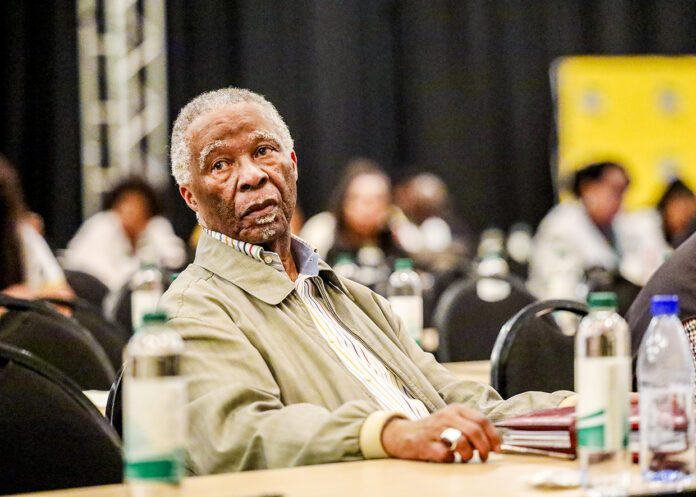
Former president Thabo Mbeki has denied that his handling of apartheid-era crimes was designed to derail prosecutions, insisting that decisions on criminal cases rested with the National Prosecuting Authority (NPA), while the executive dealt with presidential pardons and reconciliation.
Testifying before the Khampepe Commission of Inquiry on Monday, Mbeki rejected allegations that he held secret meetings to secure amnesty for former apartheid-era security force generals.
Mbeki described claims that meetings had been held to arrange amnesty for the generals as “a complete fabrication”.
READ: Jacob Zuma tells Sisi Khampepe he has millions of people backing him
He acknowledged that a meeting with the generals had taken place, but said they had argued that their political superiors should first account for their actions before the Truth and Reconciliation Commission’s (TRC) Amnesty Committee.
Mbeki also disputed suggestions that his April 2003 address to Parliament was intended to influence cases referred by the TRC for prosecution. He said the address dealt with people who had not participated in the TRC process rather than those who had applied for amnesty and had been refused.
The distinction was central to the government’s subsequent approach. People whose applications for TRC amnesty were rejected had their cases referred to the NPA for possible prosecution. They were expressly excluded from the special presidential pardon process introduced in 2007.
The later dispensation was intended to deal with a different group: certain offenders who had not applied for TRC amnesty but had been convicted of politically motivated crimes. Those who had not been convicted remained subject to the NPA’s decision on whether to prosecute or not.
Mbeki said the government introduced the separate mechanism after its initial approach to dealing with people who had bypassed the TRC “did not work”.
READ: Thabo Mbeki challenges Africa to invest in its unity dream
He maintained that the change was about how outstanding cases were handled, rather than an attempt to undermine the commission or interfere with prosecutions.
“In essence, the approach did not differ, but who handled cases differed,” he said.
The special pardon process resulted in 33 prisoners being pardoned, including members of the African National Congress and the Pan Africanist Congress who had been convicted of serious crimes.
Mbeki maintained that the president’s constitutional power to grant pardons did not extend to directing investigators to abandon cases or prosecutors not to pursue individual suspects. He said decisions on prosecutions belonged to the NPA.
His testimony comes amid scrutiny of whether political decisions or interventions contributed to the failure to investigate and prosecute apartheid-era crimes identified through the TRC process.
Mbeki’s appearance follows an unsuccessful attempt to prevent the commission from compelling him to testify. He is expected to return on Tuesday for a second day of testimony.
- Former president Thabo Mbeki denied that his handling of apartheid-era crimes aimed to derail prosecutions, stating that criminal case decisions rested with the National Prosecuting Authority (NPA).
- Mbeki rejected allegations of secret meetings to secure amnesty for apartheid-era security force generals, describing such claims as "a complete fabrication."
- He acknowledged a meeting with the generals, where they argued that their political superiors should first account for actions before the Truth and Reconciliation Commission’s (TRC) Amnesty Committee.
- Mbeki clarified that a 2003 parliamentary address targeted those who did not participate in the TRC process, not those who applied for amnesty and were refused, whose cases went to the NPA for prosecution.
- The special presidential pardon process, introduced in 2007, pardoned 33 prisoners convicted of politically motivated crimes, but prosecutorial decisions remained the responsibility of the NPA.


