


More than 40,000 students whose families are too poor to afford tertiary education but too rich for full funding by the National Student Financial Aid Scheme (NSFAS) have been left stranded after R3 billion meant to accommodate them was redirected to other expenditure items.
This follows the Public Protector’s probe into systemic issues that have rocked the state-sponsored student funding scheme over the years.
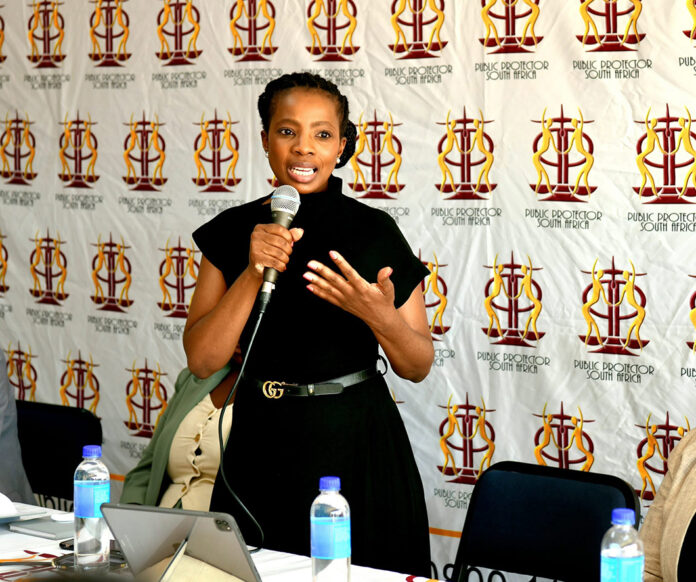
During Tuesday’s briefing on the interim findings of the wide-ranging probe, Public Protector Advocate Kholeka Gcaleka painted a grim picture of NSFAS, focusing mainly of happenings at the scheme since 2012.
The missing middle’s missing R3bn
“In so far as the MTT Report’s recommendation that provision needed to be made for funding for the ‘missing middle’, DHET (Department of Higher Education and Training) reported that NSFAS was capitalised with R3 billion over a three-year cycle from 2024 to 2027 to support students from this category,” said Gcaleka, who painted a picture of an NSFAS on the brink of total collapse.
“However, despite receipt of those 43,261 applications from students eligible to receive this funding, NSFAS could not effect its roll-out as it needed to procure a new loan system,” she added.
The probe found that this money had since been “reprioritised”.
READ: NSFAS: From beacon of hope to symbol of state failure
‘Persistent governance instability’
Gcaleka emphasised that she did not find anything different from previous independent probes into NSFAS, instead pointing out that NSFAS having been placed under administration three times in the past eight years was evidence of the endemic systemic issues that besiege the scheme.
Said Gcaleka:
“The evidence gathered depicts NSFAS as an institution affected by persistent governance instability, administrative weakness and inadequate systems.”
“These deficiencies have impaired its ability to discharge its statutory mandate effectively, efficiently and in a manner consistent with the standards expected of a public entity entrusted with public funds and vulnerable beneficiaries.
“The investigation observed repeat instances of executive interventions through section placing NSFAS under administrations, which occurred three times in the past eight years. Independent reviews, including the Ministerial Committee of Inquiry (2021), concluded that NSFAS has functioned in a near-permanent state of crisis.”
Student accommodation prompts separate probe
So massive and complex are systemic issues at NSFAS, Gcaleka elected to exclude student accommodation from this investigation which has been going on for five years on the trot.
Consequently, she decided to instead conduct a separate probe on student accommodation issues at NSFAS.
“The investigation further identified systemic concerns regarding student accommodation, including delays in the payment of accommodation allowances, weaknesses in the accreditation and verification of private accommodation, and the resulting risks of fraud, exploitation and student housing instability.
“Given the complexity and systemic nature of these issues, and following in loco inspections conducted at sampled institutions, the Public Protector has resolved to conduct a separate own-initiative systemic investigation into student accommodation.”
READ: Ousted NSFAS administrator, Manamela not off the hook
Among other recommendations Gcaleka has made in the interim until the final report is issued is for South Africa to learn from countries where tertiary education state welfare is functioning like a well-oiled machine.
One such recommendation is NSFAS paying universities directly, not through third parties. A sentiment strongly voiced by the Economic Freedom Fighters (EFF) through its parliamentary contributions in the higher education portfolio committee and during debates in the joint sitting.
“It has been observed that Australia and New Zealand appear strongest on operational efficiency of their student financial aid models, in that tuition is paid directly to institutions, repayment is income-contingent, and tax authorities use verified earnings data to collect automatically,” said Gcaleka.
“This reduces administrative duplication, limits default risk and minimises the burden on borrowers. Canada adds the value of a single application and coordinated data-sharing, while Germany demonstrates that national policy can be delivered effectively through regional offices,” she explained.
Gcaleka said in her final report, she will give strict deadlines to parliament, ministers of finance and higher education and universities on what must be done to set NSFAS straight.
Interested parties will also be given an opportunity to comment on the interim report before one that is final and binding is issued.
- More than 40,000 students categorized as the "missing middle" have been left without NSFAS funding after R3 billion allocated for them was redirected.
- NSFAS has faced persistent governance instability, administrative weaknesses, and inadequate systems, leading to it being placed under administration three times in eight years.
- A separate probe has been initiated to investigate systemic concerns regarding student accommodation, including delays and risks of fraud and exploitation.
- Recommendations include learning from countries like Australia and New Zealand, where tuition is paid directly to universities and repayment is income-contingent.
- The Public Protector will issue a final report with strict deadlines for Parliament, ministers, and universities, and will allow for public comment before making it binding.


