


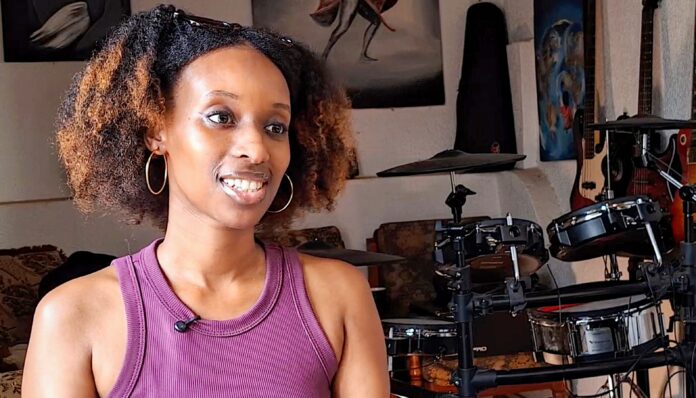
Angell Mutoni, known by her stage name as Angell, stands before a wall-length mirror in a rehearsal studio in Nyamirambo, running through the final lines of her performance. She looks confident and professional – chin lifted, shoulders squared and eyes locked straight ahead. The verses spoken out loud land flawlessly.
“I’ve been told that I look like I’m not nervous,” she says. “But deep inside I am,” she said, taking a break from the intense delivery.
Nyamirambo is where Kigali generates its creative energy. The neighbourhood has produced some of Rwanda’s sharpest rap talent and Mutoni knows every corner of it. This is where she has been coming to rehearse and record, for years. Where her beats are made, where her sound became recognisably hers.
“It’s important for African women to have control over their work. We need to take the narrative in whatever field we’re in, especially in music. In Africa, we are so few who have the opportunity to work in this field in an independent way,” the artist explained.
Product of old-school rumba
Angell has been walking this talk since 2011.
She was born in Uganda. Her family moved back to Rwanda, then to Canada. She came back to Kigali at fourteen. Her sound was shaped by her father’s old-school rumba and Afro rhythms, and she carried a notebook full of short stories and poems. The ambition was there. She was just too shy to say it out loud, until she discovered spoken word poetry. She began attending open-mic nights in Kigali, learning how to hold a room.
Hip-hop came next, and it came naturally. She started hanging around studios. The rooms were full of boys. She felt their gaze but she freestyled anyway, she said.
Fifteen years of building
She released her first song in 2011. What followed was fifteen years of building – three mixtapes, three EPs, and a reputation inside Kigali’s underground creative movement known as Nu Kigali. The scene pushed back against a mainstream that rapped almost exclusively in Kinyarwanda. It embraced genre fluidity and global influences. Angell was one of its most prominent names. She rapped in English, Kinyarwanda, and French, weaving the three languages into a sound she calls her “poetic afro” style.
“My poetic afro genre is a mix of different sounds, lyricism, and storytelling. There’s a lot that goes into mixing hip-hop and poetry sounds, whether traditional, modern, or Western. It’s a fusion of different things that creates a story on its own,” she explained.
There were no blueprints for what she was building. There were also very few spaces designed for someone like her.
“I want to be able to create those spaces that I didn’t have when I was starting out,” she said.
The milestones
The milestones came, through hard work and resilience. In 2016, she was named a top-ten nominee for the Prix Découvertes RFI. Running since 1981, Prix Découvertes RFI is one of Africa’s most prestigious music competitions – the launchpad for careers that include Tiken Jah Fakoly, Amadou and Mariam, and Rokia Traoré.
In 2022, she opened the Commonwealth Women’s Forum at the Commonwealth Heads of Government Meeting (CHOGM) in Kigali, performing before more than 600 delegates and Rwanda’s First Lady, Jeannette Kagame. The audience gave her a standing ovation. That same year, she was selected from amongst nine artists globally for the Goethe Talent Program and took the stage at the Pop Kultur Festival in Berlin, Germany.
Producer S4DM, who has collaborated with her across multiple projects, put it plainly.
“Her dedication to live performance and continuous growth as an artist inspires me. She has shown that even in a male-dominated industry, perseverance and passion make all the difference,” he said.
Home audience ‘my hardest room’
She has performed across continent but the hardest room, she said, is still her home audience.
“It’s always more nerve-wracking to perform for my own people. I get more nervous when it’s Kigali,” she admits. “But when it’s outside Kigali, I’m like: this is new. Let’s just have fun with it.”
Rwanda’s music sector has been growing alongside her. According to IFPI’s Global Music Report 2025, Sub-Saharan Africa’s recorded music revenues surpassed US$100 million for the first time in 2024. The region reached $110-million, a 22.6% increase, making it one of the fastest-growing music markets in the world.
Rwanda is part of that wave. But for women in hip-hop, the terrain has never been smooth. Opportunity and resistance tend to arrive together. Angell is frank about what building a sustainable career in this market actually requires.
“The music industry in Rwanda is still developing and the market is very tiny. It is hard to become a working artist,” she says. “Just doing music isn’t enough. You have to be very many things.”
The producer who has been closest to that journey is Eric Bapfakurera Fabrice, known professionally as Barick. He is the founder of Kigali label and production house BMCG (Barick Music Creation Group) and produced the majority of her debut album.
“Building an authentic Rwandan identity in music will take time. But it is essential for shaping the future of Rwanda’s hip-hop scene,” he says.
The album he and Angell built together is called The Delivery. Released in mid-2025, its fourteen tracks move through pop, R&B, boom bap, and rap. Pan African Music described it as expressing “a rich and ultimately very varied set of artistic desires and impulses”. She took it across East Africa and Europe on its release.
The record draws on a wide range of influences. Missy Elliott and Timbaland for energy. Janet Jackson for emotional restraint. Lauryn Hill for lyricism. British rapper Little Simz for what it means to stay grounded while going global.
Music In Africa Conference
In November 2024, Angell took that journey to a new stage. She performed with the +250 collective at the Music In Africa Conference for Collaborations, Exchange and Showcases (ACCES), held for the first time in Kigali at the Kigali Convention Center. Organised by the Music In Africa Foundation in partnership with Rwanda’s Ministry of Youth and Arts, the event brought professionals from more than 40 countries to the Rwandan capital.
+250 is named for Rwanda’s telephone country code, pronounced abiri nitanu in Kinyarwanda. It is a sixteen-strong collective of rappers, producers, musicians, and singers formed through a collaboration between Pan African Music and Kigali agency Cornwine.
Among +250’s members are Bushali, Ish Kevin, B-Threy, Slum Drip, and Ice Nova. Together, they recorded a debut album with Grammy-winning American producer Roark Bailey, whose credits include Drake, Post Malone, and Playboi Carti. In October 2025, +250 performed at the Euro-Africa Biennial at Tropisme Hall in Montpellier, France.
Angell is also the founder of the Eclectic Nappy Heads Collective, an all-women initiative creating safe spaces and supporting aspiring female musicians in Rwanda. She co-hosts The Kila Kitu Podcast, exploring culture, identity, and everyday life with guests and fellow hosts. Kila kitu means “everything” in Swahili. It is an apt name for someone who refuses to be boxed in.
“Representation matters,” she says. “When people see others who are like-minded, it inspires young women and shows them that it’s possible. Even being heard on TV or radio can make someone believe they can do it too.”
She is also clear about what she is building towards.
“As the industry in Rwanda grows, as more people listen to music, it will be easier for the coming generation to get into this world,” she said. “Easier than it was for us, anyway.”
- Angell Mutoni, known by her stage name as Angell, stands before a wall-length mirror in a rehearsal studio in Nyamirambo, running through the final lines of her performance.
- She looks confident and professional – chin lifted, shoulders squared and eyes locked straight ahead.
- The verses spoken out loud land flawlessly.
- “I’ve been told that I look like I’m not nervous,” she says.
- “But deep inside I am,” she said, taking a break from the intense delivery.


