


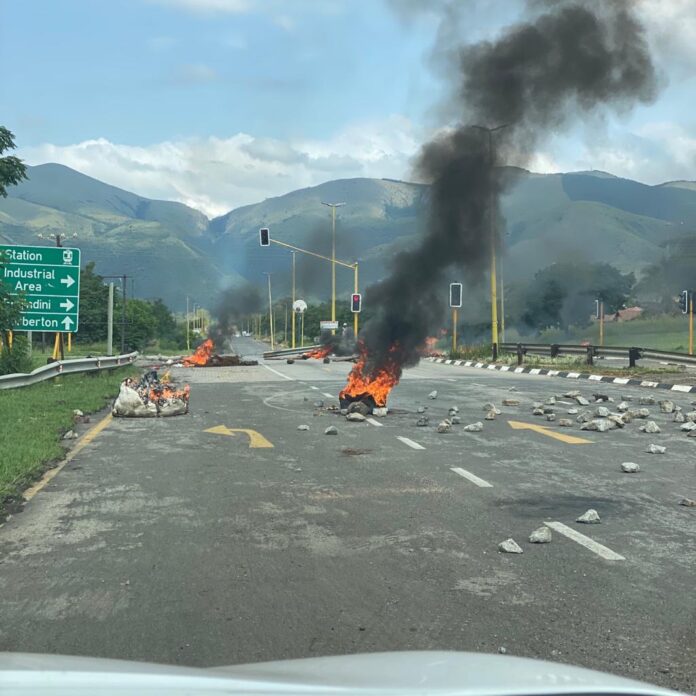
South Africa’s streets have once again become a stage for marches, demonstrations and political expression. Depending on whom you ask, the protests are either a legitimate eruption of long-standing socio-economic frustrations or part of a more coordinated and shadowy attempt to destabilise the country. As with many politically charged moments, the truth is more grounded — and far less conspiratorial — than some narratives suggest.
At their core, South Africa’s recurring protests are not difficult to decode. They are the predictable outcome of structural pressures that have built over decades: persistent inequality, high unemployment, failing local service delivery and a growing distrust between citizens and the state. These are not abstract problems. They are lived realities that shape how communities respond when water runs dry, electricity fails, housing remains scarce or corruption allegations go unanswered.
It is tempting in moments of instability to search for a hidden architect behind the chaos. Social media, political commentary and even some public figures sometimes point to unnamed funders, foreign interests or rival political factions allegedly orchestrating unrest from behind the scenes. Yet, despite the frequency of such claims, concrete evidence of a unified coordinating force behind nationwide protests remains elusive. What is far more visible is fragmentation: different communities protesting different issues at different times, often with no central coordination beyond shared frustration.
The suggestion that external actors are deliberately funding or directing protests also tends to oversimplify a much more complex reality. Civil society organisations, trade unions, student movements and local advocacy groups do receive funding in South Africa — as they do in most democracies — but this is not the same as orchestrating national instability. The existence of funding does not automatically equate to manipulation. In most cases, the organisations operate transparently within legal frameworks and focus on specific issues such as labour rights, housing or governance accountability.
Within this landscape, former president Jacob Zuma’s name often surfaces in discussions about political unrest. His continued influence in certain political circles, along with his polarising legacy, makes him an easy focal point for speculation. However, linking him directly to broad protest movements across the country stretches beyond what is publicly verifiable. South Africa’s protest ecosystem is decentralised. It is driven more by local grievances than by directives from national political elites, regardless of how influential those figures might be.
Another increasingly discussed idea is whether instability in South Africa serves a broader purpose of isolating the country from its African neighbours or weakening its regional standing. This theory, while dramatic, does not align well with how African diplomacy and economics function in practice. African states are deeply interconnected through trade, labour movement and regional institutions such as the African Union and SADC. The collapse or isolation of South Africa would not be a strategic advantage for the continent — it would be a shared economic setback.
If anything, African governments tend to prioritise stability over fragmentation. Even when political disagreements arise, responses are typically cautious and diplomatic rather than punitive. The idea of coordinated continental backlash against South Africa is therefore more speculative than substantive.
Similarly, secessionist narratives, such as calls for Cape Town independence or economic separation of the Western Cape, tend to emerge from regional dissatisfaction rather than a coherent national trend. The movements reflect political frustration and regional identity debates more than any realistic pathway to state fragmentation. Economically, breaking up South Africa would introduce severe risks, including currency instability, reduced investor confidence and disrupted trade networks that extend well beyond national borders.
Perhaps the most important question is not who might be “behind” the protests but what conditions make them so persistent. The answer remains uncomfortable but straightforward: South Africa continues to grapple with structural inequality, youth unemployment, weak local governance in some municipalities and a lingering trust deficit between citizens and political institutions. These are slow-burning pressures that naturally manifest in periodic waves of protest.
This is not unique to South Africa. Across the continent, many African countries face similar challenges— economic systems struggling to absorb growing young populations, uneven development and governance systems evolving in their ability to deliver consistent services. In that sense, South Africa is not an outlier but part of a broader continental reality where democratic promise often collides with economic constraint.
One of the risks in interpreting the events through a purely conspiratorial lens is that it can obscure the work required to address them. If protests are assumed to be externally manufactured, then the urgency of domestic reform is reduced to a matter of security response rather than governance improvement. Yet the persistence of demonstrations suggests something deeper: citizens are not simply reacting to influence — they are reacting to conditions.
Of course, no political environment exists without contestation or competing interests. Parties, movements and leaders will always seek to shape narratives and mobilise support. But this is different from asserting the existence of a centrally coordinated strategy to destabilise a country. The evidence for the former is visible in any democracy; the evidence for the latter remains largely speculative.
South Africa’s wave of protests should therefore be understood as a reflection of unresolved structural issues rather than a puzzle of hidden puppeteers. The danger lies not in imagining too little complexity but in imagining too much where simpler explanations exist.
Ultimately, the country’s challenge is not to uncover secret masterminds but to confront visible and long-standing problems: economic exclusion, governance weaknesses and uneven development. Until those issues are meaningfully addressed, the streets will probably continue to speak — loudly, frequently, and in ways that no conspiracy theory can fully explain away.
- Daniel Makokera is a renowned media personality who has worked as a journalist, television anchor, producer and conference presenter for over 20 years.
- South Africa’s recurring protests stem from deep-rooted structural issues like inequality, unemployment, poor service delivery, and distrust between citizens and the state, rather than from coordinated political conspiracies.
- Claims of external actors or former president Jacob Zuma orchestrating the unrest lack concrete evidence; protests are decentralized and driven primarily by local grievances.
- The notion that instability is meant to isolate South Africa from its African neighbors or weaken its regional role is speculative and contradicts the interconnected economic and diplomatic ties within the continent.
- Secessionist movements and regional dissatisfaction do not represent a coherent national fragmentation trend but highlight ongoing regional political and identity frustrations.
- Addressing the persistent protests requires confronting underlying socio-economic challenges and governance weaknesses rather than attributing unrest to hidden manipulators or conspiracies.


