


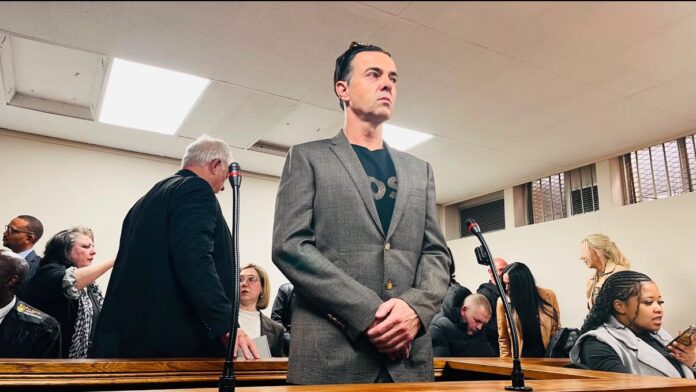
Disbarred attorney Peet Viljoen has offered to pay R250,000 in bail, submit to house arrest and report daily to police in a final bid to convince the Pretoria Specialised Commercial Crime Court to release him pending trial.
The proposal formed part of Viljoen’s replying affidavit, which was read into the court record by his advocate, Andre Steenkamp, before the State launched a detailed attack on the defence’s version on Thursday.
Viljoen is facing about 400 charges, including fraud, corruption, theft, forgery, uttering and perjury, linked to an alleged R27-million City of Johannesburg property fraud scheme.
Pretrial detention should be exception, instead of rule
Concluding his affidavit, Viljoen urged the court to determine his bail application through the lens of the Constitution, arguing that pretrial detention should remain the exception rather than the rule.
Through his advocate, he submitted that the “interests of justice” favoured his release and proposed stringent bail conditions to address the State’s concerns.
Viljoen told the court he was prepared to pay a further R200,000 in bail in addition to the R50,000 previously paid, bringing the total amount lodged with the court to R250,000.
He also offered to remain under house arrest for the duration of the criminal proceedings and, if required, report daily to a police station or directly to the investigating officer.
The defence argued that these conditions would eliminate any concern that Viljoen posed a flight risk while protecting his constitutional right to liberty pending trial.
Right to freedom before conviction
In his affidavit, Viljoen relied heavily on constitutional principles and international human rights law, arguing that bail exists to balance the state’s power to prosecute with an accused person’s right to freedom before conviction.
He submitted that South African courts are required to consider fairness, equity and the proper exercise of judicial discretion when deciding whether an accused person should be granted bail.
The affidavit also referred to regional and international human rights instruments, including the African Charter on Human and Peoples’ Rights, which recognise the presumption of liberty and provide that pretrial detention should be the exception rather than the rule.
Quoting Constitutional Court jurisprudence, Viljoen argued that the primary objective of the bail system is to maximise personal liberty while ensuring that accused persons stand trial.
“We respectfully pray that this Honourable Court consider granting bail to the applicant under such conditions as it may deem appropriate,” the affidavit states.
Defence dismisses numerous allegations
Earlier in the day, Viljoen’s advocate spent several hours reading the replying affidavit into the record, dismissing numerous allegations relied upon by the state as “make-up stories” and arguing that they related to incidents dating back as far as 2011 for which he was never prosecuted.
The defence submitted that if the allegations disclosed genuine criminal offences, the State would have charged Viljoen years ago instead of relying on them during his bail application.
Viljoen also challenged allegations that he fled South Africa, insisting that he voluntarily requested to be deported from the United States despite knowing he would be arrested on his return.
According to the affidavit, he initially applied for voluntary deportation but later waived certain immigration rights and requested deportation to South Africa because of the conditions under which he was being detained.
The defence further rejected allegations that Viljoen misled investigators about relocating to Cape Town, arguing that the affidavit clearly explained that he and his wife merely explored the possibility before abandoning the plan because it proved unworkable.
Viljoen also accused investigating officer Colonel Ursula Herfurth of presenting misleading evidence regarding his residential address.
Referring to transcripts of telephone conversations and court recordings attached to the affidavit, the defence argued that they demonstrated Col Ursula Herfuth knew where Viljoen was staying but nevertheless relied on a different address in support of the state’s opposition to bail.
According to Viljoen, the transcripts showed the investigating officer had accepted information regarding his address during conversations with witnesses but failed to disclose that fact in her affidavit.
Defence blames current bail proceedings on state’s procedural failures
The defence also argued that the current bail proceedings were the result of the State’s own procedural failures rather than any conduct on Viljoen’s part.
Counsel submitted that previous High Court findings had already criticised the prosecution’s handling of the matter and argued that prosecutors had failed to follow the correct legal procedures, forcing Viljoen to seek a review of the earlier proceedings.
“The reason we are here today is because the State did not follow the legal procedures,” the defence submitted.
After the defence concluded its submissions, prosecutor Willem van Zyl began systematically challenging Viljoen’s replying affidavit, arguing that several of the claims made by the defence were contradicted by the evidence before the court.
Van Zyl rejected suggestions that prosecutors had deliberately delayed re-enrolling the matter after it was struck from the roll.
He told the court that he had only taken over the prosecution in early 2024 and had not been involved in the matter during the preceding years.
He explained that after assuming responsibility for the prosecution, he first had to familiarise himself with a complex case spanning more than a decade.
“I had to take over the matter, firstly. Secondly, I had to study it and certainly understand it. Mostly, I had to go through 13 years’ worth of documents and the case docket,” Van Zyl said.
‘No sinister reason’ behind delay
He told the court that this explained why the matter was not immediately re-enrolled and insisted there was “no sinister reason” behind the delay.
Van Zyl also defended the state’s reliance on historical evidence, arguing that prosecutors have a constitutional duty to place all relevant information before the court when opposing bail.
Referring to Constitutional Court authority, he said the prosecution would have failed in its duty had it withheld evidence it considered relevant.
“I would be failing in my duty if I did not place that evidence before the court,” he submitted.
The prosecutor further argued that while courts should exercise caution before depriving an accused person of liberty, that caution should never override common sense.
“The exercise of caution should never be allowed to displace the exercise of common sense,” Van Zyl submitted.
He told the court that every bail application requires a balancing exercise between an accused person’s constitutional right to freedom, the public interest and the interests of justice.
According to Van Zyl, section 60(4) of the Criminal Procedure Act provides the framework for determining when the interests of justice require that bail be refused.
He argued that the state had placed sufficient evidence before the court to establish not just one, but several of the statutory grounds contained in section 60(4), which, in the state’s view, justified Viljoen’s continued detention pending trial.
Inconsistencies regarding Viljoen’s residential arrangements
Van Zyl also referred to evidence concerning Viljoen’s movements after leaving South Africa, telling the court that Viljoen and his wife had initially indicated they intended relocating to Cape Town. He argued that the move never materialised and submitted that the couple instead travelled to the United States, a sequence of events the State contends is relevant to assessing whether Viljoen poses a flight risk.
He also challenged Viljoen’s contention that investigators did not know where he was living before his arrest.
Referring to communications and annexures attached to the defence’s own affidavit, Van Zyl argued that the documents raised questions about the addresses provided to investigators and the timeline of Viljoen’s residential arrangements. He submitted that these inconsistencies undermined aspects of Viljoen’s replying affidavit and would be addressed further during the State’s submissions.
The prosecutor further argued that the court should consider the broader consequences of the alleged offences and not limit its assessment to any financial prejudice. He submitted that the State’s concerns extended to what it described as a pattern of procedural irregularities, non-compliance with legal processes and the wider interests of justice.
Van Zyl maintained that the court should consider the totality of the evidence rather than each allegation in isolation when deciding whether the interests of justice favoured Viljoen’s release.
Judgment reserved
After hearing submissions from both the defence and the state, the magistrate reserved judgement in the bail application.
The matter was postponed to August 17, when the Pretoria Specialised Commercial Crimes Court is expected to deliver its ruling on whether Viljoen will be granted bail pending his trial. Until then, Viljoen will remain in custody.
ALSO READ: Peet Viljoen claims state relying on withdrawn cases to oppose bail
- Disbarred attorney Peet Viljoen offered R250,000 bail, house arrest, and daily police reporting in a bid for release pending trial on about 400 charges linked to a R27-million City of Johannesburg property fraud scheme.
- Viljoen's defense argued pretrial detention should be the exception, emphasizing constitutional and international human rights principles protecting the right to freedom before conviction.
- The defense dismissed many state allegations as outdated or unprosecuted, challenged claims of Viljoen fleeing the country, and accused investigators of presenting misleading evidence.
- Prosecutor Willem van Zyl countered defense claims, highlighting procedural fairness, the state's duty to present all relevant evidence, and arguing multiple statutory grounds justify Viljoen's continued detention.
- The court reserved judgment, with a ruling on the bail application expected on August 17; Viljoen remains in custody pending this decision.


