
Reserve Bank keeps interest rates unchanged

The South African Reserve Bank (SARB) has decided to keep its benchmark repo rate unchanged at 7%, with governor Lesetja Kganyago warning that escalating tensions in the Middle East and rising oil prices continue to threaten the country’s inflation outlook.

The Monetary Policy Committee (MPC) voted to leave rates unchanged, with four members supporting a hold and two favouring a 25-basis-point increase.

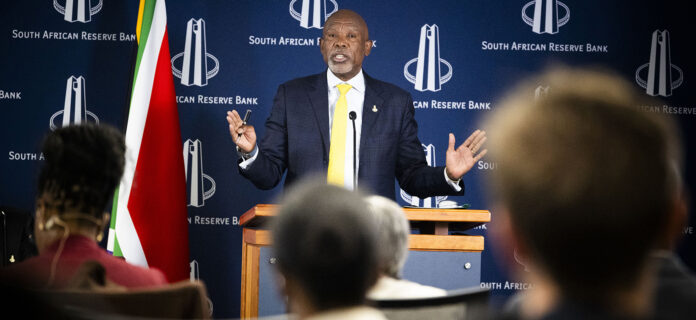
Announcing the MPC decision on Thursday, Kganyago said the conflict in the Middle East had entered “a new and volatile phase”, contributing to a sharp rebound in global oil prices.


“Oil prices, which had declined to about 70 dollars a barrel earlier this month, have now rebounded to roughly 90 dollars,” said Kganyago.

Inflation, weakening economic activity

Kganyago said the decision was taken against a backdrop of persistent inflation risks and weakening economic activity.

“Inflation is still too high, while growth is weak,” he said, adding that recent inflation readings had remained above target largely because of higher fuel costs.

The Reserve Bank expects headline inflation to remain above 4% until early next year, with the possibility of further pressure should global oil prices continue to rise.

The governor warned that the war in the Middle East has disrupted supply chains and hurt incomes globally, while South Africa’s economy is also feeling the effects through weaker confidence and higher fuel costs.

Although first-quarter growth surprised on the upside at close to 2% year-on-year, Kganyago said the expansion was driven mainly by stronger net exports rather than domestic demand.

“We anticipate slower growth through the second and third quarters of this year. Consumer confidence has fallen sharply, and business confidence has also weakened,” he said.


Concerns about municipal dysfunction

The central bank also highlighted growing concerns about municipal dysfunction, which Kganyago described as an increasingly significant obstacle to economic growth.

“It is increasingly clear that municipal dysfunction has become a binding constraint on growth,” he said.

Despite the cautious outlook, the Reserve Bank believes economic activity could recover in the second half of the year if global conditions stabilise and domestic reforms gain traction.

The MPC’s latest projections indicate interest rates are likely to remain broadly stable for the rest of the year, with potential rate cuts only later in the forecast period if inflation gradually falls towards the bank’s 3% target.

Wariness about upside risks

However, Kganyago stressed that policymakers remain wary of upside risks, particularly if inflation expectations continue rising or if oil prices surge further.

“Our decisions will continue to be taken on a meeting-by-meeting basis, with careful attention to the outlook, data outcomes, and the balance of risks to the forecast,” he said.

Concluding the announcement, Kganyago reiterated that the Reserve Bank’s primary objective remains bringing inflation sustainably down to 3%, saying the MPC “will act as needed” to achieve that goal.

ALSO READ: Fuel shock pushes inflation to 5%

Subscribe To Our Newsletter 

  • Please upload the news article you would like me to summarize.

🎧 Listen to this article

The South African Reserve Bank (SARB) has decided to keep its benchmark repo rate unchanged at 7%, with governor Lesetja Kganyago warning that escalating tensions in the Middle East and rising oil prices continue to threaten the country's inflation outlook.

Announcing the Monetary Policy Committee's (MPC) decision, Kganyago said the conflict in the Middle East had entered “a new and volatile phase”, contributing to a sharp rebound in global oil prices.

“Oil prices, which had declined to about 70 dollars a barrel earlier this month, have now rebounded to roughly 90 dollars,” said Kganyago.

The MPC voted to leave rates unchanged, with four members supporting a hold and two favouring a 25-basis-point increase.

Kganyago said the decision was taken against a backdrop of persistent inflation risks and weakening economic activity.

“Inflation is still too high, while growth is weak,” he said, adding that recent inflation readings had remained above target largely because of higher fuel costs.

The Reserve Bank expects headline inflation to remain above 4% until early next year, with the possibility of further pressure should global oil prices continue to rise.

The governor warned that the war in the Middle East has disrupted supply chains and hurt incomes globally, while South Africa's economy is also feeling the effects through weaker confidence and higher fuel costs.

Although first-quarter growth surprised on the upside at close to 2% year-on-year, Kganyago said the expansion was driven mainly by stronger net exports rather than domestic demand.

“We anticipate slower growth through the second and third quarters of this year. Consumer confidence has fallen sharply, and business confidence has also weakened,” he said.

The central bank also highlighted growing concerns about municipal dysfunction, which Kganyago described as an increasingly significant obstacle to economic growth.

“It is increasingly clear that municipal dysfunction has become a binding constraint on growth,” he said.

Despite the cautious outlook, the Reserve Bank believes economic activity could recover in the second half of the year if global conditions stabilise and domestic reforms gain traction.

The MPC's latest projections indicate interest rates are likely to remain broadly stable for the rest of the year, with potential rate cuts only later in the forecast period if inflation gradually falls towards the bank's 3% target.

However, Kganyago stressed that policymakers remain wary of upside risks, particularly if inflation expectations continue rising or if oil prices surge further.

“Our decisions will continue to be taken on a meeting-by-meeting basis, with careful attention to the outlook, data outcomes, and the balance of risks to the forecast,” he said.

Concluding the announcement, Kganyago reiterated that the Reserve Bank's primary objective remains bringing inflation sustainably down to 3%, saying the MPC “will act as needed” to achieve that goal.

Subscribe To Our Newsletter 

LEAVE A REPLY

Please enter your comment!
Please enter your name here

This site uses Akismet to reduce spam. Learn how your comment data is processed.

