


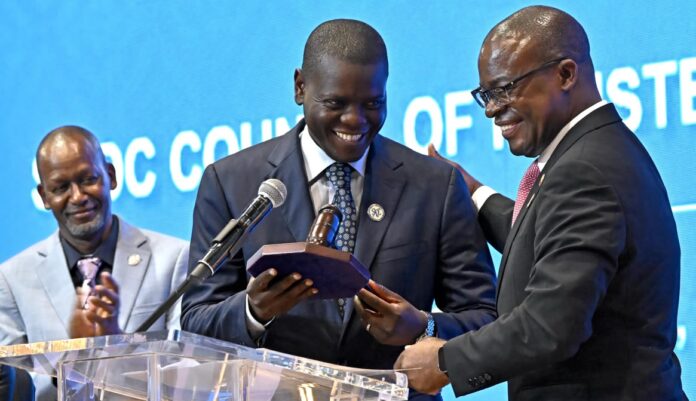
South Africa must address the country’s growing migration concerns without turning to vigilantism or trampling on human rights, International Relations and Cooperation Minister Ronald Lamola has warned.
Lamola made the remarks in Durban on Wednesday as South Africa assumed the SADC Council of Ministers chairpersonship for 2026–2027, putting migration and the movement of people firmly on the regional agenda.
His comments come as South Africa continues to grapple with a vigorous public debate around irregular migration, the integrity of the country’s borders, access to economic opportunities and pressure on communities and public institutions.
Unlawful action condemned
But Lamola said legitimate concerns about migration could not become a licence for unlawful action.
“As we address the legitimate concerns of our citizens, we equally and forcefully reject all forms of vigilantism and human rights violations,” he said.
Also Read: Stats SA finds migration dip linked to recent crackdown
He said the response to irregular migration had to remain within the law.
“Addressing the challenges associated with irregular migration must occur within an orderly and lawful framework,” Lamola said.
‘Migration not solely a border-security problem’
Lamola also pushed back against treating migration solely as a border-security problem, arguing that the movement of people across Southern Africa is closely tied to economic opportunity and employment.
“We are fully aware that the movement of people across our region is frequently connected to broader questions of economic opportunity and employment and not just a security issue,” he said.
He pointed to Durban’s own history as an example of how migration and economic development have been intertwined.
“Indeed, as Durban’s story shows, our country’s industrial development immensely benefited from the large labour pools from our region and beyond,” he said.
Call for long-term solutions
The minister said SADC countries needed to find long-term solutions to migration rather than allowing the issue to fuel hostility between communities.
“We are hopeful that, together, we can chart a path towards holistic and long-lasting solutions to the migration challenges facing our region,” he said.
Lamola called on SADC member states to sign the regional protocol on the free movement of people, saying this would help create a system that allows migration to take place legally and in an orderly manner.
“We therefore call on countries within our bloc to sign the protocol on the free movement of people to enable regular and orderly migration,” he said.
The call places migration within the broader SADC project of regional integration, where the movement of people is viewed alongside the movement of goods, services and skills.
Lamola’s position also reflects the difficult balance facing South Africa: responding to public concerns about irregular migration while maintaining its economic and political relationships with neighbouring countries.
Migration was only one part of South Africa’s priorities as it took over the SADC chairpersonship.
Lamola said the country would focus on peace, security and stability; accelerated industrialisation; infrastructure development; and social and human capital development.
Mineral wealth ‘must benefit Africa’
Critical minerals will also feature prominently in the agenda.
Nearly 30% of the world’s proven critical mineral reserves are found in the SADC region, including about half of the world’s cobalt reserves and 20% of its graphite reserves.
Also Read: South Africa agrees new climate loan, critical minerals cooperation on Germany visit
But Lamola warned that simply exporting raw resources would not deliver the prosperity the region needs.
“Our region’s wealth has nourished economies far and wide, while our own economies have remained trapped in old patterns of extractive accumulation,” he said.
Push to increase intra-regional trade
South Africa wants SADC to increase intra-regional trade and build regional value chains, with a target of reaching 50% intra-SADC trade.
Lamola also highlighted the continent’s young population and the urgent need for job creation to keep pace with population growth.
“By 2030, within the next four years, one in four young people in the world will be from Africa,” he said.
“This means our economies and level of job creation must be at the same par with population growth.”
For Lamola, the migration debate therefore cannot be separated from the region’s economic future.
- South Africa's International Relations Minister Ronald Lamola emphasized addressing migration concerns legally without resorting to vigilantism or violating human rights.
- South Africa assumed the SADC Council of Ministers chairpersonship for 2026–2027, prioritizing migration and movement of people in the regional agenda.
- Lamola urged SADC member states to sign the regional protocol on the free movement of people to facilitate orderly and legal migration.
- The SADC region holds nearly 30% of the world’s proven critical mineral reserves, including significant amounts of cobalt and graphite, which Lamola wants to leverage for regional prosperity.
- South Africa aims to increase intra-SADC trade to 50% and stresses the need for economic growth and job creation to keep up with Africa's rapidly growing youth population.


