


The World Health Organisation (WHO) has finally pieced together how a bird-watching couple unknowingly helped spark an international hantavirus scare that reached South Africa, after a luxury expedition cruise turned into a floating health emergency involving deaths, intensive care evacuations, and multiple countries scrambling to trace passengers.
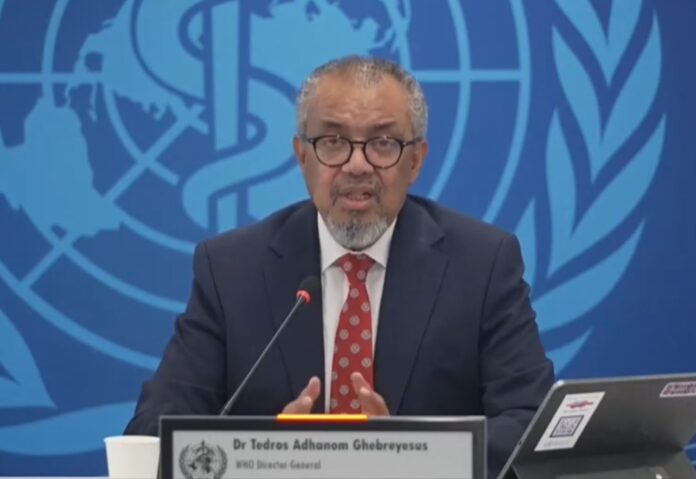
During a press briefing in New York, WHO director-general Tedros Adhanom Ghebreyesus outlined the timeline behind the deadly outbreak aboard the ill-fated MV Hondius, confirming that the virus involved is the Andes strain of hantavirus, a rare Latin American variant capable of human-to-human transmission.
Potentially deadly virus
Hantavirus is a rare but potentially deadly virus mainly spread through contact with infected rodents, their urine, droppings or saliva, often when contaminated particles become airborne and are inhaled.
The Andes strain, largely associated with parts of South America, is considered especially dangerous because, unlike most hantaviruses, it can spread between humans. Symptoms usually begin like flu before escalating in severe cases to breathing complications, organ failure and death.
“The first case was of a man who developed symptoms on the 3rd of April and died on the ship on the 11th of April. No samples were taken, and because his symptoms were similar to those of other respiratory diseases, Hantavirus was not suspected,” Ghebreyesus said.
What initially appeared to be an isolated illness aboard the cruise ship would later unravel into a multinational medical crisis stretching from South America to Africa and Europe.
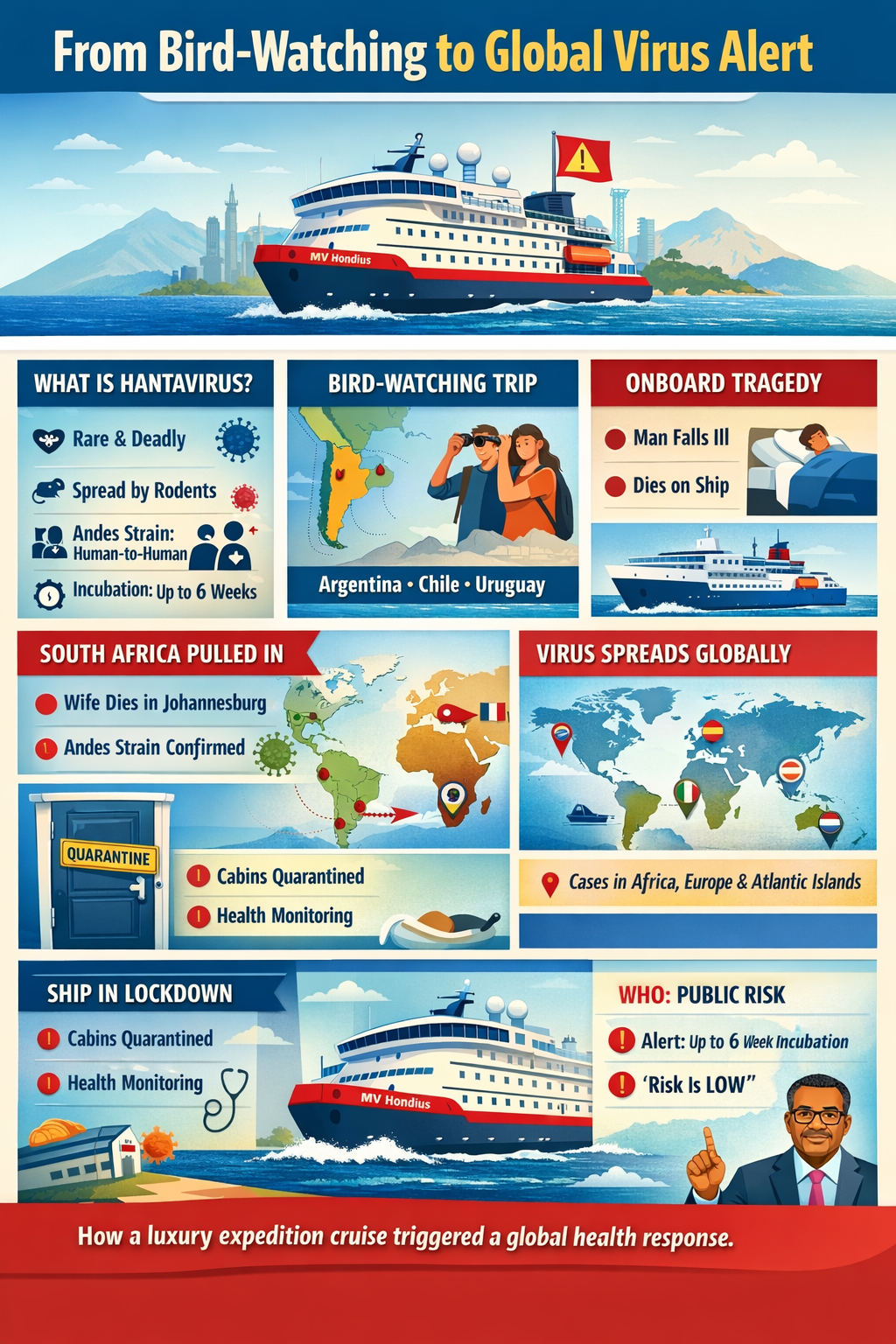
According to the WHO, the deceased man and his wife had travelled through Argentina, Chile and Uruguay before boarding the ship on a bird-watching trip that included visits to areas inhabited by rodent species known to carry the Andes virus.
Before health authorities could fully understand what they were dealing with, the man’s wife had already left the vessel.
“The man’s wife went ashore when the ship docked on the island of Antalina and was also symptomatic. She deteriorated during the flight to Johannesburg on the 25th of April and died the next day,” Ghebreyesus said.
The woman’s death effectively pulled South Africa into the global response operation.
Samples taken in South Africa by the National Institute for Communicable Diseases later confirmed the infection as hantavirus.
WHO also confirmed that another critically ill passenger was evacuated from Ascension Island to South Africa after presenting symptoms aboard the ship.
“Another man presented to the ship’s doctor on the 24th of April and he was evacuated on the 25th of April from the Island of Ascension to South Africa, where he remains in intensive care,” Ghebreyesus said.
The WHO chief added that a third passenger later died after developing symptoms aboard the vessel on April 23.
Rapid spread of virus
Like a ghost moving silently through cabins, airports and islands, the virus travelled faster than suspicion. By the time hantavirus was identified, passengers had already dispersed across continents.
WHO said Cabo Verde authorities assisted in evacuating three additional symptomatic passengers from the vessel.
“Two are in a stable condition in the hospital, and one is asymptomatic and is now in Germany,” Ghebreyesus said.
An eighth confirmed case later emerged in Switzerland after a passenger who disembarked in Saint Helena reported himself to doctors in Zurich.
“Following advice from the ship’s operator, he reported himself with symptoms in Zurich, Switzerland, and was confirmed yesterday to be infected with Hantavirus,” Ghebreyesus said.
WHO said no additional passengers remaining aboard the vessel had shown symptoms so far, although global health authorities remain on alert because the incubation period for the Andes strain can last up to six weeks.
“Given the incubation period of the Andes virus, which is six weeks, it’s possible that more cases may be reported,” Ghebreyesus warned.
Passengers from Canada, Denmark, Germany, the Netherlands, New Zealand, Saint Kitts and Nevis, Singapore, Sweden, Switzerland, Türkiye, the United Kingdom and the United States were among those who disembarked during the voyage.
Effort to trace affected passengers
WHO said South African authorities are tracing passengers who may have been exposed during the Saint Helena to Johannesburg flight involving the deceased woman.
“WHO is supporting health authorities in South Africa to follow up people who were on the flight from Saint Helena to Johannesburg with the woman who later died,” Ghebreyesus said.
The ship is now heading toward the Canary Islands after Ghebreyesus personally requested docking assistance from Spanish Prime Minister Pedro Sánchez.
Passengers have effectively been confined to their cabins under strict monitoring measures.
“Anyone who shows symptoms will be isolated immediately,” Ghebreyesus said.
Despite the seriousness of the incident, WHO moved to calm fears of widespread global transmission.
“While this is a serious incident, WHO assesses the public risk as low,” Ghebreyesus said.
- The Andes strain of hantavirus, a rare Latin American virus capable of human-to-human transmission, caused a deadly outbreak aboard the MV Hondius cruise ship, sparking an international health emergency involving multiple countries including South Africa.
- The index case was a man who became ill and died aboard the ship in April after traveling through Argentina, Chile, and Uruguay, with his wife subsequently falling ill, disembarking in South Africa, and also dying, triggering a multinational response.
- Additional passengers showed symptoms and were evacuated or sought treatment in various countries including South Africa, Germany, and Switzerland, with a total of at least eight confirmed cases across continents.
- The virus spread rapidly as passengers disembarked in different countries during the incubation period of up to six weeks, prompting extensive efforts by WHO and national authorities to trace and monitor exposed individuals.
- Despite the severity and international spread, WHO assessed the overall public risk as low, implementing containment measures such as passenger isolation and strict monitoring on the ship now heading to the Canary Islands.


