


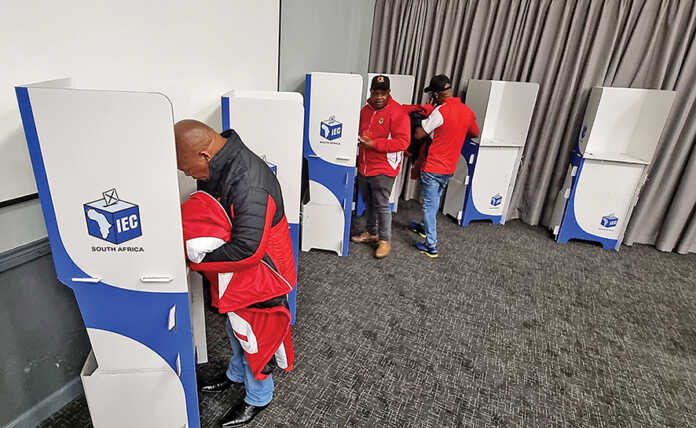
A newly registered political party’s attempt to reserve places on Cape Town ballot papers using placeholder candidates has been rejected after the Electoral Court ruled that electoral fairness depends on applying deadlines even when they shut competitors out.
The ruling leaves the United Democratic Front (UDF) Party unable to field its intended candidates in about 110 wards in the November 4 local government elections.
The party argued that its registration was finalised only on August 24, leaving it four days to recruit candidates before the August 28 deadline.
It initially sought more time but later asked to nominate one person in several wards and replace that person with properly selected candidates before a later cut-off.
Judge Leicester Adams, with acting judge Nobahle Mangcu-Lockwood and additional member Professor Retselisitsoe Phooko concurring, said the plan was unlawful.
“The proposed replacement stage is in effect the submission of new nominations after the deadline,” Adams said.
He found that the Municipal Electoral Act allowed the IEC to amend the timetable generally when necessary for a free and fair election, but not to grant one party an exemption.
“The Act confers no power to exempt one party from a deadline that continues to bind all others,” the court said.
The political dispute was not about competing ideas. It was about organisation under scarcity: too little time, too few confirmed candidates and 110 wards sought by a party trying to establish itself.
Uncertainty over registration shaped its preparations. But the court found that the crisis was substantially self-created.
Crisis of its own making
The party lodged the hard copy of its registration application seven weeks after submitting it electronically and chose the abbreviation that caused its refusal. It also made its first public call for candidates only around August 23.
“Registration was not a precondition for preparation,” Adams said. The party could have identified wards, recruited candidates and completed forms while its application was pending.
“Awaiting the outcome of the review before preparing was the applicant’s own choice,” the court said. “That risk cannot now be transferred to the Electoral Commission, to other contestants or to the electorate.”
READ: Fikile Mbalula rejects claims ANC wants special treatment from IEC
That finding replaced the party’s coherent account – that delayed registration made compliance practically impossible, with the court’s factual account of missed preparation and avoidable delay.
The judges treated the IEC’s neutrality, the statutory timetable and equal treatment of contestants as more important than the fortunes of one new party or its leaders.
The court identified no corruption. Its diagnosis was organisational failure, not a weak state captured throughentrenched political patronage networks.
“There can be no ad hoc condonations or indulgences,” Adams said, warning that exceptions could create a perception that electoral authorities favoured some parties.
Compliant parties tilt the scales
The apparently powerless actors were the parties and independent candidates that met the deadline but were not before court. Their compliance nevertheless tilted the case against the applicant because extending time would penalise those who had organised within the rules.
The court said fairness could not be assessed only through the hardship of one contestant. An extension “could prejudice other parties’ election build-ups and indeed free and fair elections”.
The judgment turns a procedural decision into a broader claim about democratic legitimacy. Elections confer authority only when competitors and voters accept the rules as even-handed.
“Elections must not only be free and fair, but they must be perceived as being free and fair,” the court said, quoting Constitutional Court precedent.
READ: Beyond political theatre: Why South Africa’s development data over election rituals
Its argument sought compassion for unusual timing. The IEC successfully made the controlling question whether any individual party may escape a deadline binding everyone else.
The application was dismissed, with each side ordered to pay its own costs.
- The Electoral Court ruled that the United Democratic Front (UDF) Party cannot field its intended candidates in about 110 wards for the November 4 local government elections due to missed nomination deadlines.
- The UDF Party's registration was finalized on August 24, giving it only four days before the August 28 candidate nomination deadline, which the court ruled was insufficient for extensions or substitutions.
- Judge Leicester Adams stated that the proposed candidate replacement plan was unlawful as it constituted late submission of nominations after the deadline, which the Municipal Electoral Act does not permit for individual parties.
- The court found that the UDF Party's late preparations and delays, including submitting registration hard copies late and public candidate calls just before deadlines, were self-created crises.
- The court emphasized that electoral fairness depends on equal treatment and adherence to deadlines for all parties, ruling that no exceptions could be granted without compromising democratic legitimacy.


