
IEC says ballots will be crowded due to high number of contestants

  • Johannesburg has the highest number of parties on the Proportional Representation ballot, followed by Tshwane, eThekwini, Ekurhuleni and Cape Town.
  • IEC deputy chief electoral officer Masego Shiburi said parties in most metros will be listed side by side in two columns to accommodate the large number of contestants.
  • Ballot size and layout will vary between municipalities and wards, depending on the number of candidates contesting.

Voters in some of South Africa’s biggest metros will face crowded ballot papers in the November 4 local government elections, with the sheer number of political parties contesting forcing the Electoral Commission of South Africa (IEC) to change its ballot.

The City of Johannesburg has the highest number of parties contesting the Proportional Representation (PR) ballot, followed by other major metros including Tshwane, eThekwini, Ekurhuleni and Cape Town.

The IEC says the number of contestants in these municipalities means a double-column ballot will be unavoidable, although the ballot will remain on a single page. During a briefing on Wednesday, chief electoral officer Sy Mamabolo said the commission’s preference was to have parties listed in a single column, but the number of contestants in the major metros made this impractical.
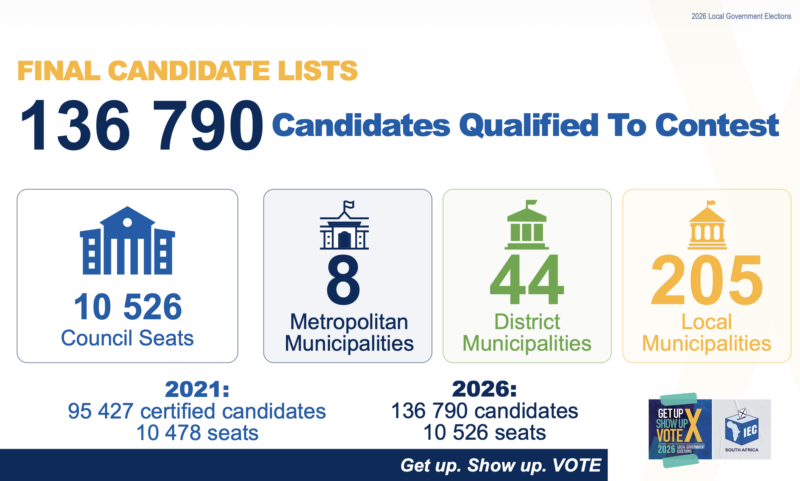
The massive number of candidates has made a double ballot unavoidable. – Source: IEC

“An unprecedented 136 790 candidates have satisfied the statutory requirements to contest seats across the eight metropolitan municipalities,” he said.
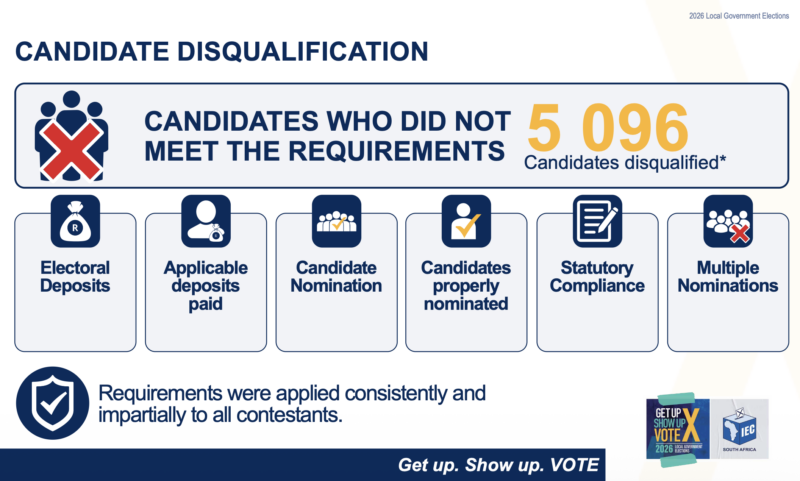
Not all candidates made the cut for the 2026 local government elections. Source: IEC


Why the ballot design is changing

Mamabolo’s deputy, Masego Shiburi, then explained how it will change the appearance of the ballot.

“Unavoidably, in the majority of the metros, the parties will be set side by side on a double-column ballot paper. It is still a single-page ballot paper,” he said.

READ: ANC loses Electoral Court fight over 181 councillor candidates

The design of the ballot will not be identical across the country. Shiburi explained that the size and layout would depend on the number of candidates contesting in each municipality and ward, meaning voters in areas with fewer contestants would receive a smaller ballot.

“It will differ from municipality to municipality. It will differ from ward to ward. Where you have fewer candidates, obviously the size of the ballot will be smaller. Where you have the most contestants, as is the case in the City of Johannesburg, you will have a bigger ballot paper, but still in one page.”

Joburg leads in number of contestants

With Johannesburg emerging as the metro with the largest number of parties competing for seats, changes in the appearance of the ballot-paper are expected.

But the issue stretches beyond the metropolitan municipalities, with Emfuleni, Polokwane, Rustenburg, Nelson Mandela Bay and Capricorn being part of the top 10.

READ: Parties warn IEC against doing ‘favours’ for ANC regarding list submissions

Focus shifts to voter education

The IEC is now turning its attention to voter education to ensure that voters are comfortable navigating the different ballot layouts when they enter voting stations.

Shiburi explained that civic education would increasingly focus on helping voters understand how the ballots would be structured and how they could identify their preferred parties and candidates.

“Civic education transitions now to deal with balloting and voting education, that is the message we now accentuate,” he said.

He highlighted that voters would need to familiarise themselves with the visual cues on the ballot so that they could identify their preferred party or candidate without difficulty.

Meanwhile, male candidates constitute the majority at 62%, female candidates account for 38%. Among PR candidates, women represent 44% and men 56%. In ward contests, men constitute 65% of candidates while women account for 35%.
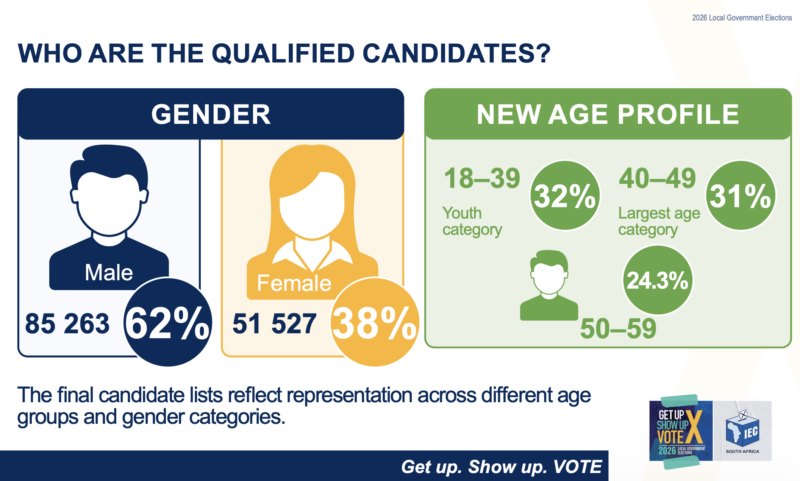
Men make up more than 62% of the eligible candidates.


  • The IEC is changing ballot papers to a double-column format for South Africa's major metros due to the high number of political parties contesting, while keeping the ballot to a single page.
  • Johannesburg has the highest number of parties contesting the Proportional Representation (PR) ballot, followed by Tshwane, eThekwini, Ekurhuleni, and Cape Town.
  • A total of 136,790 candidates met the requirements to contest seats across the eight metropolitan municipalities.
  • The size and layout of ballots will vary by municipality and ward, with larger ballots in areas with more contestants, such as Johannesburg.
  • Male candidates make up 62% overall, with women comprising 38%; among PR candidates, women are 44%, and in ward contests, men constitute 65%.

🎧 Listen to this article

Voters in some of South Africa’s biggest metros will face crowded ballot papers in the November 4 local government elections, with the sheer number of political parties contesting forcing the Electoral Commission of South Africa (IEC) to change its ballot.

The City of Johannesburg has the highest number of parties contesting the Proportional Representation (PR) ballot, followed by other major metros including Tshwane, eThekwini, Ekurhuleni and Cape Town.

The IEC says the number of contestants in these municipalities means a double-column ballot will be unavoidable, although the ballot will remain on a single page. During a briefing on Wednesday, chief electoral officer Sy Mamabolo said the commission’s preference was to have parties listed in a single column, but the number of contestants in the major metros made this impractical.

“An unprecedented 136 790 candidates have satisfied the statutory requirements to contest seats across the eight metropolitan municipalities," he said.


Mamabolo's deputy, Masego Shiburi, then explained how it will change the appearance of the ballot.

"Unavoidably, in the majority of the metros, the parties will be set side by side on a double-column ballot paper. It is still a single-page ballot paper,” he said.

READ: ANC loses Electoral Court fight over 181 councillor candidates

The design of the ballot will not be identical across the country. Shiburi explained that the size and layout would depend on the number of candidates contesting in each municipality and ward, meaning voters in areas with fewer contestants would receive a smaller ballot.

“It will differ from municipality to municipality. It will differ from ward to ward. Where you have fewer candidates, obviously the size of the ballot will be smaller. Where you have the most contestants, as is the case in the City of Johannesburg, you will have a bigger ballot paper, but still in one page.”

With Johannesburg emerging as the metro with the largest number of parties competing for seats, changes in the appearance of the ballot-paper are expected.

But the issue stretches beyond the metropolitan municipalities, with Emfuleni, Polokwane, Rustenburg, Nelson Mandela Bay and Capricorn being part of the top 10.

READ: Parties warn IEC against doing ‘favours’ for ANC regarding list submissions

The IEC is now turning its attention to voter education to ensure that voters are comfortable navigating the different ballot layouts when they enter voting stations.

Shiburi explained that civic education would increasingly focus on helping voters understand how the ballots would be structured and how they could identify their preferred parties and candidates.

“Civic education transitions now to deal with balloting and voting education, that is the message we now accentuate,” he said.

He highlighted that voters would need to familiarise themselves with the visual cues on the ballot so that they could identify their preferred party or candidate without difficulty.

Meanwhile, male candidates constitute the majority at 62%, female candidates account for 38%. Among PR candidates, women represent 44% and men 56%. In ward contests, men constitute 65% of candidates while women account for 35%.


LEAVE A REPLY

Please enter your comment!
Please enter your name here

This site uses Akismet to reduce spam. Learn how your comment data is processed.

