


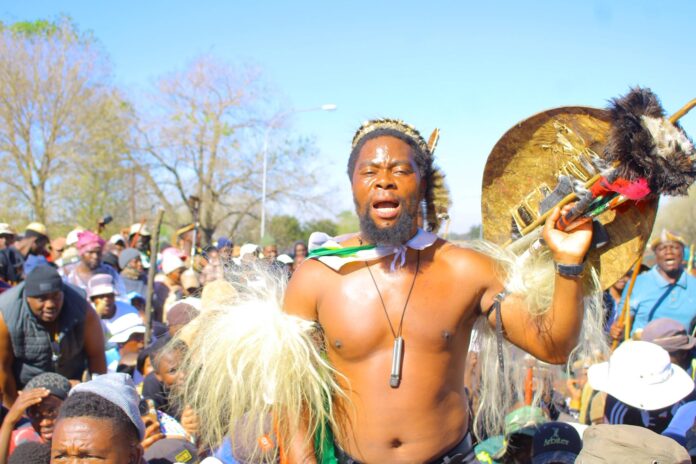
President Cyril Ramaphosa reportedly held a late-night meeting with leaders of one of the country’s biggest anti-illegal immigration movements on Monday in what appears to have been a final attempt to ensure Tuesday’s nationwide protests remained peaceful while signalling that the government had heard public anger over illegal immigration.
The meeting between Ramaphosa and Insizwa Nobunsizwa’s Nkosikhona “Phakel’ umthakathi” Ndabandaba and Ngizwe Mchunu was confirmed to the media by the Presidency on Tuesday morning.
Presidential spokesperson Vincent Magwenya said the president met the organisers on Monday and urged them to ensure their planned demonstrations remained within the law.
While the presidency released only a brief account of the discussion, Ramaphosa’s weekly newsletter, published just hours before the meeting, provides the clearest indication yet of the message he was expected to deliver behind closed doors.
‘Deep concerns’ about illegal immigration
The newsletter acknowledges that South Africans have “deep concerns” about illegal immigration, weak border management, pressure on public services and criminal syndicates exploiting the country’s immigration system. He writes that those concerns are “real” and deserve to be heard.
That acknowledgement is significant because it mirrors the central demands of protest organisers, who have argued that government has failed to confront undocumented immigration and its consequences.
But the president couples that recognition with a firm warning that protests must remain peaceful and lawful.
Right to protest goes hand in hand with respecting the law
“The right to protest is enshrined in our Constitution,” Ramaphosa wrote. “But the right to protest and freedom of expression do not allow people to threaten or intimidate others or to engage in acts of vandalism or violence.”
According to Magwenya, that was precisely the message Ramaphosa reinforced during Monday night’s meeting.
“The president emphasised to both of them that the right to protest is coupled with the responsibility to observe the law and to protest peacefully,” he said.
Magwenya added that Ramaphosa reminded the organisers that government “remains the sole authority responsible for the enforcement of migration laws”.
The president’s newsletter also sets out what the government says it is doing to address the issue, including strengthening border management, increasing enforcement against undocumented immigration, improving asylum and visa systems and tackling corruption that has weakened immigration controls.
He also reveals that the government has spent recent weeks consulting widely on the issue, including meetings with traditional leaders, businesses, labour, religious organisations and other formations before extending those engagements directly to protest leaders.
Enforcing immigration laws state’s responsibility
Perhaps the strongest indication of Ramaphosa’s message comes later in the newsletter, where he warns against citizens taking immigration enforcement into their own hands.
He says foreign nationals who are lawfully in South Africa remain entitled to constitutional protection and argues that demanding identity documents or enforcing immigration laws is the responsibility of state law enforcement agencies, not private citizens.
Ramaphosa further warns that vigilantism “has no place in our constitutional democracy” and says no grievance, however legitimate, justifies violence or intimidation.
The late-night meeting came as police and other security agencies mounted one of the country’s biggest coordinated security operations ahead of demonstrations expected in several provinces, with authorities seeking to balance the constitutional right to protest against concerns over possible violence and attacks on foreign nationals.
Read More: Ramaphosa dumps NUM speech as Phakel’ umthakathi vows to deliver memo
- President Cyril Ramaphosa held a late-night meeting with leaders of a major anti-illegal immigration movement to urge peaceful and lawful protests ahead of nationwide demonstrations.
- The Presidency confirmed the meeting, emphasizing the government's recognition of public concerns around illegal immigration, border management, and related criminal activities.
- Ramaphosa’s newsletter acknowledged the "deep concerns" about immigration issues while warning that protests must respect the law and reject violence or intimidation.
- The president stressed that enforcing immigration laws is the government's responsibility, condemning vigilantism and affirming constitutional protections for lawful foreign nationals.
- Ahead of the protests, authorities launched a large security operation to balance protecting the right to protest with preventing violence and attacks on foreign nationals.


