


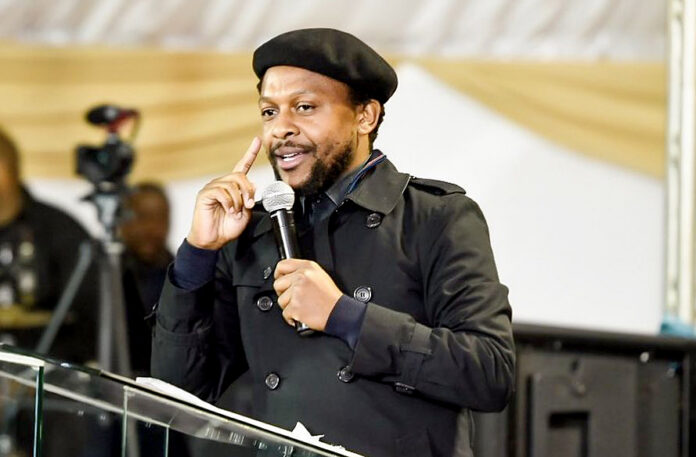
Mbuyiseni Ndlozi is calling for a new form of grassroots politics that moves citizens away from waiting for government solutions and towards building their own systems of survival, production and accountability.
In his document, “11 Theses on the Call for Batho Pele Convention: Siyazenzela”, dated August 25, the ex-Economic Freedom Fighters (EFF) spokesperson and Member of Parliament (MP) argues that South Africa has reached a point where communities must reclaim the power they have surrendered to political parties and state institutions.
READ: Ndlozi resigns from EFF to focus on academia, civil society
His argument starts with a diagnosis of state failure.
Ndlozi says the promise of Batho Pele, which placed citizens at the centre of government service, has been abandoned because political leaders and bureaucrats have turned public institutions into vehicles for personal interests.
“The ‘Batho Pele’ principle, once a sacred covenant of our Constitution, is dead,” he writes.
He argues that the problem is not only individual corruption but also a wider political culture where citizens remain dependent on institutions that no longer serve them.
“This is not merely a failure of individuals,” Ndlozi writes. “It is a predatory state machinery that treats public funds as private property.”
The alternative he proposes is the Batho Pele Convention, which he presents as a movement of organised citizens who will rebuild community power outside traditional political structures.
Ndlozi says South Africans must move beyond what he calls the politics of the “beggar-voter”, where citizens wait for politicians to deliver promises made during elections.
Ndlozi says communities have been reduced to petitioners who repeatedly ask public institutions to provide services and rights that already belong to them.
“For too long, we have been conditioned to be professional petitioners,” he writes, accusing citizens of being forced to kneel before failing municipalities and departments while “begging for the rights we already own”.
“The age of the ‘beggar-voter’ should come to an end,” he writes.
For Ndlozi, democracy cannot only exist when citizens vote.
He argues that people must exercise power every day by organising around their own needs and using their collective skills to solve problems.
“We must cease to be ‘clients’ of a failed bureaucracy and resolve to become the architects of our own survival,” he writes.
READ: New think tank Vuka Azania launches assault on post-1994 settlement
The foundation of the proposal is Siyazenzela, which Ndlozi describes as a practice of self-reliance rather than a temporary response to government failure.
He argues that communities must build their own capacity and create networks of people who can provide solutions where institutions have collapsed.
“When the state abdicates, its mandate returns to the people,” Ndlozi writes.
He calls this a “parallel machine of service”, where communities organise around practical problems such as fixing schools, clinics, roads, water systems and other basic services.
The political argument behind the proposal is that South Africa needs a different type of leadership.
Ndlozi rejects what he calls the “Cult of the Professional Politician”, arguing that some leaders have turned public service into a career path, “a ladder for personal enrichment” while communities continue to suffer.
Ndlozi also rejects politics built around powerful individual leaders.
“We must declare the End of the Messiah Complex,” he writes, saying communities do not need “charismatic saviours or strongmen” to lead them.
Instead, he calls for leaders rooted in communities who gain authority through service.
“Leadership is not a career; it is a sacrificial stewardship,” he writes.
The Batho Pele Convention is therefore presented as more than a civic organisation. Ndlozi describes it as a new political home for communities that feel abandoned by existing institutions.
“The Batho Pele Convention is not a debating club but the grassroots machinery of the dispossessed,” he writes.
For Ndlozi, the argument is therefore no longer about finding a better party to govern. It is about whether citizens can organise enough power outside parties to stop waiting for government altogether.
He argues that the Batho Pele movement must bring together people who build, teach, protect and heal and create a new form of localised power outside party structures.
- Mbuyiseni Ndlozi advocates for a grassroots political movement called the Batho Pele Convention focused on self-reliance and community power outside traditional political parties.
- Ndlozi criticizes the current state for failing citizens, describing a predatory political culture where public institutions serve personal interests rather than the public good.
- He calls for an end to the "beggar-voter" mentality, urging communities to stop waiting for government assistance and instead become architects of their own survival through organised collective action.
- The Batho Pele Convention proposes creating a "parallel machine of service" where communities independently address practical issues like education, healthcare, and infrastructure.
- Ndlozi rejects professional politicians and charismatic leaders in favor of community-rooted leadership based on service and sacrificial stewardship.


