


The critical findings of the Constitutional Court’s 2019 majority judgment against former Public Protector Busisiwe Mkhwebane may have legally failed to survive the test of evidence beyond a reasonable doubt.
This follows Mkhwebane’s formal acquittal on perjury charges by the Pretoria Magistrates’ Court this week, effectively closing a high-stakes criminal saga that has divided the country’s legal fraternity for years.
READ MORE: State’s retreat in Mkhwebane perjury battle changes complexion of case
The criminal prosecution of Mkhwebane stemmed directly from a scathing 2019 apex court ruling concerning her controversial Absa/Bankorp investigation. In that civil matter, the Constitutional Court (ConCourt) majority held that Mkhwebane had acted in bad faith and misled courts regarding her undisclosed meetings with former President Jacob Zuma.
However, following a full criminal trial testing those exact allegations, the Pretoria Magistrates Regional Court granted Mkhwebane a Section 174 discharge application, ruling that the state’s evidence was wholly insufficient to establish criminal guilt.
Civil findings fail criminal test
The acquittal highlights the stark divide between the civil standard of proof – the balance of probabilities, used by the Constitutional Court majority and the strict standard of proof beyond a reasonable doubt required in criminal law.
In the 2019 apex court ruling, the majority judgment, penned by Justices Sisi Khampepe and Leona Theron, aggressively condemned Mkhwebane’s honesty.
READ MORE: ‘Standing for the truth cost me dearly’ – Mkhwebane
The majority wrote at the time: “This court noted that the Public Protector had put forward a number of falsehoods in the course of litigation… She was not honest about her engagements during the investigation.” They further asserted that her entire model of investigation was profoundly flawed and compromised by bad faith.
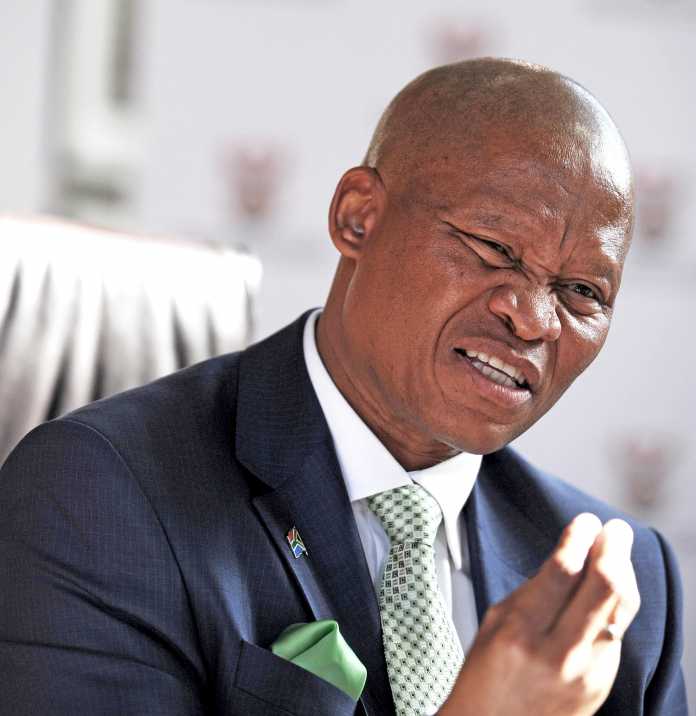
Yet, the criminal court’s recent dismissal of the perjury charges aligns directly with the prophetic 2019 minority judgment penned by former Chief Justice, Mogoeng Mogoeng. In his dissenting opinion, Mogoeng fiercely resisted the majority’s rush to brand Mkhwebane a liar without ironclad proof, warning against the weaponisation of judicial inferences.
Mogoeng’s minority judgment returns
Mogoeng noted in his minority judgment: “The requirements of gross negligence or bad faith have not been met… There is no definitive proof of dishonesty or intentional misrepresentation.” He argued that penalising the Chapter 9 head on the basis of suspicion would fundamentally undermine the independence of the office.
The outcome stands as a powerful vindication of Mogoeng’s minority position, leaving the Constitutional Court majority’s findings permanently unproven under the ultimate standard of criminal accountability.
READ MORE: Mkhwebane gets another shot at R10m payout
On Wednesday the National Prosecuting Authority (NPA) was forced to concede defeat. The state’s case completely buckled during the trial when prosecutors withdrew the primary perjury charge, which subsequently compromised the foundation of the remaining four alternative counts. Because the NPA’s evidence could not withstand judicial scrutiny, Mkhwebane’s legal team successfully moved for a Section 174 discharge application.
NPA case collapses
Ultimately, the NPA offered no viable resistance to the discharge, leaving the Pretoria Magistrates’ Court to acquit her on all remaining counts due to a total lack of standard criminal evidence.
READ MORE: Setumo Stone | How Zuma, Mkhwebane could have benefitted from Phala Phala principles
The acquittal marks a steep institutional decline from the NPA’s initially aggressive stance. When first initiating the case under the guidance of the Hawks, the NPA publicly maintained that the charges were not frivolous and were firmly rooted in the apex court’s findings.
Throughout years of delays, interlocutory reviews, and representations, the state insisted it was ready for trial, only to fail the evidentiary test when the case was finally called.
- Former Public Protector Busisiwe Mkhwebane was formally acquitted on perjury charges by the Pretoria Magistrates' Court this week due to insufficient evidence.
- The prosecution originated from a 2019 Constitutional Court majority ruling that accused Mkhwebane of bad faith and misleading courts during her Absa/Bankorp investigation.
- The Magistrates' Court ruled in favor of Mkhwebane using a Section 174 discharge application, finding the state's evidence inadequate to prove criminal guilt beyond a reasonable doubt.
- The Constitutional Court's 2019 minority judgment by former Chief Justice Mogoeng Mogoeng, which dissented from the majority's conclusions, argued there was no definitive proof of dishonesty or bad faith by Mkhwebane.
- The National Prosecuting Authority withdrew the primary perjury charge during trial and failed to resist the discharge application, leading to Mkhwebane's full acquittal on all counts.


