


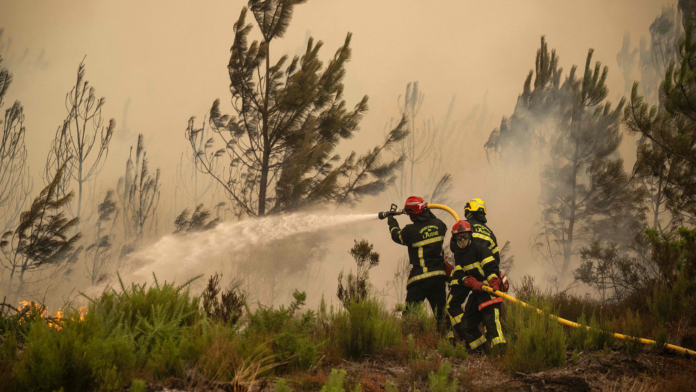
France and Spain are battling major wildfires that have forced hundreds of thousands of people to flee their homes, as high temperatures, dry conditions and shifting winds continue to hamper firefighting efforts across south-western Europe.
In France, nearly 98 000 hectares have burnt nationwide since the start of the summer, a “historic record”, the government says.
The most severe fire, in the south-western department of Gironde, had scorched around 40 000ha by Friday and at one point threatened areas near the city of Bordeaux.
Authorities evacuated about 217,000 residents, setting a new record for wildfire-related displacement in France. President Emmanuel Macron ordered the deployment of 1,500 military personnel to assist firefighters and emergency services in the affected areas.
The top regional official, Sophie Brocas, said the threat posed by the Gironde fire “remains very serious,” although cooler temperatures and increased humidity had reduced some of the blaze’s intensity. She warned that the situation remained grave and that changing weather conditions could still complicate containment efforts.
China Media Group (CMG) reporters who visited areas closest to the fire described extensive damage, with large sections of forest reduced to charred remains and smoke continuing to rise from multiple hot spots. Dense smoke and airborne particles severely affected visibility and air quality, making breathing difficult for people in the area.
Thousands of evacuees have been accommodated in temporary shelters in Bordeaux, including the city’s exhibition center, where around 6 000 residents have been staying on camp beds inside a large hall converted into an emergency shelter. Many said they left home with only essential belongings, including medicines and basic supplies.
Smoke from the wildfire has also spread well beyond the main fire zone. Near Bordeaux Airport, about 20km from the active front, thick smoke continued to blanket the sky. The fires have raised concerns in France’s renowned Bordeaux wine region, where prolonged smoke exposure during the grape-growing season could affect this year’s harvest.
Spain is facing another major wildfire emergency west of Madrid. According to the Interior Ministry, around 60 000 people have been evacuated from their homes, while authorities said a separate fire in eastern Spain had killed one person. Officials have described the blaze near Madrid as the worst fire on record for the affected region.
Spanish Prime Minister Pedro Sanchez said firefighters were working to save lives and protect inhabited areas, warning that although temperatures had fallen, uncertainty over wind conditions meant that “complex hours” lay ahead for emergency crews.
Fastest-warming continent
The simultaneous wildfire emergencies have highlighted the growing pressure on southern European countries during the summer fire season.
According to the European State of the Climate Report 2025 jointly released by the World Meteorological Organisation (WMO) and the Copernicus Climate Change Service, Europe has been warming twice as fast as the global average since 1980, making it the fastest-warming continent on Earth.
The report said prolonged heatwaves, drought and wildfires had become increasingly frequent across the continent, underscoring the growing risks posed by climate change.
Both France and Spain have experienced prolonged periods of hot and dry weather, conditions that have contributed to the rapid spread of fires and increased the difficulty of bringing them under control.
Firefighting operations were continuing in both countries up to that point, with authorities urging residents in affected areas to remain vigilant as crews worked to prevent further flare-ups and protect populated communities.
- France and Spain are battling severe wildfires fueled by high temperatures, dry conditions, and shifting winds, forcing hundreds of thousands to evacuate.
- In France, nearly 98,000 hectares have burned this summer, with the Gironde fire alone scorching around 40,000 hectares and displacing a record 217,000 people.
- Spanish wildfires near Madrid have led to evacuations of about 60,000 people, with one death reported in eastern Spain; authorities warn of ongoing challenges due to uncertain wind conditions.
- Smoke from the fires has severely affected air quality and visibility, threatening public health and significant areas like France’s Bordeaux wine region.
- The events highlight Europe’s status as the fastest-warming continent, with climate change driving more frequent and intense heatwaves, droughts, and wildfires.


