


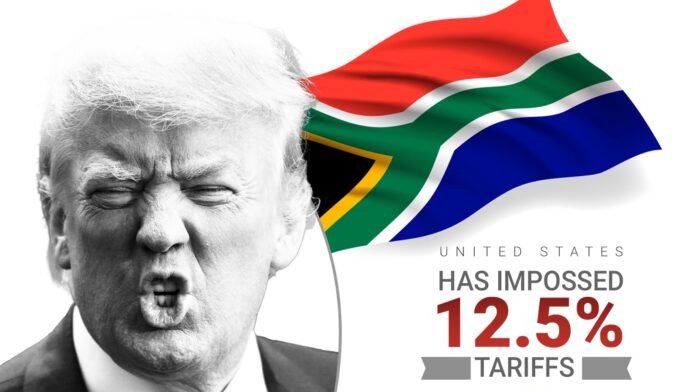
The US has imposed new tariffs of 12.5% on selected South African exports, escalating trade tensions between Washington and Pretoria despite months of diplomatic efforts to avoid the move.
The tariffs came into effect on Friday under Section 301 of the US Trade Act of 1974, with duties ranging from 10% to 12.5% applied to imports from 60 economies. South Africa was placed in the higher tariff tier alongside China, Japan and South Korea after the Office of the US Trade Representative (USTR) concluded that the country does not adequately enforce bans on imports made with forced labour.
Announcing the decision, US Trade Representative Ambassador Jamieson Greer said the US had long enforced its own prohibition on forced-labour imports and expected its trading partners to do the same.
“The US has had a forced labour import ban for nearly a century, and rigorously enforces it; it’s well past time for our trading partners to do the same,” Greer said.
The investigations were launched on March 12 2026 at the direction of President Donald Trump. Following public hearings in April, the USTR concluded on June 2 that the countries under investigation had failed to sufficiently prohibit imports produced through forced labour, creating what Washington described as an unfair burden on US commerce.
South Africa fails to dissuade US
South Africa had attempted to avert the tariffs through engagements with the USTR. A delegation from the Department of Trade, Industry and Competition (DTIC) argued that South African law already prohibits forced labour, noting the country’s ratification of International Labour Organisation conventions and provisions in the Customs and Excise Act that allow the South African Revenue Service to seize prohibited goods. Those arguments, however, failed to secure an exemption.
The new tariff is expected to affect some of South Africa’s biggest export sectors, including automotive manufacturing, agriculture, metals and broader manufacturing. Products already subject to existing US Section 232 steel and aluminium tariffs are excluded from the additional levy.
The latest trade action adds to a growing list of diplomatic and economic disputes between the two countries.
Relations have deteriorated over the past two years, with the US boycotting the G20 Leaders’ Summit hosted by South Africa in November 2025. President Trump labelled the summit a “total disgrace”.
Godongwana snub
South Africa also faced a diplomatic setback when Finance Minister Enoch Godongwana was excluded from G20 Finance Ministers and Central Bank Governors meetings held in the US. Washington has also repeatedly criticised Pretoria’s foreign policy, including its case against Israel at the International Court of Justice, questioning South Africa’s non-aligned foreign policy stance.
The latest tariffs replace an earlier temporary trade measure. In July 2025, the US imposed a 30% tariff on South African goods under emergency powers. Those tariffs were struck down by the US Supreme Court in February 2026, which ruled that President Trump had exceeded his authority under the International Emergency Economic Powers Act. Trump then invoked Section 122 of the Trade Act, introducing a temporary 10% global tariff that expired on 24 July 2026 after reaching its 150-day statutory limit.
Although the African Growth and Opportunity Act (AGOA) has been extended until the end of 2026, South Africa’s future participation remains uncertain. Greer previously described South Africa as a “unique problem” during testimony before a US Senate Appropriations subcommittee, raising concerns that Pretoria could lose preferential access to the American market.
The new tariffs come at a particularly difficult time for South Africa’s economy.
The country is already grappling with record fuel prices driven by conflict in the Middle East, which has pushed up global oil prices. President Cyril Ramaphosa has warned that higher fuel costs will slow economic growth and place additional pressure on inflation. As transport costs rise, consumers are also expected to face higher food prices.
While the tariffs and fuel price increases stem from different causes, together they are expected to increase costs for exporters, businesses and households already under economic strain.
- The US imposed new tariffs of up to 12.5% on selected South African exports due to inadequate enforcement of bans on forced labor imports.
- South Africa was placed in a higher tariff tier alongside China, Japan, and South Korea after investigations directed by President Trump.
- Despite South Africa’s legal prohibitions on forced labor and diplomatic efforts, the US maintained tariffs affecting key sectors like automotive, agriculture, and manufacturing.
- These tariffs exacerbate already strained US-South Africa relations, marked by diplomatic snubs and trade disputes, including previous tariff reversals by the US Supreme Court.
- The tariffs, combined with rising fuel prices from Middle East conflicts, pose additional economic pressures on South Africa, impacting growth, inflation, and consumer costs.


