


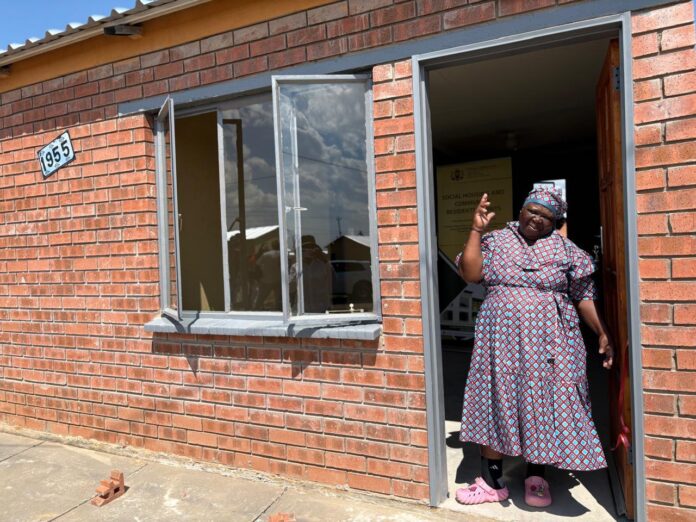
The country’s housing delivery crisis emerged as one of the most significant findings from National Treasury’s latest budget review, exposing a growing disconnect between public spending and service delivery outcomes.
The National Treasury told Parliament’s Appropriations Committee that despite billions of rand being allocated to housing programmes over recent years, delivery performance has deteriorated sharply.
The government department said this during its appearance before Parliament’s Appropriations Committees, where a budget adjustment process, which placed the government’s ability to translate public spending into economic growth, infrastructure delivery and measurable outcomes under the spotlight.
The debate touched on whether the country’s spending failures are increasingly rooted in implementation weaknesses rather than a lack of funding.
Read more: Parliament rejects spending 100% of budget without real service delivery ahead of MTBPS
National Treasury defended a package of budget adjustments and reallocations worth more than R54-billion, arguing that the measures are designed to strengthen disaster resilience, improve public sector efficiency, support municipalities, modernise revenue collection and preserve fiscal stability.
Yet it was Treasury’s assessment of the housing sector that ultimately exposed the core dilemma facing public finances.
Housing delivery crisis exposes deeper fiscal problem
One of the most revealing moments of the hearing came when National Treasury disclosed the findings of a detailed review of the Human Settlements Development Grant.
The findings painted a picture of worsening delivery despite sustained expenditure.
According to Treasury:
- Housing completions have fallen by approximately 60% since 2018.
- Serviced sites have declined by about 50% during the same period.
- Government spent roughly R12.9-billion on professional fees over seven years.
- Nearly 60% of those professional fees could not be linked to completed housing projects.
The findings have prompted the National Treasury to temporarily reprioritise R7.8-billion from housing allocations while reforms are implemented.
Treasury officials told MPs that expenditure performance alone can no longer be treated as evidence of success. In many cases, departments have continued spending close to their allocations while delivery outcomes have deteriorated.
The review suggested that the problem is no longer primarily one of resource constraints but rather weaknesses in project preparation, procurement systems, implementation capacity and accountability.
Read more: Godongwana’s lofty infrastructure plans threatened by skills shortages
Economically, the housing findings may represent one of the most important signals in the MTBPS process.
For years, South Africa’s fiscal debate has centred on how much the government spends. Treasury is increasingly shifting attention towards whether spending is producing value.
The housing programme has become the clearest example of a broader national challenge: expenditure growth does not automatically translate into developmental outcomes.
Local government moves to the centre of growth strategy
The committee briefing also reflected Treasury’s growing recognition that municipalities sit at the centre of South Africa’s economic recovery efforts.
Local government remains responsible for much of the infrastructure that underpins economic activity, yet many municipalities continue to struggle with governance failures, financial distress and weak implementation capacity.
To address those shortcomings, Treasury plans to increase municipal funding significantly over the medium term while strengthening oversight.
Read more: All eyes on Enoch Godongwana’s MTBPS as Treasury balances revenue windfall and slowing economy
The additional R21.8 billion allocated through the local government equitable share is intended to support demographic pressures, rising service-delivery costs and growing demands from poor households.
At the same time, Treasury is introducing stronger performance-based funding models, project readiness assessments and technical support interventions aimed at improving implementation.
The message emerging from the MTBPS process is increasingly clear: municipalities will receive additional resources, but they will also face stricter performance requirements.
Disaster recovery becomes a permanent fiscal consideration
Another key theme emerging from the adjustment process is the growing fiscal burden of climate-related disasters.
Recent floods have forced the government to redirect funding towards reconstruction of damaged roads, hospitals, public facilities and municipal infrastructure.
Treasury told MPs that all disaster allocations were subjected to detailed verification by the National Disaster Management Centre (NDMC), which assessed both the scale of damage and the ability of institutions to spend the funds effectively.
The introduction of the R3.5 billion Municipal Disaster Recovery Grant reflects Treasury’s view that climate-related shocks will increasingly require dedicated fiscal responses.
Read more: All eyes on Enoch Godongwana’s MTBPS as Treasury balances revenue windfall and slowing economy
The strengthening of contingency reserves also points to a significant change in fiscal planning.
Treasury indicated that potential El Niño impacts, droughts, fires and water security risks are becoming increasingly important considerations in budget planning.
Climate resilience is therefore evolving from a periodic spending requirement into a structural feature of South Africa’s fiscal framework.
Early retirement programme framed as long-term fiscal reform
One of the most closely scrutinised allocations was the R6.4 billion designated for voluntary early retirement incentives.
Treasury argued that while the cost appears substantial, it represents a long-term saving rather than additional expenditure.
More than 28,000 public servants have been approved across the first two phases of the programme.
According to Treasury, replacing senior employees with younger entrants on lower salary scales could generate around R4 billion in annual savings while simultaneously creating employment opportunities within the public sector.
From a fiscal perspective, the initiative forms part of Treasury’s strategy to manage compensation costs, which remain one of the government’s largest spending pressures.
SARS modernisation seen as a revenue-generating investment
Among the most economically significant allocations is funding directed towards the South African Revenue Service.
The Special Appropriation Bill includes substantial funding for SARS modernisation, which Treasury described as one of the highest-return investments available to the state.
The upgrades are expected to improve tax compliance, strengthen enforcement capabilities and enhance revenue collection without increasing tax rates.
Read more: Setumo Stone | Godongwana’s MTBPS exposes gap between political and economic freedom
In an economy facing weak growth and constrained taxpayers, improving collection efficiency offers government a less damaging route to raising revenue than introducing additional taxes.
Additional allocations for the Border Management Authority follow a similar rationale, with Treasury arguing that stronger border systems and upgraded technology can support trade facilitation while improving security outcomes.
Parliament pushes back
Despite Treasury’s explanations, MPs repeatedly challenged officials on accountability, project delays and underspending.
A recurring concern across political parties was that Parliament is being asked to approve billions of rands in adjustments without sufficient information on implementation outcomes.
Several MPs argued that legislative oversight must move beyond approving expenditure levels and focus more directly on evaluating whether spending decisions are generating measurable economic and social returns.
A shift from inputs to outcomes
Perhaps the most important economic theme emerging from the hearing was Treasury’s own recognition that the country measures spending more effectively than it measures results.
Officials acknowledged that many government programmes continue to rely on activity-based indicators rather than outcome-based assessments.
Read more: Economists criticise MTBPS for prioritising debt over jobs and infrastructure
Departments frequently report on money spent, programmes launched and administrative actions completed. They are less successful at demonstrating whether those activities improve housing delivery, reduce crime, create employment or stimulate economic growth.
The concern surfaced repeatedly across discussions about housing, infrastructure, policing, municipal grants and gender-based violence interventions.
The housing review provided perhaps the starkest example of why this matters: billions can be spent while outputs continue to decline.
Fiscal stability meets delivery pressure
The wider picture emerging from the committee hearings is one of cautious fiscal optimism combined with significant implementation risk.
Treasury believes the country is gradually strengthening its fiscal position through a growing primary surplus, tighter expenditure controls and debt stabilisation measures.
But Parliament’s interrogation revealed a deeper challenge confronting policymakers.
The fiscal credibility will increasingly depend not on how much money government allocates, but on whether those allocations are translated into houses, roads, infrastructure, functioning municipalities and improved living standards.
And judging by Treasury’s own assessment of the housing sector, that may now be the most important economic reform challenge facing the state.
- National Treasury revealed that housing completions have dropped by approximately 60% since 2018 despite sustained spending, with about 60% of R12.9 billion spent on professional fees unlinked to completed projects.
- Treasury plans to reprioritise R7.8 billion from housing allocations to implement reforms addressing weaknesses in project preparation, procurement, implementation capacity, and accountability.
- Municipal funding will increase by R21.8 billion through the local government equitable share, with stronger performance-based funding models and oversight introduced to improve service delivery.
- A new R3.5 billion Municipal Disaster Recovery Grant was introduced to address climate-related disasters, signaling climate resilience as a structural feature of South Africa’s fiscal framework.
- Treasury is investing in SARS modernisation, described as a high-return investment to improve tax compliance and revenue collection without raising tax rates.


