


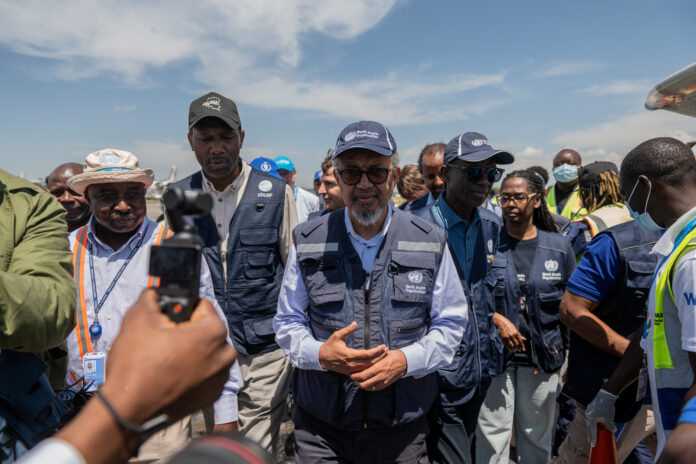
BUNIA, Democratic Republic of Congo: The World Health Organisation chief travelled on Saturday to the Congolese province hardest hit by an Ebola outbreak, urging residents to seek treatment and practice safe burials as officials scramble to contain the fatal disease.
The outbreak – the 17th in Democratic Republic of Congo and the third-largest since Ebola was discovered half a century ago – is outpacing the global response, something WHO Director-General Tedros Adhanom Ghebreyesus acknowledged this week before travelling to Kinshasa on Thursday.
His visit came as Brazil said on Saturday that it was investigating a suspected Ebola case in Sao Paulo state involving a man who recently visited Congo. Authorities said the patient was in isolation at a specialist hospital.
After meeting Prime Minister Judith Suminwa Tuluka on Friday, Tedros flew on Saturday to Bunia, capital of Ituri province, where the first cases were confirmed earlier this month.
At a press conference alongside Congo’s health minister, Tedros said the rare Bundibugyo strain has no approved vaccines or treatments, making early palliative care – including isolation, rehydration and pain management – critical.
“Seeking care early makes a real difference,” he said.
He also urged residents to practice safe burials, warning the bodies of Ebola victims were highly contagious.
“I understand how painful it is to lose someone and how much it means to honour them properly,” he said.
“While we grieve for those we have lost, we must do everything we can so that we do not lose another.”
There have been multiple attacks on health facilities by crowds seeking to reclaim bodies for traditional burials, in which family members handle the body without proper protective equipment.
The WHO said on Friday that there were 906 suspected cases of Ebola in Congo, including 223 suspected deaths under investigation.
Health Minister Samuel Roger Kamba said later on Friday authorities had identified 1 028 suspected cases, with 225 confirmed.
RESPONSE ‘HAS NOT YET CAUGHT UP’
Health officials and aid workers say they lack even basic supplies such as masks after the outbreak spread undetected for weeks.
Medical charity Medecins Sans Frontieres warned on Saturday the response was inadequate.
“Never before has an Ebola outbreak recorded so many cases so soon after its declaration,” Dr Alan Gonzalez, MSF deputy director of operations, said in a statement.
“Like everyone in the affected areas, MSF teams are witnessing a response that has not yet caught up to the rapid spread of the epidemic.”
The number of medical organisations on the ground and the level of support remained far short of what was needed, Gonzalez added.
On arriving in Kinshasa on Thursday, Tedros called for more international support, saying the WHO had received only about a third of the funding it required.
Dr Jean Kaseya, the director general of the Africa Centres for Disease Control and Prevention, said on Thursday that initial funding pledges had dropped sharply as some donors reconsidered contributions.
CONGO SAYS OUTBREAK NOT ‘OUT OF CONTROL’
Ebola cases have been confirmed in three of Congo’s provinces and in neighbouring Uganda, which this week closed its border with Congo.
Kamba has spent several days in Ituri before Tedros’s visit. At a press conference on Thursday, he rejected reports suggesting the outbreak was “out of control”.
On Saturday, appearing alongside Tedros, he said health officials had sufficient resources to meet testing needs, even as the MSF said “hundreds of samples remain untested”.
Congo’s experience with Ebola, including a small outbreak last year, would help contain the disease, Kamba said, adding that neighbouring countries should keep their borders open.
“We have experience with epidemics. We defeated Ebola last year. We tell you, trust us, we know what we are doing.”
- WHO Director-General Tedros Adhanom Ghebreyesus visited the hardest-hit Ituri province in DR Congo amid the 17th and third-largest Ebola outbreak, urging early treatment and safe burials due to no approved vaccines for the Bundibugyo strain.
- The outbreak has resulted in over 1,000 suspected cases and more than 200 confirmed deaths; health responses are struggling with shortages of basic supplies and slow containment efforts.
- Multiple attacks on health facilities have occurred as locals resist safe burial protocols, preferring traditional methods that risk spreading the virus.
- International funding and response efforts remain insufficient, with WHO receiving only about one-third of requested funds and organizations like MSF warning that the epidemic's spread outpaces current efforts.
- Congolese health officials assert the outbreak is not "out of control," highlighting past experience with Ebola containment and urging neighboring countries to keep borders open despite Uganda’s closure.


