


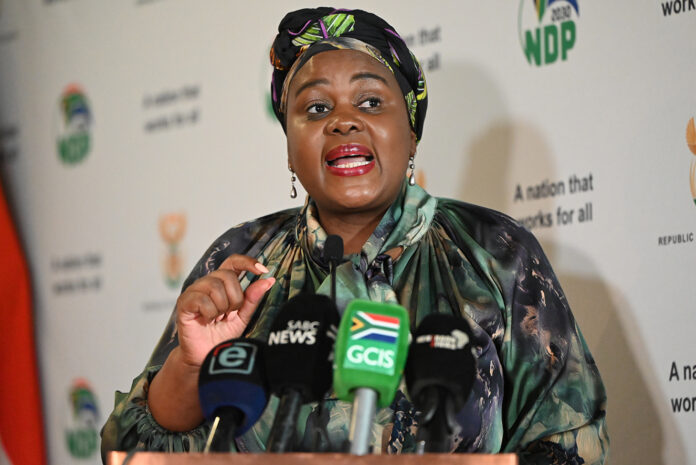
Justice Minister Mmamoloko Kubayi has raised concerns about what she described as an inconsistency in the tenure arrangements governing senior appointments in the National Prosecuting Authority (NPA), adding that the government is reviewing the legislation.
Giving evidence before the Khampepe Commission of Inquiry, Kubayi said the president appoints the National Director of Public Prosecutions (NDPP) for a 10-year term, while deputy national directors are appointed on a different basis and remain in office until retirement.
“You have an NDPP that has 10 years, but the deputies are lifetime, until they retire. So that is an inconsistency that we have found, that we are looking at,” Kubayi said.
Broader review of legislation governing NPA
She said the issue was part of a broader review of legislation governing the NPA and the security of tenure of senior officials appointed by the president.
“In terms of the NDPP, we do believe that the current provision does give us a leeway,” she said, adding that there were differing views on whether the NDPP’s tenure should be extended.
“There are also those who are proposing that maybe we must extend age to 70 years, like we do with the judges. Others are saying no, 65 is correct.”
Kubayi said the government was currently reviewing the relevant legislation and intended to consider public submissions before deciding on possible changes.
“When we go out in public, we look at what the public is recommending, and for us to be able to deal with the issues,” she said.
Safeguards to protect from political interference
At the same time, Kubayi said safeguards were needed to ensure that the NDPP remained protected from operational and political interference.
“Similarly, we do not want to involve the NDPP in the operation, because the NDPP must not be tainted by issues,” she said.
She used the possibility of an NDPP having to face criminal proceedings as an example of why the office should be protected by appropriate checks and balances.
“So those checks and balances must still be in place to protect the office of the NDPP,” Kubayi said.
Read More: ‘Government committed to helping TRC families find closure’ – Mmamoloko Kubayi
The minister also told the commission that she was reluctant to give an opinion on certain issues relating to reparations because the commission’s eventual recommendations could be referred to her for implementation.
Kubayi said giving an opinion before receiving the commission’s findings could undermine public confidence in her ability to implement its recommendations impartially.
“If tomorrow there are difficulties, people will not trust the difficulties, to be honest,” she said.
“They will say she’s putting up the barriers because she never, in the first place, believed in this thing.”
The commission also questioned Kubayi about whether recommendations or issues arising from the Rodriguez judgment had been acted upon, including matters allegedly raised with former justice minister Ronald Lamola by Advocate Shamila Batohi.
Kubayi said she had no personal knowledge of those communications and that no relevant records had been found.
She added that the department’s records did not show that anything had been done in that regard.
Kubayi said the commission would be better placed to obtain those details from the people directly involved.
“I understand that the ministers and the NDPPs, either previous and current, are coming before the commission, including the director generals,” she said.
“And there would be a better place to be able to give those details where I couldn’t give a personal account of them as the current justice minister.”
- Justice Minister Mmamoloko Kubayi highlighted an inconsistency in the National Prosecuting Authority (NPA) tenure, noting that the National Director of Public Prosecutions (NDPP) serves a 10-year term, while deputy national directors serve until retirement.
- The government is reviewing legislation governing the NPA and the security of tenure for senior officials, with public submissions being considered before any decision.
- Kubayi emphasized the need for safeguards to protect the NDPP from operational and political interference to maintain the integrity of the office.
- She refrained from commenting on reparations issues before the commission's findings to avoid undermining public confidence in the implementation of recommendations.
- Kubayi stated she had no personal knowledge or records regarding actions taken on recommendations from the Rodriguez judgment or communications involving former justice minister Ronald Lamola and Advocate Shamila Batohi.


